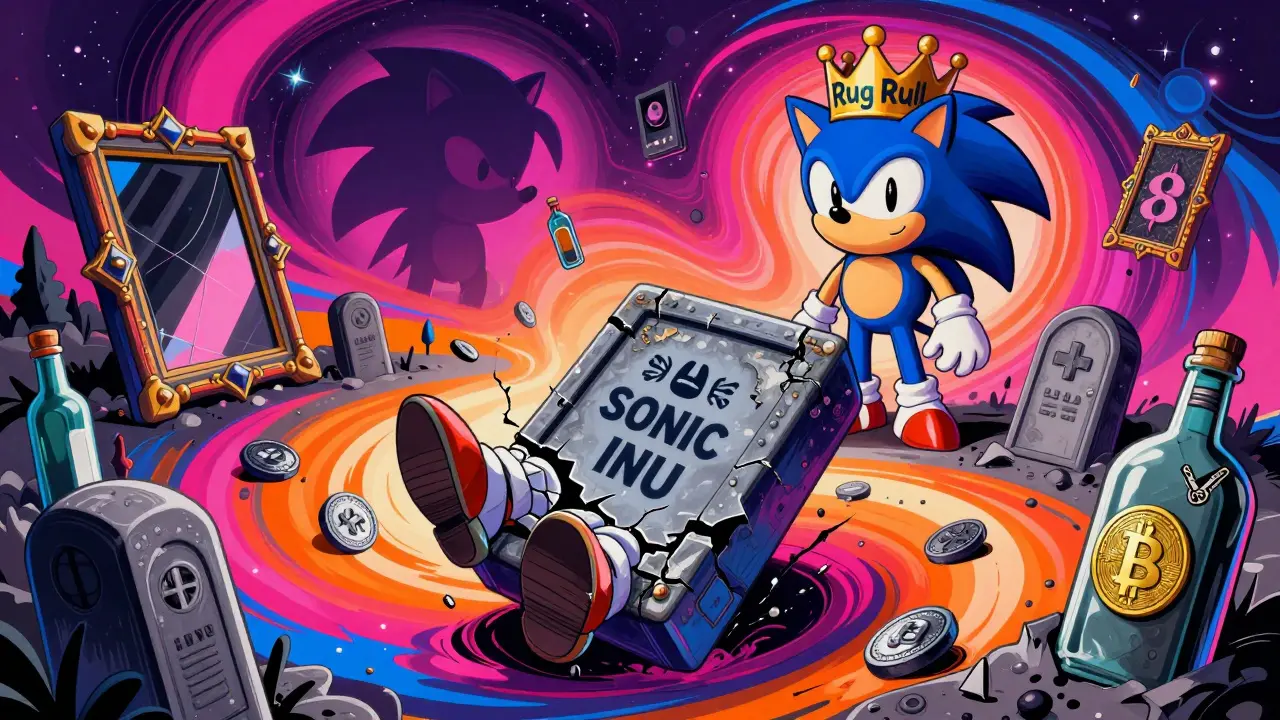
When you hear Sonic Inu, you might think of a fast blue hedgehog racing through rings and loops. But in crypto, Sonic Inu (SONIC) is something else entirely - a dead meme coin that promised fun and profit but delivered only losses and frustration.
Launched on April 21, 2023, Sonic Inu was built on the Binance Smart Chain (BSC) with a simple pitch: combine the global popularity of Sonic the Hedgehog with a crypto token that rewards holders just for keeping it. No big team. No real product. Just a logo, a contract, and a dream.
It didn’t take long for that dream to collapse.
How Sonic Inu was supposed to work
Sonic Inu’s design followed the classic meme coin playbook. Total supply: 420 quadrillion tokens. That’s 420,000,000,000,000,000. It sounds insane - and it was. The idea was to make each token worth almost nothing, so people could buy billions of them and feel like they were getting rich.
Every time someone traded SONIC, 5% of the transaction was redistributed to everyone else holding the coin. That’s called a reflection. Sounds fair, right? But here’s the catch: with almost no one actually trading, and even fewer people holding long-term, the rewards were meaningless.
It also had an NFT marketplace - sonic-inu-nft-store.nftify.network - that promised users could buy digital art and collectibles using BNB. But as of October 2025, that site returns a 404 error. It’s gone. Dead. Like the rest of the project.
The numbers don’t lie - Sonic Inu is dead
At its peak in May 2023, SONIC hit a price of $0.000000000000104339. Today, it trades around $0.0000000000003. That’s a 97.3% drop. Not a correction. A crash.
Market cap? Around $491,000. That’s less than the price of a decent used car. Compare that to Dogecoin’s $13 billion or Shiba Inu’s $7 billion. Sonic Inu doesn’t even register on the same scale.
Trading volume? CoinMarketCap shows $0 in 24 hours. CoinGecko says $313 - a number so small it’s practically invisible. That means if you bought SONIC today, you’d have a hard time selling it. No buyers. No liquidity. Just a token stuck in your wallet.
There are only 14,450 holders left. A year ago, there were over 50,000. People are leaving. Fast.
Why no one can sell Sonic Inu
Here’s the brutal truth: you can’t sell what no one wants to buy.
Most exchanges - Binance, Coinbase, Kraken - never listed SONIC. It only trades on decentralized platforms like PancakeSwap. That means you need a wallet like MetaMask, you need to know how to add custom tokens, and you need to set slippage to 20-30% just to get a trade to go through.
And even then? You might fail five times before one succeeds. Reddit users report spending hours trying to exit their positions. One user, u/MemeInvestor2023, wrote: “Bought 100T SONIC at launch. Now worth less than $0.01. Complete rug pull.”
The project’s official website went offline in September 2025. The Twitter account @SonicInuBSC hasn’t posted since July 20, 2025. The Telegram group, once home to over 4,000 members, now has 387 - and most of them are just asking, “Is this dead?”
Experts say it’s a warning sign
Dr. Elena Rodriguez from CryptoQuant called tokens like SONIC “effectively dead projects with no recovery path.” Binance Research found that 99.7% of coins with market caps under $1 million and daily volume under $1,000 die within 18 months. Sonic Inu has been alive for over two years - and still collapsed.
Messari flagged it in their “Red Flags in Meme Coin Sector” report for having 78% of its initial liquidity locked in just three wallets. That’s a classic sign of a pump-and-dump. The team likely dumped their tokens early and vanished.
Even the fanbase didn’t help. Sega, the company behind Sonic the Hedgehog, publicly stated they had no relationship with Sonic Inu. No license. No partnership. Just someone using a famous character to attract gullible investors.
What about the NFTs? The rewards? The community?
The NFT marketplace is gone. The reflection rewards? Worthless. With so few people trading, the tiny amount of tokens redistributed each time barely adds up to a fraction of a cent. You’d need to hold trillions of tokens to earn even a dollar.
The community? It’s a graveyard. Trustpilot has 12 reviews. Average rating: 1.2 out of 5. Comments like “impossible to sell,” “website disappeared,” and “waste of gas fees” dominate. LunarCrush’s sentiment analysis shows 87% of social media chatter about SONIC is negative - words like “scam” and “dead” are everywhere.

Who still buys Sonic Inu?
Only two kinds of people: those who don’t know any better, and those who think they can catch a miracle pump.
Some new crypto users see a coin trading for a fraction of a penny and think, “If I buy a quadrillion, I’ll be rich.” But they don’t realize that the value isn’t in the number of tokens - it’s in the price per token. A coin at $0.0000000000003 will never become $1 unless the entire market cap jumps from half a million to billions. That’s not possible for a coin with no utility, no team, and no buyers.
Others are gambling on a “1000x” rumor. CryptoMemeGuru on Twitter once predicted SONIC could explode in the next bull run. It didn’t. And it won’t. There’s no engine left to drive it. No code updates. No marketing. No news. Just silence.
The bottom line: Don’t touch Sonic Inu
Sonic Inu isn’t a failed crypto project. It’s a cautionary tale.
It had no real team. No roadmap. No product. No exchange listings. No community support. No website. No future.
If you see someone promoting SONIC today, they’re either lying, desperate, or both. The token has no liquidity. No value. No chance of recovery. Holding it means paying gas fees for nothing.
There are thousands of meme coins like this. Most die within months. Sonic Inu lasted longer than most - but only because it was so low, it didn’t even register as a threat. Now, it’s just a ghost in the blockchain.
Learn from it. Never invest in a coin just because it has a cute name or a popular character. Look at the team. Look at the volume. Look at the liquidity. If any of those are missing - walk away.
Is Sonic Inu (SONIC) still active?
No. Sonic Inu is effectively dead. Its official website went offline in September 2025, its Twitter account hasn’t posted since July 2025, and its NFT marketplace returns 404 errors. There has been no development activity on its smart contract since July 2025. The project has no team, no updates, and no future roadmap.
Can I still buy or sell Sonic Inu?
Technically, yes - but only on decentralized exchanges like PancakeSwap, and only if you’re willing to risk losing your money. Liquidity is nearly zero, so selling is extremely difficult. You’ll need to set slippage to 20-30% and may fail multiple times before a trade goes through. Most users report being unable to exit their positions at all.
Is Sonic Inu a scam?
While not legally proven as a scam, Sonic Inu exhibits all the hallmarks of one: anonymous team, no official ties to Sonic the Hedgehog, suspicious token distribution (78% in three wallets), dead website, abandoned social media, and zero utility. Experts and users alike classify it as a rug pull disguised as a meme coin.
What’s the current price of Sonic Inu?
As of October 2025, Sonic Inu trades at approximately $0.0000000000003. This is down 97.3% from its all-time high of $0.000000000000104339 in May 2023. With a market cap under $500,000 and near-zero trading volume, it has no practical value.
Should I invest in Sonic Inu?
Absolutely not. Sonic Inu has no team, no liquidity, no exchange listings, no future development, and no community support. It’s a dead asset. Any money you put into it is likely gone forever. Even if it somehow gained traction, the token’s structure makes it impossible to recover value. Treat it as a warning, not an opportunity.
What to do if you already own Sonic Inu
If you bought SONIC and still hold it, you have two choices: hold it forever (and pay gas fees for nothing) or try to sell it - knowing you’ll likely lose everything.
There’s no recovery plan. No rescue. No second chance. The only thing you can do now is learn from the mistake. Never invest in a project based on hype, memes, or nostalgia. Always check the team, the liquidity, the volume, and the real-world use case - or lack of one.
Sonic Inu isn’t a coin. It’s a lesson.
Write a comment