You probably hate managing private keys. One slip-up, one forgotten seed phrase, and your assets are gone forever. That friction has kept millions of regular people out of Web3. Enter Self Chain, a Layer 1 blockchain that aims to fix this by removing the need for users to handle keys directly. If you've seen the ticker SLF popping up on exchanges and wondered what it actually does, you're in the right place.
Self Chain isn't just another altcoin chasing hype. It's the native token of a network built on "intent-centric" architecture. Think of it as a translator between what you want to do (e.g., "swap ETH for USDC") and how the blockchain actually executes it. Instead of you manually routing transactions across bridges and DEXs, Self Chain uses AI and smart contracts to find the best path for you. But before you buy, you need to understand its history, its tech, and why its price data looks so confusing right now.
The Rebrand: From Frontier to Self Chain
If you remember Frontier (FRONT), you might be confused about why it's suddenly called Self Chain. Here's the deal: Frontier rebranded to Self Chain in August 2024. This wasn't just a logo change; it was a strategic pivot. The team moved away from being primarily an aggregator interface toward becoming a dedicated infrastructure layer focused on user experience.
Binance facilitated a 1:1 token swap, meaning if you held FRONT, you got SLF. This transition signals a shift in focus. While Frontier was known for connecting various DeFi apps, Self Chain doubles down on the underlying plumbing-specifically, making those connections invisible to the user. The goal is to make using decentralized applications feel as simple as using a centralized bank app, but without giving up custody of your funds.
How Self Chain Works: Intent-Centric & Keyless
The core innovation here is twofold: Intent-Centric Access and Keyless Wallet Infrastructure. Let's break down what that actually means for you.
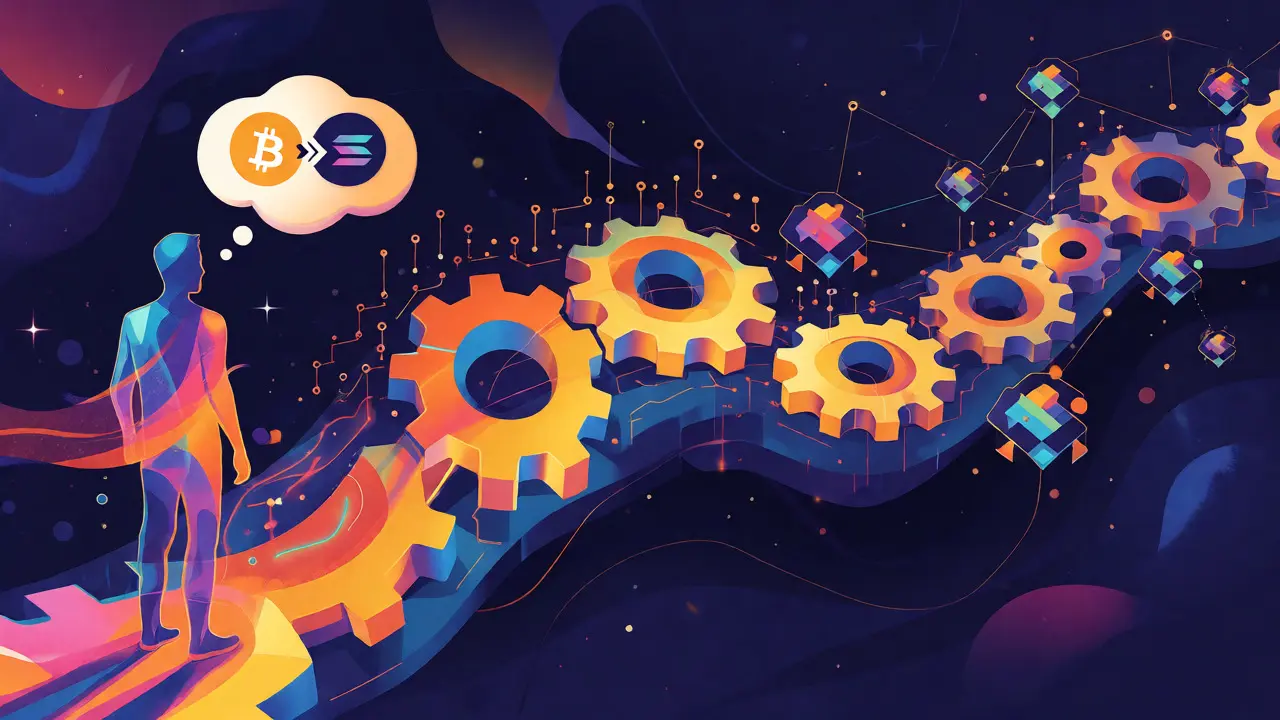
Intent-Centric Architecture: In traditional blockchains, you tell the network exactly what steps to take. You approve the token spend, then call the swap function, then maybe bridge assets. With Self Chain, you state your intent. For example, "I want to move $50 worth of BTC into Solana staking." The network, leveraging Large Language Models (LLMs) and specialized smart contracts, figures out the optimal route. It finds the cheapest fees, the fastest bridges, and the best exchange rates, then executes the transaction automatically.
Keyless Security via MPC-TSS: This is the part that solves the seed phrase problem. Self Chain uses Multi-Party Computation Threshold Signature Schemes (MPC-TSS). Instead of one private key sitting on your phone, the key is split into fragments. These fragments are distributed among different devices or parties. To sign a transaction, a threshold number of these fragments must come together. If someone steals one fragment, they can't access your funds. This eliminates the single point of failure that plagues traditional wallets.
| Feature | Traditional Wallet (EVM) | Self Chain (SLF) |
|---|---|---|
| Private Key Management | User manages seed phrase | MPC-TSS splits keys across devices |
| Transaction Routing | Manual selection of DEX/Bridge | AI-driven intent resolution |
| Cross-Chain UX | Fragmented, requires multiple steps | Unified access layer |
| Security Model | Single signature risk | Threshold signature security |
Tokenomics: Supply and Distribution
When looking at SLF, pay close attention to supply numbers because they vary depending on where you look. According to recent data, the maximum supply of Self Chain is capped at 360 million tokens. However, the circulating supply has been fluctuating as vesting schedules unlock more tokens.
As of late 2025/early 2026 reports, estimates for circulating supply range between 97 million and 167 million tokens. This discrepancy matters. If only ~27% of the total supply is in circulation, there's significant room for dilution when the remaining tokens unlock. Investors should check the current vesting schedule on the official Self Chain documentation, as large unlocks can create selling pressure. The fact that Binance supports SLF through Simple Earn services suggests institutional confidence, but always weigh that against the potential for supply inflation.
Price Volatility and Market Data
Here is where things get tricky. If you check different sites for the price of SLF, you might see wildly different numbers. Some sources report prices around $0.08, while others show fractions of a cent ($0.0004). Why?
This often happens due to different trading pairs, liquidity fragmentation, or stale data feeds. For instance, Coinbase reported a price near $0.08 with a market cap around $14 million, while other aggregators showed much lower values. Always verify the real-time price on the exchange where you plan to trade. The all-time high was recorded near $0.83, showing massive volatility. A drop of over 99% from ATH indicates that early investors have faced significant drawdowns, but it also highlights the speculative nature of small-cap altcoins like SLF.
Trading volume is moderate. It's not Bitcoin-level liquidity, so large sell orders could impact the price significantly. If you're planning to enter a position larger than a few thousand dollars, consider using limit orders rather than market orders to avoid slippage.
Where to Buy and Store SLF
Since Binance led the rebrand, it remains a primary hub for SLF trading. You can trade SLF against USDT, BTC, and TRY (Turkish Lira). Other platforms like Kraken and Crypto.com also list the token, though liquidity may vary.
- Binance: Offers spot trading, margin, and copy trading. Also supports Simple Earn for staking-like returns.
- Kraken: Good for fiat on-ramps if you prefer USD/EUR deposits.
- NOW Wallet: A non-custodial option specifically mentioned for holding SLF securely outside of exchanges.
Remember, even though Self Chain offers keyless solutions, when you hold SLF on an exchange, you don't control the keys. For long-term holding, moving tokens to a supported non-custodial wallet is generally safer.
Is Self Chain a Good Investment?
This depends entirely on your risk tolerance. Self Chain tackles a real problem: bad UX in crypto. If their intent-centric model gains adoption, demand for SLF could rise as the token is used for gas and governance within the ecosystem. However, competition is fierce. Projects like Near Protocol and various account abstraction-focused chains are vying for the same "easy crypto" narrative.
Watch for these catalysts:
1. **Adoption Metrics:** Are developers actually building dApps on Self Chain?
2. **Unlock Schedule:** When do the next big batches of tokens hit the market?
3. **Partnerships:** Continued support from major exchanges like Binance is a positive signal, but new integrations with popular DeFi protocols would be stronger validation.
Don't invest money you can't afford to lose. SLF is a mid-cap altcoin with high volatility. It's not a stable store of value yet.
What happened to Frontier (FRONT)?
Frontier rebranded to Self Chain in August 2024. Existing FRONT holders swapped their tokens 1:1 for SLF. The project shifted focus from being an aggregator to providing a modular, intent-centric Layer 1 blockchain infrastructure.
How does Self Chain's keyless wallet work?
It uses Multi-Party Computation Threshold Signature Scheme (MPC-TSS). Instead of a single private key, the key is split into fragments across multiple devices or parties. A transaction requires a threshold number of signatures to authorize, eliminating the risk of losing a single seed phrase.
Why is the price of SLF different on different websites?
Price discrepancies often arise from low liquidity on certain exchanges, different trading pairs (e.g., SLF/USDT vs. SLF/BTC), or delayed data updates. Always check the live order book on the specific exchange you intend to use before making a trade.
Can I stake Self Chain (SLF)?
Yes, platforms like Binance offer "Simple Earn" products for SLF, allowing holders to generate yield. Additionally, as a Layer 1 blockchain, future native staking mechanisms may allow validators to secure the network in exchange for rewards.
What is the max supply of Self Chain?
The maximum supply of Self Chain (SLF) is fixed at 360 million tokens. A portion of this supply is currently in circulation, with the remainder subject to vesting schedules and distribution plans.
Write a comment