Imagine getting paid every time you post a photo, comment on a friend’s update, or share a meme. That sounds like a dream job, right? Well, that is exactly the promise behind Pop Social, an AI-powered SocialFi platform that rewards users with PPT tokens for their engagement and content creation. But before you rush to download the app and start posting, you need to understand what this project actually is, how it works, and whether the hype matches the reality.
Pop Social isn’t just another social media app trying to copy Instagram or TikTok. It sits in a niche called SocialFi-a blend of social networking and decentralized finance. The goal? To take ownership of your data and your content away from big tech giants and put it back in your hands, backed by blockchain technology. If you are curious about how this plays out in practice, here is everything you need to know about the PPT token, the ecosystem, and the risks involved.
The Core Concept: Bridging Web2 and Web3
Most people use traditional social media because it is easy. You sign up with an email, and boom-you are connected. But there is a catch: the platform owns your audience, your data, and often, the rights to your content. Pop Social aims to fix this by building a bridge between these centralized platforms and the decentralized world of Web3.
At the heart of this system is the idea of a unified identity. Currently, if you have accounts on Twitter, Instagram, and Discord, those identities are separate silos. Pop Social uses Decentralized Identity (DID) and Soulbound Tokens (SBTs) to create a single, verifiable on-chain identity for each user. Think of an SBT as a digital badge that proves who you are and what you have achieved across different networks. Unlike regular tokens, you cannot sell or transfer an SBT. This prevents bad actors from buying fake reputations and helps build a more trustworthy community.
This approach allows Pop Social to claim it can "bring the next billion users to Web3." By simplifying the complex world of crypto wallets and private keys into a familiar social media interface, they hope to onboard users who might otherwise be intimidated by blockchain technology.
How the Economy Works: PPT and Pop Credit
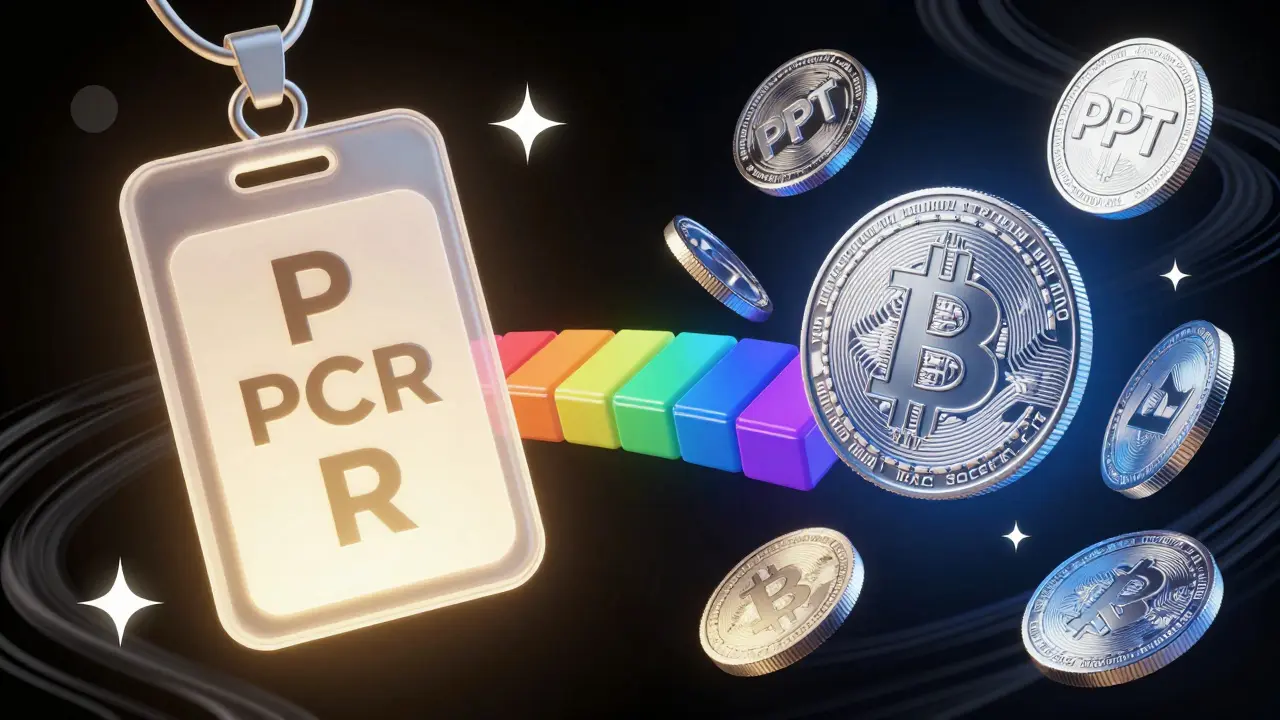
You cannot talk about Pop Social without talking about its currency. The ecosystem runs on two main assets: the tradable PPT token and the non-tradable Pop Credit (PCR). Understanding the difference between these two is crucial.
- Pop Credit (PCR): This is your reputation score. You earn PCR by engaging with the platform-posting content, liking posts, sharing updates, and interacting with other users. PCR is not money; you cannot buy it or sell it on an exchange. It represents your contribution level within the community.
- PPT Token: This is the actual cryptocurrency. It has value, can be traded, and serves as the medium of exchange within the Pop ecosystem. Users receive daily distributions of PPT based on their PCR scores. Essentially, the more valuable your contributions (higher PCR), the more PPT you earn.
There is a specific mechanic to keep in mind: you can convert your Pop Credit into PPT tokens, but only up to three times per day. This limit is likely designed to prevent bots from gaming the system and to manage liquidity. Once converted, those PPT tokens belong to you. You can hold them, trade them, or use them within the app.
Tokenomics and Supply Details
When evaluating any crypto project, the numbers tell half the story. Here is the breakdown for Pop Social’s PPT token:
- Total Supply: Fixed at 200,000,000 PPT. There will never be more than this amount created.
- Circulating Supply: Approximately 85.63 million PPT (self-reported by CoinMarketCap). This means roughly 42.8% of all tokens are currently in circulation.
- Initial Sale Price: The token launched in Q4 2023 with public sale prices ranging from $0.10 to $0.20.
- Funding: The project raised around $50,000 in its initial October 2023 sale window.
The fixed supply is a key feature for investors worried about inflation. Since no new tokens can be minted, the value depends entirely on demand and utility within the ecosystem. However, a significant portion of the supply was allocated to early investors and the team, which is standard in crypto but worth noting when assessing potential sell pressure.
| Metric | Value |
|---|---|
| Max Supply | 200,000,000 PPT |
| Blockchain Networks | BNB Smart Chain, Polygon |
| Token Standard | BEP-20 / ERC-20 |
| Reward Mechanism | Daily distribution based on PCR |
Utility: What Can You Actually Do With PPT?
A token without utility is just a number on a screen. Pop Social assigns several practical uses to the PPT token to keep it circulating within the ecosystem:
- Governance: Holders can vote on proposals that shape the future of the platform. This gives the community a say in development priorities and fund allocation.
- Staking: Users can stake their PPT to earn additional rewards. The platform promotes "uncapped" staking perks, though specific Annual Percentage Yields (APY) vary and should be checked directly in the app.
- In-App Purchases: PPT is used to unlock features like "Treasure Chests," level up user accounts, and process transactions within the social feed.
- Treasury Redistribution: A portion of value captured by the Pop Treasury is redistributed back to contributors via PPT, creating a circular economy where active users benefit from platform growth.
Price Volatility and Market Reality
Here is where things get tricky. Crypto markets are notoriously volatile, and small-cap SocialFi tokens are no exception. Data from various aggregators shows significant discrepancies in PPT’s price history, highlighting the risks involved.
At its launch in late 2023, PPT sold for around $0.10. Some snapshots show prices climbing above $0.30. However, other data points from major exchanges like Binance have shown prices dropping to fractions of a cent, such as $0.000499. This represents a decline of nearly 99.5% from the initial sale price. While these fluctuations may reflect different trading pairs, liquidity issues, or specific market conditions at the time of the snapshot, they serve as a stark warning: PPT is a high-risk asset.
Trading volume has also been inconsistent. In some periods, 24-hour volume was reported as low as $265. Low liquidity means that large buys or sells can drastically move the price, making it difficult for traders to enter or exit positions without slippage. Always check real-time data on reputable exchanges like Bybit or Binance before making any decisions.
Security and Privacy Considerations
Pop Social emphasizes "user privacy autonomy," allowing users to control what data is shared. However, because the platform operates on public blockchains like BNB Smart Chain and Polygon, transaction histories are transparent by default. The use of Soulbound Tokens helps mitigate Sybil attacks (where one person creates multiple fake accounts), but it does not hide your activity from the network.
As of now, there are no widely published third-party security audit reports for the Pop Social smart contracts. While the project lists backers like Fundamental Labs and Ceras Ventures, the lack of independent security verification is a gap that cautious investors should note. Always ensure you are using official links to avoid phishing scams, especially when connecting your wallet.
Who Is Behind Pop Social?
The project has attracted attention from several crypto-native entities. Backers include venture funds like Fundamental Labs and proMatrix Capital, as well as infrastructure partners like Chainlink. Media coverage has appeared on outlets like Cointelegraph. These partnerships lend some credibility to the project’s technical ambitions, particularly regarding its multi-chain architecture and AI integrations.
However, the team remains relatively anonymous compared to established Web2 companies. The focus is heavily on the product roadmap rather than individual founders. For many crypto projects, this is common, but it means you are betting on the code and the community rather than a known brand name.
Is Pop Social Worth Your Time?
If you are a creator looking for alternative revenue streams, Pop Social offers an interesting experiment. The ability to monetize engagement directly through tokens is a compelling shift from the ad-revenue models of Facebook or YouTube. The AI-powered tools promised in their roadmap could further streamline content creation and discovery.
On the flip side, if you are purely an investor, proceed with extreme caution. The price volatility is severe, and the long-term viability of SocialFi projects remains unproven. The sector is crowded, and user retention is a constant challenge. Ask yourself: Are you willing to engage daily to earn small amounts of PPT, or are you hoping for a quick flip? The latter strategy carries significant downside risk given the historical price drops.
Ultimately, Pop Social represents a bold attempt to redefine social interaction through decentralization. Whether it succeeds depends on execution, adoption, and the broader crypto market cycle. Stay informed, do your own research, and never invest more than you can afford to lose.
What is the current price of Pop Social (PPT)?
The price of PPT is highly volatile and varies significantly across exchanges. Historical data shows ranges from $0.0004 to over $0.30 depending on the timeframe and liquidity. Always check real-time prices on major exchanges like Bybit or Binance before trading.
How do I earn PPT tokens?
You earn PPT by participating in the Pop Social app. First, you gain Pop Credit (PCR) through activities like posting, liking, and sharing. Then, you can convert your PCR into PPT tokens up to three times per day. Higher engagement leads to higher PCR and more PPT rewards.
Is Pop Social available on iOS and Android?
Yes, Pop Social is designed as a mobile-first application. Users can download the app to access the social feed, manage their decentralized identity, and claim rewards. Ensure you download it from official sources to avoid security risks.
What blockchains does PPT run on?
PPT is a multi-chain token. It primarily operates on BNB Smart Chain (as BEP-20) and Polygon (as ERC-20). The project plans to expand to additional chains in the future to improve interoperability and reduce gas fees.
Can I sell my Pop Credit (PCR)?
No, Pop Credit (PCR) is non-tradable. It serves solely as a metric of your reputation and contribution within the Pop Social ecosystem. You must convert PCR into PPT tokens within the app if you wish to trade or withdraw value.
Write a comment