
Most people think of venture capital as a world of leather-bound term sheets and private meetings in glass-walled offices. But what if that entire process moved on-chain? That is the promise behind AngelBlock, a platform designed to connect early-stage startups with investors through smart contracts rather than intermediaries. At the heart of this ecosystem sits the Tholos token, commonly known by its ticker THOL. It serves as the primary utility asset for accessing investment opportunities, staking for governance rights, and paying transaction fees within the network.
If you are wondering whether THOL is worth your attention, you need to look past the hype and understand how it actually works. This isn't just another meme coin; it is a functional tool in a specific niche of decentralized finance. However, like many projects in this space, it comes with significant volatility and liquidity risks that every investor should know before diving in.
The Core Concept: On-Chain Venture Capital
AngelBlock operates as a non-custodial fundraising protocol. In plain English, this means the platform does not hold your money in a centralized bank account or corporate wallet. Instead, funds are locked into smart contracts that automatically execute agreements based on pre-coded rules. This design aims to solve a major pain point in traditional crypto investing: trust. When you invest via AngelBlock, the vesting schedules for startup tokens and the distribution of proceeds are handled transparently on the blockchain.
The project launched its Token Generation Event (TGE) on February 15, 2023. Since then, it has positioned itself as a bridge between retail investors and high-potential projects in the crypto, fintech, and blockchain sectors. The goal is ambitious: to create what some partners describe as the largest decentralized venture capital fund. To make this happen, THOL acts as the fuel for the engine, required for everything from basic access to advanced governance participation.
How THOL Works: Utility and Features
Why would anyone buy or hold THOL? The answer lies in its multifaceted utility within the AngelBlock ecosystem. Unlike speculative assets that rely solely on price appreciation, THOL is designed to have intrinsic demand drivers based on user activity.
- Platform Access: Holding THOL is often a prerequisite for unlocking certain features on the AngelBlock interface, including the ability to view detailed startup profiles and participate in raises.
- Staking and Rewards: Users can stake their THOL tokens to earn rewards. The protocol offers an auto-compounded annual percentage yield (APY), which has been reported to reach up to 22% depending on the size of the reward pool and total staked amount.
- Governance Participation: Stakers delegate voting power to validators. These validators perform due diligence on startups and select which projects get listed. Your stake essentially gives you a say in the quality of deals presented to the community.
- Gas Fees: Instead of needing ETH to pay for transaction fees on the underlying network, users can use THOL as gas for protocol interactions, simplifying the user experience.
- Loyalty Tiers: Higher holdings of THOL unlock better loyalty tiers. These tiers provide benefits like larger ticket sizes for investments, discounted platform fees, and priority access to new listings.
This structure creates a feedback loop: active users need THOL to participate, and participation generates value for the token holders through rewards and governance influence.
Tokenomics: Supply, Distribution, and Deflation
Understanding the economics of a token is crucial for assessing its long-term viability. THOL has a fixed maximum supply of 400,000,000 tokens. This cap was established after the initial analysis suggested a higher number, but the final model reduced the supply by 80 million tokens to increase scarcity.
One of the most critical aspects of THOL's design is that it is deflationary. No new tokens will ever be minted. Once the TGE concluded, the supply became static, meaning any change in circulation must come from burning or locking mechanisms. Here is how the supply breaks down according to official data:
| Category | Percentage | Notes |
|---|---|---|
| Treasury | ~30.6% | Funds for operations and future development |
| Team & Shareholders | ~22.5% | Subject to vesting schedules |
| Community Airdrop | ~12.8% | Distributed to early adopters |
| DEX Liquidity Pools | 14% | Providing market depth on exchanges |
| Other | Remaining | Includes marketing, advisors, etc. |
The deflationary pressure comes from two main sources. First, when users pay gas fees in THOL, those tokens are removed from circulation. Second, the protocol takes a success fee on completed fundraising rounds. A portion of this fee-specifically 25%-is used to buy back THOL from the open market. This mechanism ties the token's demand directly to the success of the startups funded through the platform. If more startups raise money, more THOL is bought back and burned, theoretically increasing the value of remaining tokens.
The xTHOL Governance Model
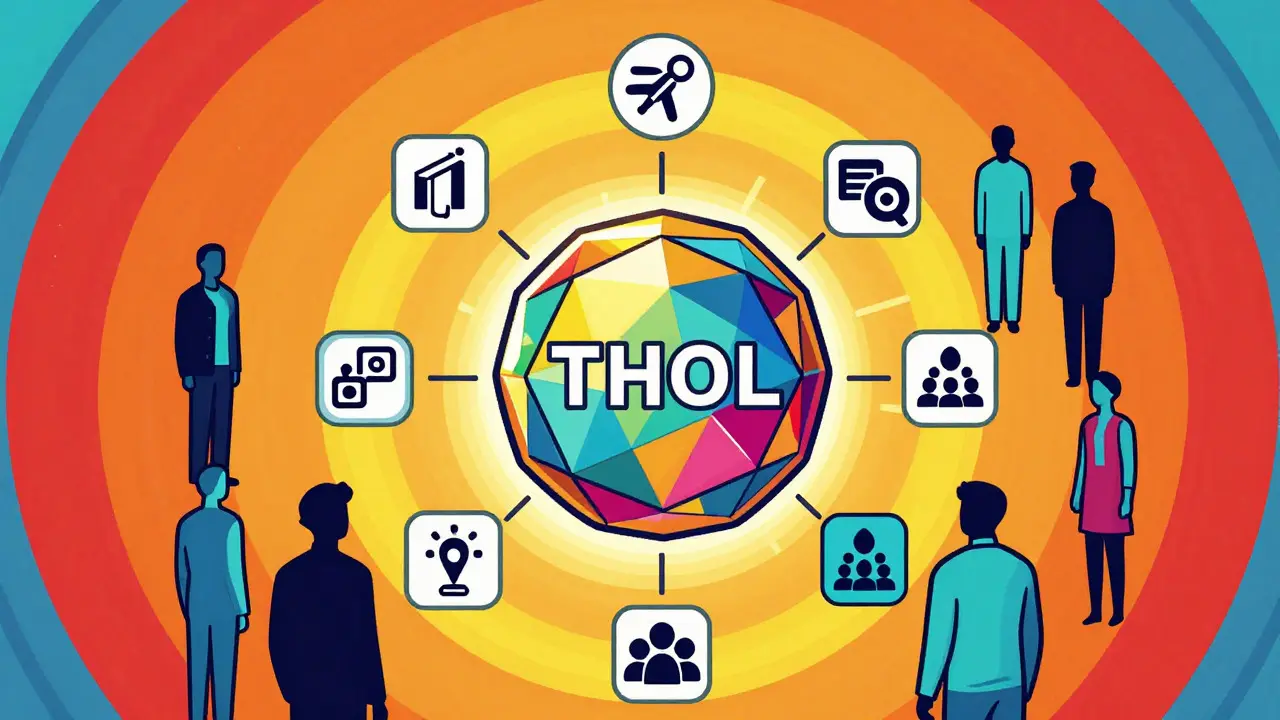
A unique feature of the AngelBlock ecosystem is the introduction of xTHOL. While THOL is the transferable ERC-20 token used for economic transactions, xTHOL is a non-transferable governance token. You cannot buy xTHOL on an exchange; you earn it by performing actions within the protocol, such as staking THOL or participating in due diligence.
This two-token structure is designed to prevent "whale" dominance in governance decisions. In many decentralized autonomous organizations (DAOs), whoever holds the most tokens controls the votes. By separating economic utility (THOL) from governance power (xTHOL), AngelBlock aims to ensure that decision-making remains with active participants who contribute to the ecosystem's growth, rather than passive holders who simply dumped coins into a wallet.
Market Performance and Risk Factors
Let's talk numbers, because they tell a stark story. THOL reached its all-time high of approximately $0.17 shortly after its launch in February 2023. As of mid-2026, the price has experienced a dramatic decline, trading in the range of fractions of a cent (e.g., $0.00005 to $0.0002 depending on the data source). This represents a drawdown of over 99% from its peak.
This extreme volatility is characteristic of micro-cap cryptocurrencies. With a market capitalization often fluctuating between $12,000 and $300,000 across different aggregators, THOL sits far outside the top 1,000 digital assets. The low liquidity means that even small trades can cause significant price swings. For example, CoinCodex recorded a volatility index of nearly 27.5%, indicating rapid and unpredictable price movements.
Data discrepancies among platforms like TradingView, CoinGecko, and MarketCapOf further complicate the picture. Some sources show higher prices and volumes, while others reflect the true thinness of the order books. Investors must cross-reference multiple sources to get an accurate snapshot of the current state.
Where to Trade THOL
If you decide to proceed, accessibility is relatively straightforward compared to obscure tokens. THOL is listed on several centralized and decentralized exchanges. The primary venues include:
- MEXC: Often cited as having the highest trading volume for THOL pairs.
- Uniswap V3: Allows for peer-to-peer swapping using Ethereum gas or wrapped ETH.
- BitMart and C14: Additional centralized options for buying and selling.
To start, you would typically acquire THOL on one of these platforms, transfer it to a compatible wallet (like MetaMask), and then connect that wallet to the AngelBlock dashboard to begin staking or investing in startups.
Is AngelBlock Worth It?
AngelBlock fills a genuine gap in the crypto landscape by offering a transparent, non-custodial way to invest in early-stage projects. Its focus on validator-driven due diligence and automated vesting addresses real inefficiencies in traditional venture capital. The deflationary tokenomics and dual-token governance model show thoughtful design aimed at long-term sustainability.
However, the market reality is harsh. The massive price drop since 2023 highlights the risks associated with micro-cap assets. Low liquidity means getting in and out of positions can be difficult without slippage. Furthermore, the success of THOL is entirely dependent on the adoption of the AngelBlock protocol itself. If startups don't choose to raise funds here, and investors don't flock to the platform, the buyback mechanisms won't trigger, and the utility of the token diminishes.
For seasoned crypto investors comfortable with high-risk, high-reward scenarios, THOL might offer exposure to the emerging sector of on-chain venture capital. For conservative investors, the volatility and lack of institutional backing may present too much uncertainty. Always do your own research and never invest more than you can afford to lose.
What is the maximum supply of THOL?
The maximum and total supply of THOL is fixed at 400,000,000 tokens. No new tokens will be created after the Token Generation Event (TGE).
How does THOL differ from xTHOL?
THOL is a transferable ERC-20 token used for payments, staking, and trading. xTHOL is a non-transferable governance token earned through protocol activity, giving users voting rights without allowing them to sell their influence.
Is THOL a good investment?
THOL is considered a high-risk, micro-cap asset. It has experienced significant price declines since its launch. It may suit speculative investors interested in decentralized venture capital models, but it carries substantial volatility and liquidity risks.
Where can I buy THOL?
You can trade THOL on exchanges such as MEXC, Uniswap V3, BitMart, and C14. Availability and liquidity may vary by platform.
What happens to THOL when I pay gas fees?
When THOL is used to pay for protocol interaction fees, it contributes to the deflationary mechanism. These tokens are effectively removed from circulation, reducing the total supply available in the market.
Write a comment