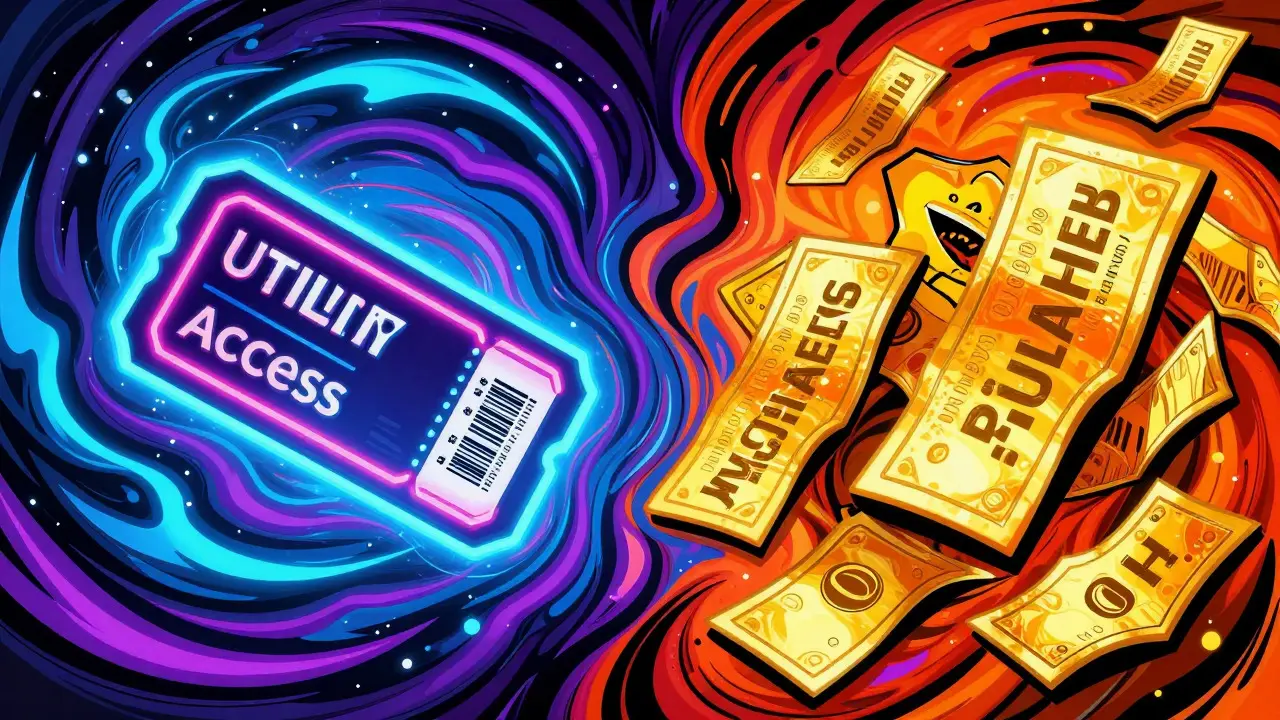
Imagine buying a ticket to a concert. You pay money, you get access to the show, but you don't own the band or the venue. Now imagine buying shares in that same band. You pay money, and now you own a piece of the company, entitled to a slice of the profits if they succeed. In the world of blockchain is a distributed ledger technology that enables secure, transparent transactions without intermediaries, this distinction is everything. It separates utility tokens from security tokens are digital assets representing ownership in real-world assets like equity or debt, subject to securities laws. Getting this wrong can mean the difference between a smooth platform launch and a multimillion-dollar fine from regulators.
The confusion isn't accidental. Early on, many projects marketed their tokens as utility tools while promising investors massive returns. Regulators noticed. Today, the line is drawn sharply by law, specifically by how those tokens function and what rights they grant holders. Understanding this split is crucial whether you're an investor looking for passive income or a developer building the next big decentralized application.
What Defines a Utility Token?
A utility token is a digital asset designed to provide access to a specific product or service within a blockchain ecosystem is essentially a digital key. Its primary purpose is functional, not financial. When you hold a utility token, you aren't buying into a company; you are buying access to its network. Think of it like buying frequent flyer miles. You use them to book flights or upgrade seats. You don't own a piece of the airline, and if the airline makes a profit, you don't automatically get a dividend check. Your value comes solely from using the service.
These tokens emerged prominently during the initial coin offering (ICO) boom of 2017-2018, largely driven by Ethereum's ERC-20 standard. They are predominantly fungible, meaning one token is identical to another, making them easy to trade and spend within their respective ecosystems. For example, IX Swap’s IXS Token grants users discounted trading fees and voting rights on their decentralized exchange. Filecoin’s FIL token provides storage capacity on its decentralized network. In both cases, the token has value because it unlocks a feature. If the platform becomes popular, demand for access rises, which may increase the token's market price, but that appreciation is a secondary effect, not a guaranteed right.
From a technical standpoint, utility tokens are relatively simple to create. They usually follow standard protocols like ERC-20 on Ethereum, BEP-20 on Binance Smart Chain, or SPL on Solana. Development time is short-often just four to six weeks-and costs typically range from $50,000 to $150,000. This accessibility fueled the rapid expansion of the crypto space, allowing developers to bootstrap communities and fund infrastructure quickly. However, simplicity comes with risk. Because they lack the rigid oversight of traditional finance, utility tokens are highly volatile. Market data shows they exhibit significantly higher price swings compared to their security counterparts, reflecting their speculative nature.
Understanding Security Tokens
In contrast, a security token represents an ownership stake in an underlying asset, such as equity, debt, or real estate, conferring legal rights to holders is a digitized version of traditional financial instruments. When you buy a security token, you are effectively buying a share in a company, a bond, or a fraction of a physical property like real estate. These tokens confer legal rights to the holder, including dividends, profit-sharing, or voting rights in corporate decisions. They are governed by strict securities regulations because they involve investment contracts where people put money in expecting profits derived from the efforts of others.
The regulatory backbone for identifying these tokens in the U.S. is the Howey Test, established by the Supreme Court in 1946. If a token passes this test-meaning there is an investment of money in a common enterprise with an expectation of profits from the efforts of others-it is classified as a security. Following the SEC's DAO Report in 2017, enforcement tightened dramatically. By 2022, nearly 99% of tokens previously marketed as utilities were reclassified as securities if they didn't strictly adhere to non-investment purposes. This shift pushed the industry toward greater compliance and transparency.
Technically, security tokens are far more complex. They cannot simply be sent from wallet to wallet like Bitcoin. They require embedded compliance features directly into their smart contract code. Standards like ERC-1400 or Polymath’s ST-20 protocol handle investor whitelisting, ensuring only accredited investors can hold or transfer the token. They also manage jurisdictional restrictions, preventing sales in countries where the offering isn't registered. Platforms like InvestaX implement multi-layered compliance architectures that verify accreditation, enforce geographic limits, and automate reporting to regulatory bodies. This complexity means launching a security token offering (STO) takes six to twelve months and costs between $500,000 and $2 million, involving extensive legal work and integration with traditional banking systems for things like dividend distributions.

Key Differences at a Glance
| Feature | Utility Token | Security Token |
|---|---|---|
| Purpose | Access to services/platforms | Ownership/investment rights |
| Regulation | Largely unregulated (unless misclassified) | Strictly regulated under securities laws |
| Holder Rights | Usage, discounts, governance votes | Dividends, profit sharing, voting |
| Volatility | High (speculative) | Lower (asset-backed stability) |
| Liquidity | High (traded on major exchanges) | Low (restricted transfers, fewer venues) |
| Launch Cost | $50k - $150k | $500k - $2M+ |
| Technical Standard | ERC-20, BEP-20, SPL | ERC-1400, ST-20 |
Regulatory Landscape and Enforcement
The regulatory environment is the single biggest differentiator between these two asset classes. Gary Gensler, Chairman of the SEC, has consistently emphasized that the vast majority of tokens currently circulating are securities. The agency applies the Howey Test rigorously, resulting in dozens of enforcement actions against issuers who failed to register their offerings. In 2022 alone, the SEC pursued 47 enforcement actions related to unregistered security token offerings, collecting over $1.2 billion in penalties.
This strict stance creates a challenging landscape for innovation but offers protection for investors. Misclassification is dangerous. Professor Angela Walch, a leading blockchain legal scholar, warned that regulatory arbitrage through misclassification has created significant gaps in investor protection. She documented numerous cases where utility tokens were marketed with implicit promises of appreciation, effectively functioning as securities without the required disclosures.
However, the global picture is shifting. While the U.S. maintains a strict approach, other jurisdictions are experimenting with clearer frameworks. Singapore’s Payment Services Act and Switzerland’s FINMA Guidelines offer models that balance innovation with oversight. The European Union’s Markets in Crypto-Assets (MiCA) regulation, fully effective by late 2024, establishes a unified framework that clearly distinguishes utility tokens from security tokens, requiring the latter to obtain authorization under existing financial regulations. This convergence aims to reduce fragmentation and provide certainty for cross-border operations.
Investment Potential and Market Dynamics
For investors, the choice between utility and security tokens depends entirely on your goals and risk tolerance. Utility tokens dominate the market by volume, accounting for roughly 78% of all token offerings. They appeal to retail investors looking for high-growth potential in emerging technologies. However, this comes with high volatility. Median daily price swings for utility tokens can exceed 12%, making them risky holdings. Their value is tied to network adoption and speculation rather than underlying cash flows.
Security tokens, on the other hand, attract institutional interest due to their stability and tangible backing. Backed by real-world assets like real estate, private equity, or government bonds, they offer predictable returns through dividends or interest payments. BlackRock’s BUIDL fund and Franklin Templeton’s OnChain U.S. Government Money Fund are prime examples of traditional finance giants entering this space. While liquidity is lower-with average daily trading volumes significantly less than utility tokens-the growth trajectory is steep. The security token market has grown at a compound annual rate of 47% since 2020, driven by the desire to tokenize trillions of dollars in illiquid assets.
User sentiment reflects this divide. Retail investors often complain about the "lack of fundamental value" in utility tokens, citing collapses like Steem’s as cautionary tales. Conversely, security token investors praise regulatory clarity and tangible asset backing but struggle with accreditation barriers. To invest in most U.S. security tokens, you must be an accredited investor, earning at least $200,000 annually or holding $1 million in net worth. This excludes the majority of retail participants, creating a two-tiered market.
Future Outlook and Hybrid Models
The boundary between utility and security tokens is not static. Technological advancements are giving rise to hybrid models that attempt to capture the benefits of both worlds. Frameworks like TokenSoft’s Universal Token allow tokens to dynamically adjust their functionality based on investor status. A token might act as a utility for general users but unlock security-like rights for accredited holders. This flexibility could help navigate complex regulatory environments while maximizing accessibility.
Looking ahead, the tokenization of mainstream assets is expected to explode. The World Economic Forum predicts that by 2027, 10% of global GDP will be tokenized, with security tokens representing the bulk of this value due to institutional adoption. Traditional financial infrastructure is integrating with blockchain technology, exemplified by DTCC’s Project Ion, which processes trillions in daily transactions using blockchain-compatible security tokens. As regulatory clarity improves globally, we can expect a maturation of the market where utility tokens drive consumer-facing applications and security tokens revolutionize institutional finance.
Is Bitcoin a utility or security token?
Bitcoin is generally considered neither a utility nor a security token in the traditional sense. It is classified as a commodity by the CFTC and lacks a central issuer, failing the Howey Test criteria for a security. It functions primarily as a store of value and medium of exchange.
Can a utility token become a security token?
Yes. If a project markets its utility token with promises of future profits or relies heavily on the efforts of a central team for value appreciation, regulators may reclassify it as a security. This happened to many ICO projects post-2017.
Why are security tokens less liquid?
Security tokens have restricted transfers due to compliance requirements. Only accredited investors can often hold them, and transfers must be verified against regulatory databases. This reduces the pool of potential buyers and sellers, lowering liquidity compared to freely tradable utility tokens.
What is the Howey Test?
The Howey Test is a legal framework used by the SEC to determine if an arrangement constitutes an investment contract (security). It asks if there is an investment of money in a common enterprise with an expectation of profits from the efforts of others.
Are utility tokens safe investments?
Utility tokens are highly speculative and volatile. Their value depends on network adoption and utility, not underlying assets. Investors should expect significant price swings and conduct thorough research on the project's fundamentals before investing.
Write a comment