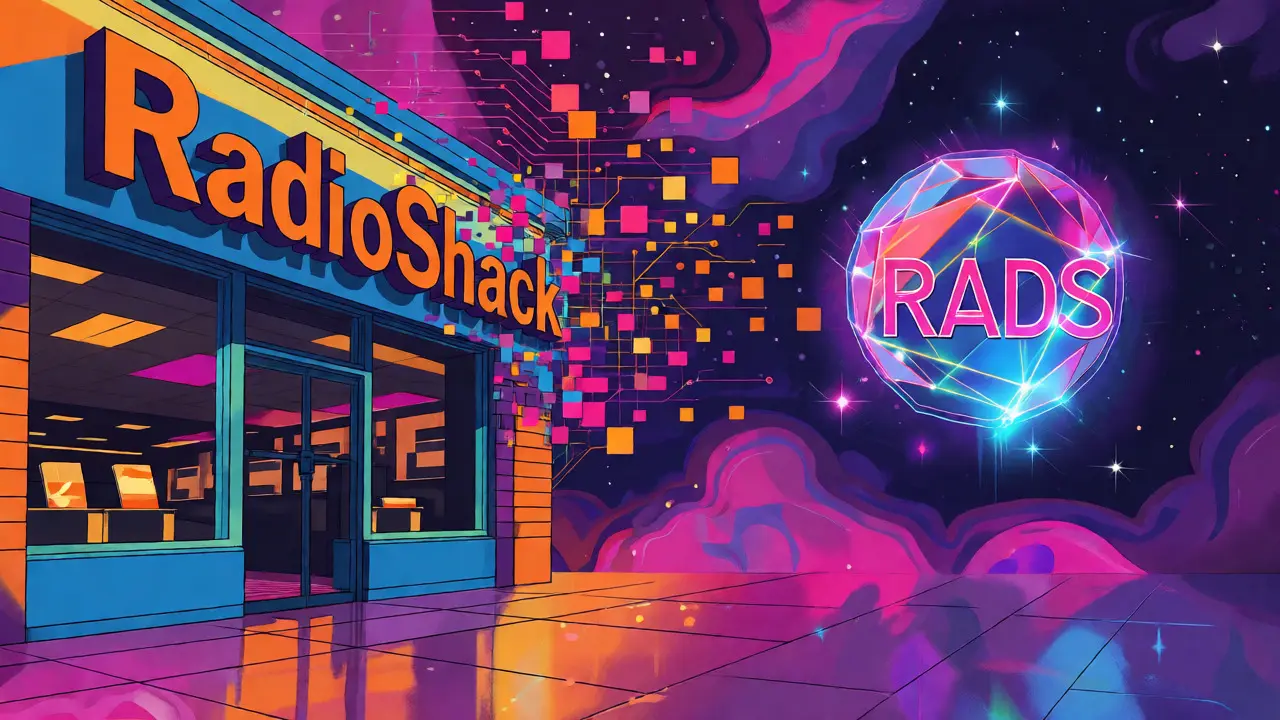
Here is the truth that most search results miss: RadioShack is not a cryptocurrency exchange. It is a token, specifically RADS, operating on the Celo blockchain. If you clicked this title expecting to sign up for a trading platform with a familiar retail brand name, you are about to have your expectations adjusted. This article breaks down what RadioShack actually is in the context of decentralized finance (DeFi), how it fits into the Celo ecosystem, and whether it deserves your attention in late 2026.
The Identity Crisis: Token vs. Platform
Let’s clear up the confusion immediately. The name "RadioShack" triggers memories of brick-and-mortar electronics stores. In the crypto world, however, names often get recycled or used metaphorically. RadioShack (RADS) is a digital asset listed on aggregators like CoinMarketCap. It functions as part of a protocol designed to optimize how tokens are swapped. Think of it less like Coinbase or Binance, and more like a specialized tool or a piece of infrastructure within a larger machine.
The core technical goal of the RadioShack protocol, according to its documentation, is to "significantly reduce the diameter of the graph of swappable tokens." That sounds complex, but here is the simple translation: it tries to make trading easier by connecting more tokens directly to each other. Usually, if you want to trade Token A for Token B, you might have to go through Token C and D first. Each hop costs money and time. RadioShack aims to cut out those middlemen hops, increasing liquidity per pair and reducing slippage for users.
Why Celo? The Infrastructure Behind RADS
You cannot understand RadioShack without understanding Celo. Celo is a layer-1 blockchain focused on mobile-first usability and financial inclusion. Unlike Ethereum, which can be slow and expensive, Celo uses a proof-of-stake consensus mechanism designed for speed and low fees. As of October 2025, Celo reported over 500,000 daily active users and $1.7 billion in monthly stablecoin volume. These numbers matter because they define the playground where RadioShack plays.
Celo became fully compatible with Ethereum upgrades after the Espresso Hardfork in March 2022. This compatibility means developers can port existing Ethereum apps to Celo easily. RadioShack leverages this environment. It doesn’t run on its own isolated chain; it lives within the Celo network. This choice provides security benefits from Celo’s validator set but also ties RadioShack’s fate to Celo’s overall health and adoption rates.
How It Works: Liquidity Graph Optimization
In decentralized exchanges (DEXs), liquidity is king. Most DEXs use Automated Market Makers (AMMs). An AMM holds pools of two tokens. To trade between non-paired tokens, routers find the best path. RadioShack claims to improve this routing logic. By reducing the "diameter of the graph," it theoretically allows for more direct swaps.
Imagine a city map. In a standard DEX, getting from Point A to Point B might require three bus transfers. RadioShack proposes adding direct train lines between major hubs. Fewer transfers mean lower transaction costs and faster settlement times. For traders executing large orders, even a small reduction in slippage can save significant amounts of money. However, this advantage only exists if there is enough liquidity in those newly connected pairs. Without deep liquidity, a direct route is just an empty road.

Market Position and Competition
Where does RadioShack fit among giants like Uniswap or PancakeSwap? It occupies a niche position. Major DEXs focus on being general-purpose marketplaces. RadioShack appears to specialize in liquidity optimization and routing efficiency within the Celo ecosystem. It competes indirectly with aggregators like 1inch or Matcha, which also try to find the best swap prices across multiple platforms.
There is no specific data on RadioShack’s total value locked (TVL) or user count in major industry reports. Publications like CoinBureau and Capital.com discuss top exchanges and Celo price predictions but rarely mention RadioShack explicitly. This silence suggests two possibilities: either it is a very new project still gaining traction, or it has limited utility compared to broader solutions. Given Celo’s ranking around #290 on CoinGecko with a market cap of roughly $275 million, RadioShack is likely a micro-cap player within a mid-cap ecosystem.
| Feature | RadioShack (RADS) | Standard DEX Aggregator |
|---|---|---|
| Primary Function | Liquidity graph optimization & token swapping | Price comparison & execution routing |
| Blockchain | Celo (EVM-compatible) | Multi-chain (Ethereum, Solana, etc.) |
| User Base | Niche / Early Adopters | Broad / Mass Market |
| Transparency | Limited public documentation | High (Public audits, extensive docs) |
Risks and Red Flags
If you are considering buying RADS or using the protocol, you need to look at the risks. First, transparency is low. There is little information available about the founding team, their funding sources, or long-term roadmap. In crypto, anonymous teams aren’t always bad, but combined with sparse documentation, they raise caution flags.
Second, dependency risk. RadioShack relies entirely on Celo. If Celo loses momentum or faces technical issues, RadioShack suffers. While Celo shows growth metrics-like quarterly transfer volumes up 100% year-over-year-it faces stiff competition from other Layer-2 solutions and newer Layer-1 chains. Third, smart contract risk. Like any DeFi protocol, bugs in the code could lead to fund losses. Without prominent third-party audits mentioned in recent news, assume the code carries higher inherent risk than audited blue-chip protocols.
User Experience and Community Sentiment
What do actual users say? Surprisingly, not much. Searches on Reddit, Trustpilot, and specialized DeFi forums yield minimal discussion about RadioShack. This lack of chatter isn’t necessarily negative; it might mean the protocol works quietly in the background. However, it also means you won’t find many troubleshooting guides or community support threads. If you encounter a bug or a stuck transaction, you might be on your own.
For beginners, this obscurity makes RadioShack a poor starting point. You would likely interact with it via a wallet like MetaMask configured for the Celo network. Ensure you have CELO tokens for gas fees. Since RADS is a token, holding it implies speculation on the protocol’s future success rather than immediate utility for everyday payments.
Verdict: Should You Care?
RadioShack (RADS) is an interesting experiment in liquidity routing on Celo, but it is not a mainstream exchange. Do not confuse it with a centralized brokerage. It is a DeFi component. For most casual investors, it offers little reason to engage unless you are actively farming yields on Celo or speculating on niche DeFi tokens. Experienced DeFi users might test it for arbitrage opportunities, but thorough due diligence on the smart contracts is mandatory before depositing significant funds.
Is RadioShack a real crypto exchange?
No, RadioShack is not a centralized exchange like Binance or Coinbase. It is a token (RADS) associated with a decentralized finance protocol on the Celo blockchain that focuses on optimizing token swap paths and liquidity.
Can I buy RADS on major exchanges?
Availability varies. You typically need to acquire CELO on a major exchange, withdraw it to a self-custody wallet, and then swap for RADS on a Celo-based decentralized exchange. Direct listings on Tier-1 centralized exchanges are rare or non-existent for niche tokens like this.
What is the main benefit of the RadioShack protocol?
The stated benefit is reducing the number of steps (hops) required to swap between different tokens. This can potentially lower transaction costs and reduce slippage for traders by creating more direct liquidity routes.
Is RadioShack related to the old electronics store?
There is no confirmed official partnership between the RadioShack retail brand and this crypto token. The name appears to be coincidental or used for branding purposes within the crypto space, unrelated to the traditional retail business model.
What are the risks of investing in RADS?
Key risks include low liquidity, limited public information about the development team, dependence on the Celo blockchain's performance, and potential smart contract vulnerabilities due to fewer public audits compared to larger protocols.
Write a comment