
Imagine trying to buy a coffee with cash in a world where every transaction is recorded on a public ledger. For many Australians holding privacy-focused cryptocurrencies like Monero or Zcash, this scenario has become uncomfortably close to reality.
If you are an Australian crypto trader, you might have noticed something strange happening lately. Your favorite exchange no longer lists XMR (Monero) or ZEC (Zcash). You aren't imagining it. Across the country, major cryptocurrency platforms have quietly-or sometimes loudly-removed these assets from their menus. But here is the twist: owning these coins isn't illegal. Trading them through regulated channels, however, has become nearly impossible.
This shift isn't just a local quirk; it's part of a massive global crackdown that hit hard in 2025 and continues to tighten its grip in 2026. So, what exactly happened? Why are Australian exchanges banning privacy coins, and more importantly, what does this mean for your portfolio?
The Regulatory Squeeze: ASIC and AUSTRAC
To understand why privacy coins are disappearing from Australian screens, we need to look at the two giants watching over the digital asset space: the Australian Securities and Investments Commission (ASIC) and the Australian Transaction Reports and Analysis Centre (AUSTRAC).
Australia operates under a dual regulatory framework. On one hand, cryptocurrency remains 100% legal for individual ownership. You can hold a wallet full of Monero in your bedroom without breaking any laws. On the other hand, the businesses that facilitate trades face strict compliance requirements. These rules are designed to prevent money laundering and terrorism financing, governed by the Anti-Money Laundering and Counter-Terrorism Financing Act 2006.
Here is where it gets tricky for privacy coins. Platforms like Monero use advanced cryptographic techniques-such as ring signatures and stealth addresses-to obscure who sent money, who received it, and how much was transferred. For regulators, this anonymity is a nightmare. It makes "Know Your Customer" (KYC) and transaction monitoring virtually impossible. If an exchange cannot prove they know who their customers are or where the money is going, they risk losing their license.
Starting March 31, 2026, AUSTRAC’s regulatory scope expands significantly to cover all digital asset service providers. This means the net is tightening. Exchanges that previously operated in gray areas now face severe penalties for non-compliance. The message from Canberra is clear: if you want to operate legally in Australia, you must provide transparency. Privacy coins, by design, refuse to do so.
Why Exchanges Are Delisting Privacy Coins
You might wonder why exchanges simply don't find a workaround. The answer lies in risk management. Running a crypto exchange is expensive and heavily scrutinized. When you add privacy coins to the mix, you introduce a level of regulatory risk that most institutional players are unwilling to bear.
In 2025, we saw a wave of delistings globally. According to data from the Independent Digital Assets Exchange (IDAX), 78% of institutional clients actively supported the removal of privacy coins to meet their AML/CTF obligations. Big banks and traditional financial institutions are starting to integrate with crypto platforms. They demand clean, traceable transactions. Privacy coins disrupt this integration.
Consider the case of Binance. In February 2025, the giant exchange delisted Monero, Zcash, and Dash from its European and US platforms. This move impacted an estimated $600 million in trading volume. While Binance operates globally, Australian users on localized versions of such platforms felt the immediate effect. Kraken followed suit in Canada in March 2025, citing FINTRAC regulations. Poloniex went even further, delisting Monero globally in April 2025 after pressure from the US Treasury Department.
Australian exchanges are mirroring this behavior. It’s not necessarily because a specific law says "you cannot list Monero." It’s because listing it invites audits, fines, and potential cancellation of their digital currency exchange registration. AUSTRAC has already shown it is willing to cancel registrations for non-compliance. No CEO wants to bet their business on the hope that regulators will look the other way.
| Region/Country | Action Taken | Date/Status | Key Driver |
|---|---|---|---|
| Japan | Complete Ban | 2018 | Financial Services Agency guidance |
| South Korea | Top Exchanges Delisted | Q1 2025 | Upbit, Bithumb compliance |
| United States | Major Exchanges Delisted | Feb-Apr 2025 | Treasury Dept & IRS pressure |
| Australia | De Facto Ban via Compliance | 2025-2026 | AUSTRAC & ASIC enforcement |
| European Union | Scheduled Comprehensive Ban | July 2027 | Anti-Money Laundering Regulation |

The Global Context: Australia Is Not Alone
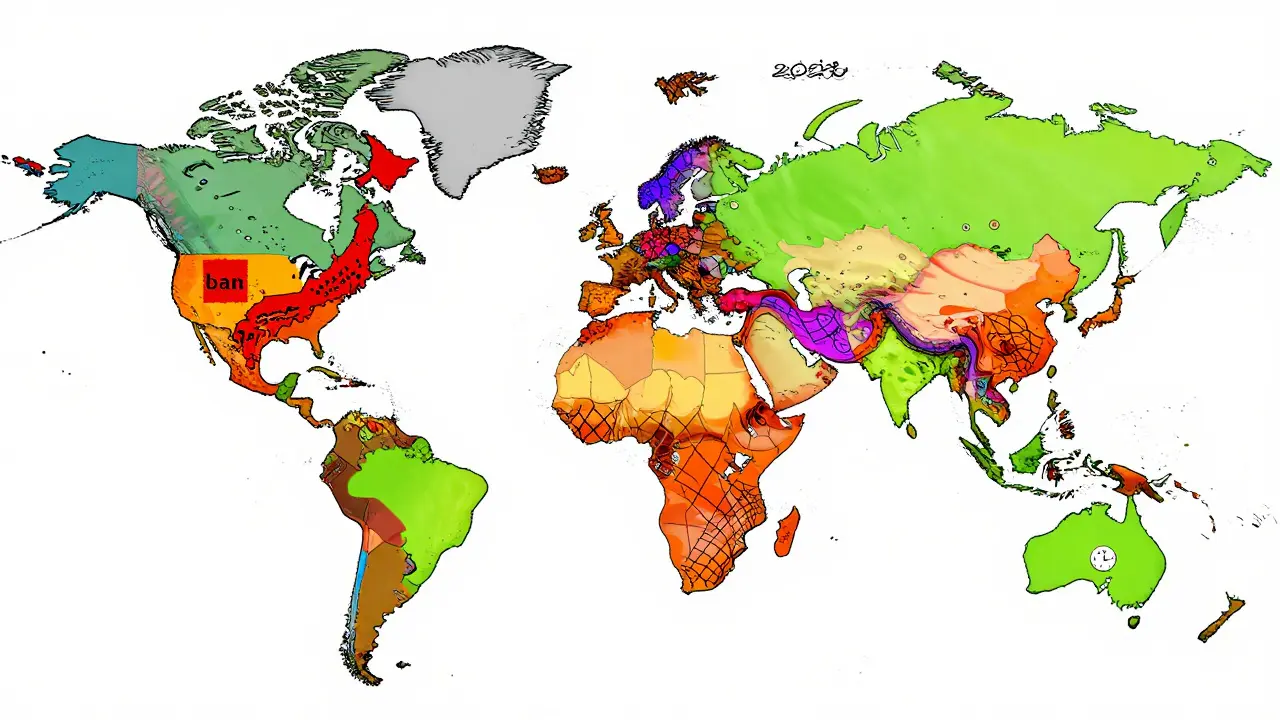
If you think Australia is being uniquely harsh, take a look around the world. The trend toward restricting privacy-enhancing technologies is widespread among developed nations.
Japan set the precedent back in 2018. Following guidance from the Japan Financial Services Agency, all registered crypto exchanges ceased supporting privacy coins entirely. It was a blunt instrument, but it worked to align the market with strict anti-money laundering standards.
In South Korea, the top five exchanges, including Upbit and Bithumb, removed privacy coins from their listings in the first quarter of 2025. This wasn't a government mandate in the same sense as Japan, but rather a preemptive strike by exchanges to avoid future regulatory headaches.
The European Union is preparing for an even stricter regime. Under new Anti-Money Laundering Regulations, a comprehensive ban on privacy coins and anonymous crypto accounts is scheduled to begin in July 2027. This gives companies time to adapt, but the direction is unmistakable.
Even jurisdictions known for crypto-friendliness are drawing lines. Switzerland and Liechtenstein still offer limited privacy coin services, but only under incredibly strict Know Your Customer frameworks. Most major global exchanges, including Bittrex and Huobi, have voluntarily delisted these assets worldwide due to regulatory pressure. Australia’s approach is consistent with this international norm: prioritize transparency over anonymity.
What Does This Mean for Users?
So, you’re an Australian user who values privacy. What are your options now that centralized exchanges have closed the door?
First, let’s be clear: you can still own privacy coins. There is no law against holding them. However, acquiring them has become significantly harder and riskier. With centralized exchanges out of the picture, many users are turning to peer-to-peer (P2P) markets.
Platforms like LocalMonero have seen a 19% uptick in activity following global delistings. P2P trading allows you to buy directly from another person, often using bank transfers or cash. But this comes with serious downsides. You lose the buyer protection offered by regulated exchanges. You face counterparty risk-the other person might scam you. You also deal with price volatility and potential legal complications if authorities scrutinize large P2P transactions.
Some users attempt to access international exchanges that haven’t fully blocked Australian IPs. This is a dangerous game. These platforms may not comply with Australian consumer protections. If something goes wrong, you have little recourse. Furthermore, attempting to bypass geo-restrictions can flag your account for suspicious activity, leading to frozen funds.
Community discussions on Reddit and other forums reflect frustration. Many privacy advocates view these restrictions as an overreach, arguing that financial privacy is a fundamental right. However, institutional investors generally support the measures. They see the removal of privacy coins as a necessary step to legitimize the broader crypto industry and attract traditional capital.
Technical Challenges vs. Compliance Needs
Why can’t technology solve this problem? Couldn’t privacy coins just add a feature that allows regulators to see transactions while keeping them private from the public?
The core issue is technical versus philosophical. Privacy coins like Monero utilize zero-knowledge proofs and ring signatures to mathematically guarantee anonymity. These features are baked into the protocol. Removing them would fundamentally change what the coin is. If Monero allowed regulators to decrypt transactions, it would no longer be a privacy coin. It would just be Bitcoin with extra steps.
The US Internal Revenue Service (IRS) has highlighted the difficulty of this challenge by offering $625,000 bounties for anyone who can break Monero’s privacy features. This underscores the sophistication of the cryptography involved. Law enforcement agencies struggle to trace illicit activities, which makes exchanges reluctant to host these assets. Even if a technical solution existed, the trust model of decentralized networks would likely reject it.
Financial compliance experts argue that the anonymity features create impossible challenges for meeting customer due diligence requirements under international banking standards. Until there is a breakthrough in "selective disclosure" technology that satisfies both privacy purists and regulators, the standoff will continue.

Looking Ahead: 2026 and Beyond
As we move deeper into 2026, the landscape is solidifying. The expansion of AUSTRAC’s powers on March 31, 2026, marks a critical juncture. This formalizes the current informal restrictions. Exchanges will no longer be able to claim ignorance or ambiguity. Compliance will be mandatory, and privacy coins will remain excluded from the mainstream ecosystem.
Industry analysts predict a few possible outcomes. First, we might see the rise of specialized, offshore exchanges catering specifically to privacy coin traders, though accessing these from Australia will remain difficult. Second, privacy coins might evolve to incorporate semi-compliant features, though this risks fragmenting the community. Third, and perhaps most likely, privacy coins will become niche assets, traded primarily on decentralized exchanges (DEXs) or via P2P networks, largely ignored by the institutional world.
For the average Australian investor, the practical takeaway is simple. If you rely on regulated exchanges for ease of use and security, privacy coins are effectively off-limits. If you are determined to hold them, you must be prepared to navigate a less regulated, higher-risk environment. The era of buying Monero as easily as Bitcoin on a local app is over.
Conclusion
The ban on privacy coins across Australian crypto exchanges is not a sudden shock but the culmination of years of regulatory pressure. Driven by ASIC and AUSTRAC, and aligned with global trends in Japan, Europe, and the US, exchanges have chosen compliance over controversy. While individual ownership remains legal, the friction required to trade these assets has increased dramatically.
This shift reflects a broader maturation of the cryptocurrency industry. As crypto moves closer to traditional finance, transparency becomes paramount. Privacy coins, by their very nature, resist this trend. For users, this means adapting to new realities: relying on P2P markets, accepting higher risks, or shifting focus to transparent assets that fit within the evolving regulatory framework. The question is no longer whether privacy coins will be banned, but how users will navigate a world where financial anonymity is increasingly treated as a liability rather than a feature.
Is it illegal to own privacy coins like Monero in Australia?
No, it is not illegal to own privacy coins in Australia. Individual ownership of cryptocurrencies, including privacy-focused ones like Monero and Zcash, remains 100% legal. The restrictions apply to licensed exchanges and financial service providers, who are prohibited from facilitating trades in these assets due to compliance requirements.
Why did Australian exchanges remove privacy coins?
Exchanges removed privacy coins to comply with Anti-Money Laundering and Counter-Terrorism Financing (AML/CTF) regulations enforced by AUSTRAC. Privacy coins obscure transaction details, making it difficult for exchanges to perform necessary "Know Your Customer" checks and monitor for illicit activity. Non-compliance can result in severe penalties, including the cancellation of their operating licenses.
Can I still buy Monero in Australia?
You can still buy Monero, but not through major regulated Australian exchanges. Options include peer-to-peer (P2P) markets like LocalMonero, decentralized exchanges (DEXs), or international platforms that may not fully comply with Australian consumer protections. These methods carry higher risks, including lack of buyer protection and potential legal scrutiny.
When did the privacy coin ban start in Australia?
There was no single day when a "ban" was enacted. Instead, it was a gradual process driven by regulatory pressure. Significant delistings occurred throughout 2025, aligning with global trends. The regulatory framework tightened further with AUSTRAC's expanded scope covering all digital asset service providers effective March 31, 2026, formalizing the de facto prohibition on regulated exchanges.
How does Australia's approach compare to other countries?
Australia's approach is moderately restrictive. It is less severe than Japan's complete ban since 2018 but more restrictive than countries with minimal oversight. It aligns closely with trends in South Korea and the US, where major exchanges have voluntarily delisted privacy coins. The EU is expected to implement a comprehensive ban by July 2027, similar in outcome to Australia's current compliance-driven restrictions.
Will privacy coins ever return to Australian exchanges?
It is unlikely in the near future. Unless there is a significant technological breakthrough that allows for privacy without compromising regulatory transparency, or a major shift in AUSTRAC and ASIC policy, privacy coins will remain incompatible with the compliance requirements of regulated Australian exchanges.
Write a comment