
Have you ever clicked 'swap' on a decentralized exchange and watched your trade sit in limbo for thirty seconds while fees ate into your profits? It’s frustrating. That’s exactly the problem PandaSwap is trying to solve. Launched as a new player in the crowded Solana ecosystem, PandaSwap claims to offer faster trades, lower costs, and a hybrid trading model that blends the best of automated market makers (AMMs) with central limit order books (CLOBs). But does it actually deliver, or is it just another flash-in-the-pan project promising the moon?
In this review, we’ll break down how PandaSwap works, compare it to giants like Raydium and Orca, and look at the real risks involved with its native $PANDA token. We’re not here to hype you up; we’re here to help you decide if this platform fits your trading strategy.
What Exactly Is PandaSwap?
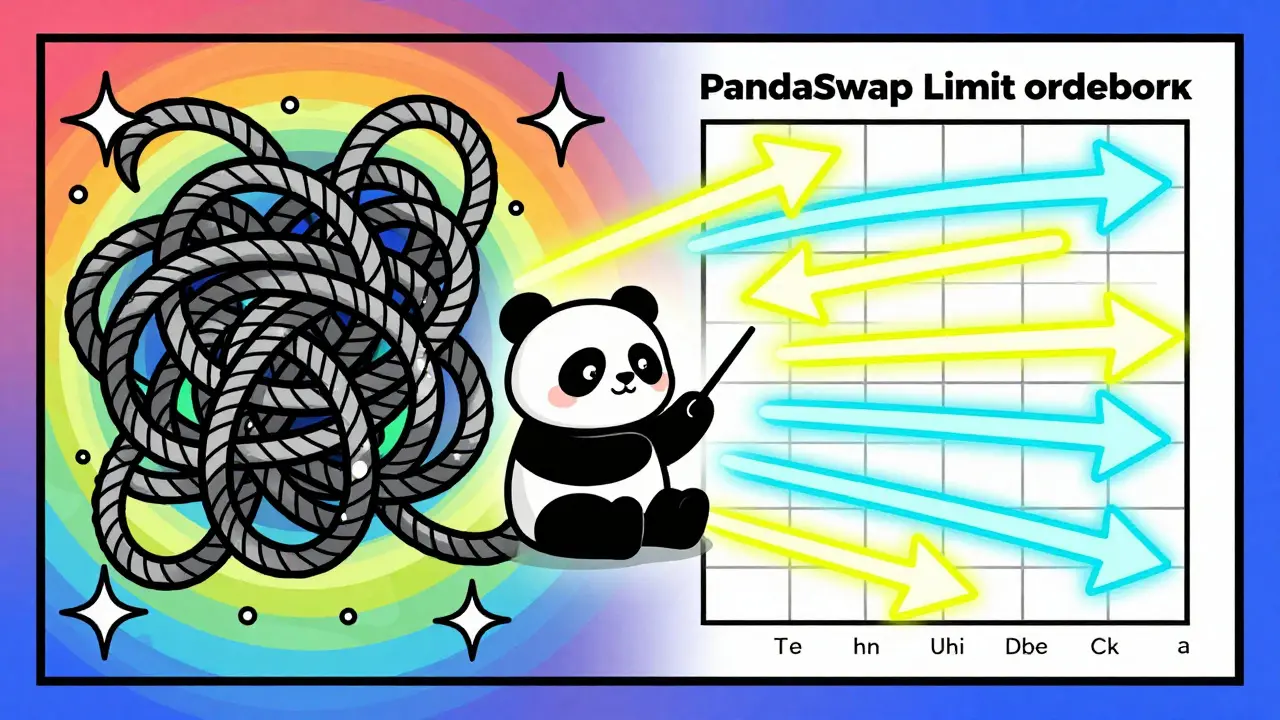
PandaSwap is a decentralized exchange (DEX) built entirely on the Solana blockchain. If you’re familiar with Ethereum-based swaps like Uniswap, you know they rely on constant product formulas (x * y = k) to determine prices. PandaSwap takes a different approach. It uses a hybrid model that combines AMM liquidity pools with a central limit order book system.
Why does that matter? Traditional AMMs can suffer from high slippage when you trade large amounts because there isn’t enough immediate liquidity in the pool. By introducing a limit order book, PandaSwap allows traders to place specific buy and sell orders at set prices. This means better price execution and less money lost to slippage, especially for medium-sized trades.
The platform leverages Solana’s high-speed infrastructure. Solana can handle approximately 65,000 transactions per second with average fees around $0.00025. PandaSwap rides this wave, offering trade execution times between 400 and 650 milliseconds. Compare that to Ethereum-based DEXs, which can take 15 to 30 seconds during peak congestion, and the speed advantage becomes clear.
Key Features and How They Work
To understand if PandaSwap is right for you, you need to look under the hood. Here are the core features that define the user experience:
- Hybrid Trading Engine: Unlike pure AMMs, PandaSwap’s CLOB integration allows for more precise pricing. You can place limit orders that wait for a matching buyer or seller, rather than accepting whatever price the AMM formula dictates.
- Shared Liquidity Mechanisms: Newer platforms often struggle with low liquidity, leading to worse prices. PandaSwap attempts to mitigate this by sharing liquidity across its pools, though it still lags behind established competitors in total depth.
- Low Transaction Costs: Because it sits on Solana, you avoid the gas wars of Ethereum. Swap fees are typically around 0.3%, similar to industry standards, but the base network fee is negligible.
- Solana Wallet Integration: Getting started requires connecting a compatible wallet like Phantom or Backpack. The process is straightforward if you’ve used Solana apps before.
The learning curve is moderate. If you’re already comfortable with Solana DeFi, you’ll feel at home. If you’re new to crypto, the interface might seem slightly complex compared to simple swap buttons on centralized exchanges, but it’s standard fare for any serious DEX.
PandaSwap vs. The Competition: Raydium, Orca, and Serum
You don’t have to use PandaSwap. In fact, most Solana traders stick to the big three: Raydium, Orca, and Serum. So, how does PandaSwap stack up against them?
| Feature | PandaSwap | Raydium | Orca |
|---|---|---|---|
| Trading Model | Hybrid (AMM + CLOB) | AMM (CLMM) | AMM (Whirlpools) |
| Transaction Speed | 400-650 ms | ~400 ms | ~400 ms |
| Liquidity Depth | Low (New Entrant) | High ($1.2B+ monthly vol) | High |
| Slippage Risk | Moderate for large trades | Low | Low |
| Best For | Limit orders, small/med trades | High volume, spot trading | Concentrated liquidity providers |
Raydium dominates the market with roughly 35% share, processing over $1.2 billion in monthly volume. Orca follows closely with 22%. PandaSwap is a newcomer. Its main selling point isn’t liquidity-it’s the limit order book functionality. If you want to execute a massive institutional-sized trade, Raydium is likely safer due to deeper order books. But if you’re a retail trader looking to place precise limit orders without paying Ethereum fees, PandaSwap offers a unique niche.
The $PANDA Token: Utility or Speculation?
Every DEX has a governance or utility token, and PandaSwap is no exception. The $PANDA token serves as the backbone of the ecosystem. However, its value proposition is murky, and price predictions vary wildly.
Some sources erroneously classify PANDA as a stablecoin pegged to an underlying asset. This is incorrect. PANDA is a volatile utility token. Its price is driven by speculation, demand for staking rewards, and governance participation.
Let’s look at the numbers. As of mid-2024, analysts offered divergent forecasts. CoinDataFlow predicted a potential range of $0.0008 to $0.0017 by 2025, suggesting significant growth. Others, like TradingBeast, were much more bearish, predicting a drop to $0.00019. Bitscreener showed extreme volatility potential, with highs near $0.0027 and lows near zero.
This volatility is a red flag for conservative investors. If you’re buying PANDA hoping for steady returns, you might be disappointed. The token is better suited for those who believe in the long-term adoption of the PandaSwap platform and are willing to ride out significant price swings. Always remember: holding a DEX token exposes you to both market risk and smart contract risk.
Risks and Downsides You Should Know
No investment is risk-free, and newer DeFi projects carry extra baggage. Here’s what you need to watch out for with PandaSwap:
- Liquidity Depth: Being new means fewer users and less capital locked in the pools. If you try to swap a large amount, you could face higher slippage than on Raydium or Orca. The 'shared liquidity' feature helps, but it hasn’t been tested under heavy load.
- Smart Contract Risk: Like all DeFi platforms, PandaSwap relies on code. While audits are standard, bugs can still exist. Always start with small amounts to test the waters.
- Market Sentiment: Recent data shows PANDA underperforming the broader crypto market, dropping 5.8% in a week where the overall market fell 4.8%. This suggests weaker investor confidence compared to blue-chip assets.
- Competition: The Solana DEX sector is growing fast, with TVL up 127% in late 2023 alone. PandaSwap needs to capture mindshare quickly before users settle into established habits with Raydium or Orca.
If you’re an institutional trader or someone moving large sums of money, PandaSwap might not be ready for you yet. Stick to the platforms with proven liquidity depths. For retail traders making smaller, frequent swaps, the risk is manageable but present.

How to Get Started with PandaSwap
Ready to give it a try? Here’s the step-by-step process to connect and trade:
- Install a Solana Wallet: Download Phantom or Backpack. These are the most widely supported wallets for Solana dApps.
- Fund Your Wallet: Buy SOL on a centralized exchange (like Coinbase or Binance) and send it to your wallet address. You’ll need SOL for transaction fees.
- Connect to PandaSwap: Visit the official PandaSwap website. Click 'Connect Wallet' and approve the connection in your Phantom/Backpack app.
- Select Your Pair: Choose the token pair you want to trade (e.g., SOL/PANDA).
- Place Your Order: Decide whether to use the instant swap (AMM) or place a limit order (CLOB). Set your price and amount.
- Confirm and Sign: Review the details, including fees and expected output, then sign the transaction in your wallet.
The interface is clean and intuitive. If you’ve used other Solana apps, you won’t feel lost. Documentation is basic but sufficient for getting started. For deeper support, check their Telegram or Discord channels, where community managers often answer questions.
Final Verdict: Is PandaSwap Worth It?
PandaSwap isn’t trying to replace Raydium or Orca overnight. It’s carving out a specific niche: offering limit order functionality on Solana with low fees. If you value precision in your trades and hate waiting for Ethereum confirmations, PandaSwap deserves a spot in your portfolio toolkit.
However, don’t expect deep liquidity yet. It’s a new entrant in a fierce market. Use it for small-to-medium trades, keep your expectations realistic regarding the $PANDA token’s volatility, and always do your own research. The technology is promising, but time will tell if it can sustain user interest against the giants.
Is PandaSwap safe to use?
Like any decentralized exchange, PandaSwap carries inherent risks, primarily related to smart contract vulnerabilities and liquidity depth. While it operates on the secure Solana blockchain, no platform is immune to exploits. It is recommended to start with small amounts and verify that the platform has undergone independent security audits before committing significant funds.
What is the difference between PandaSwap and Raydium?
The main difference lies in the trading mechanism. Raydium primarily uses an Automated Market Maker (AMM) model with concentrated liquidity, which is great for high-volume spot trading. PandaSwap uses a hybrid model that includes a Central Limit Order Book (CLOB), allowing users to place specific limit orders for better price control, though Raydium currently offers significantly higher liquidity and trading volume.
Can I use MetaMask with PandaSwap?
No, PandaSwap is built on the Solana blockchain, so it requires a Solana-compatible wallet like Phantom or Backpack. MetaMask is primarily designed for Ethereum and EVM-compatible chains. You would need to switch networks or use a different wallet to interact with PandaSwap.
What are the fees on PandaSwap?
PandaSwap charges a typical swap fee of around 0.3%, which is standard for many DEXs. Additionally, because it runs on Solana, network transaction fees are extremely low, averaging $0.00025 per transaction. This makes it much cheaper than Ethereum-based alternatives, especially during periods of high network congestion.
Is the $PANDA token a good investment?
Investing in $PANDA is highly speculative. Price predictions vary wildly, with some analysts forecasting significant growth and others predicting steep declines. The token is volatile and lacks the stability of established cryptocurrencies. Only invest what you can afford to lose, and consider it a high-risk position within a diversified portfolio.
Why should I use a limit order book instead of an AMM?
A limit order book allows you to set a specific price at which you want to buy or sell. This can result in better execution prices and reduced slippage compared to AMMs, where the price is determined automatically based on pool ratios. If you are patient and want precise control over your entry and exit points, a CLOB is advantageous.
Does PandaSwap support mobile trading?
Yes, PandaSwap is accessible via web browsers on mobile devices. Since it integrates with mobile-friendly wallets like Phantom, you can connect your wallet and execute trades directly from your smartphone browser without needing a dedicated app.
Write a comment