
Imagine living in a country where the government can freeze your bank account with a single phone call. For millions of people in nations with strict capital controls or outright cryptocurrency bans, this isn't a hypothetical scenario-it is daily life. In these environments, traditional financial systems are not just inconvenient; they are tools of surveillance and restriction. This reality has pushed a growing number of citizens toward non-custodial crypto wallets, digital tools that offer the only true form of asset ownership in a world increasingly dominated by centralized control.
The core promise here is simple but powerful: if you hold the keys, no one can take your money. Unlike custodial services like exchanges, which act as intermediaries, non-custodial wallets place full responsibility-and full power-in your hands. But how do you navigate this landscape when the very technology you rely on might be blocked or monitored? This guide breaks down exactly how these wallets work, why they matter in restricted jurisdictions, and the specific risks you must manage to keep your assets safe.
What Is a Non-Custodial Wallet?
A non-custodial wallet is a digital storage solution that grants users complete control over their private keys and cryptocurrency assets without third-party intermediaries. The fundamental principle guiding this technology is often summarized by the crypto community mantra: "not your keys, not your crypto."
To understand why this matters, you need to look at what happens behind the scenes. When you use a custodial service-like a major exchange-you are essentially renting a locker. The company holds the physical key (the private key) to your digital assets. If they go bankrupt, get hacked, or decide to freeze your account due to regulatory pressure, your access disappears. The collapse of FTX in November 2022 serves as a stark reminder of this vulnerability. Customers lost access to $8 billion in assets, and while repayments were expected by mid-2024, the process took 18 months and involved significant liquidity trade-offs.
In contrast, a non-custodial wallet generates a unique set of cryptographic codes called private keys that only you know. These keys allow you to sign transactions directly on the blockchain. There is no middleman. No customer support team to call if you forget your password. No central server that can be subpoenaed by a government. According to Cointracker’s 2024 documentation, this model is defined by "user-controlled private keys" and "no third-party reliance," providing enhanced security through decentralization. For someone living under restrictive regimes, this absence of an intermediary is not just a feature-it is a necessity for maintaining financial sovereignty.
Why They Matter in Restricted Countries
For citizens in countries where cryptocurrency is banned or heavily regulated, non-custodial wallets serve as a critical bypass mechanism. Traditional banks and centralized exchanges often require rigorous Know Your Customer (KYC) and Anti-Money Laundering (AML) checks. These processes involve handing over identification documents, proof of address, and sometimes even source-of-funds declarations. In a restricted environment, submitting this data to a centralized entity creates a permanent record that authorities can access.
Non-custodial wallets eliminate this requirement entirely. You can download a wallet app, generate a wallet, and start receiving funds without ever revealing your identity. Wilson Center’s July 2024 report highlights that these wallets function as "the only true and verifiable ownership" model that cannot be easily blocked or monitored by authorities. This makes them indispensable for individuals seeking to preserve wealth against inflation, send remittances across borders, or simply participate in the global economy without state interference.
However, it is important to distinguish between storing assets and moving them. While holding crypto in a non-custodial wallet is anonymous, converting fiat currency into crypto usually requires an on-ramp. In many restricted countries, local peer-to-peer (P2P) markets become the primary bridge. Users trade cash for crypto directly with other individuals, using the non-custodial wallet as the settlement layer. This decentralized approach minimizes exposure to centralized choke points that governments typically target first.
Types of Non-Custodial Wallets and Their Trade-offs
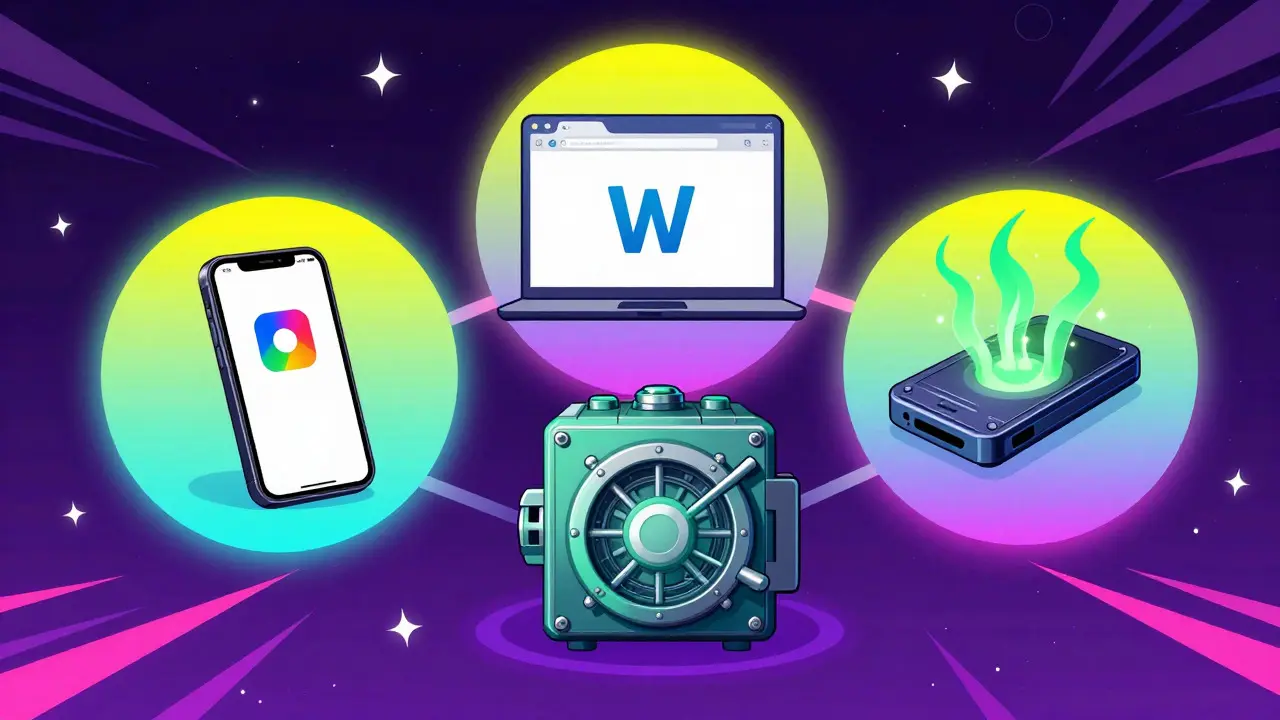
Not all non-custodial wallets are created equal. Choosing the right type depends on your technical comfort level, the value of your holdings, and the specific restrictions in your region. Here is a breakdown of the three main categories:
| Wallet Type | Security Level | Convenience | Best For |
|---|---|---|---|
| Mobile Software Wallets (e.g., Trust Wallet) | Medium | High | Daily transactions, beginners, low-value holdings |
| Browser Extensions (e.g., MetaMask) | Medium | Medium | DeFi interaction, desktop users, dApp usage |
| Hardware Wallets (e.g., Ledger Nano S/X) | High | Low | Long-term storage, high-value assets, maximum security |
Mobile Software Wallets: Apps like Trust Wallet (v2.10.0) are easy to install and user-friendly. They store your private keys on your device, encrypted locally. This is convenient for quick transactions, but if your phone is stolen or infected with malware, your assets are at risk. In restricted countries, where smartphone security may be compromised by state-sponsored spyware, this is a significant consideration.
Browser Extensions: Tools like MetaMask (version 11.15.0) integrate directly into web browsers, making them ideal for interacting with decentralized applications (dApps) like Uniswap or PancakeSwap. However, they are vulnerable to phishing attacks and browser extensions that steal data. If your computer is shared with family members or used in public internet cafes-a common scenario in some restricted regions-the risk increases.
Hardware Wallets: Devices like the Ledger Nano S ($79 USD) and Ledger Nano X ($149 USD) offer the highest tier of security. They store private keys offline, meaning they never touch the internet. Transactions are signed within the device itself before being broadcast to the blockchain. As noted in Ledger Academy’s 2024 specifications, this "air-gapped" nature makes them nearly immune to remote hacking. For anyone holding significant value in a hostile regulatory environment, a hardware wallet is not just recommended-it is essential.
The Critical Role of Recovery Phrases
If there is one thing every user must understand about non-custodial wallets, it is this: your recovery phrase is your money. During setup, your wallet generates a 12 to 24-word sequence known as a seed phrase or recovery phrase. This phrase is the master key to your entire portfolio. Lose it, and your assets are gone forever. Share it, and anyone who sees it can drain your wallet instantly.
Forvismazars’ March 2025 risk management report emphasizes that "if a private key is lost or compromised, there is no way to recover the funds." There is no "Forgot Password" button. There is no customer support hotline. In restricted countries, where users may face sudden displacement or confiscation of devices, securing this phrase becomes a matter of survival.
Here are best practices for protecting your recovery phrase:
- Write it down physically: Use pen and paper. Store it in a fireproof and waterproof container. Avoid digital copies like photos in your cloud drive, which can be hacked or subpoenaed.
- Use multiple backups: Create two or three copies and store them in separate secure locations. One at home, one in a safety deposit box, one with a trusted friend abroad.
- Consider Shamir Backup: Advanced hardware wallets like newer Ledger models offer Shamir backup options (introduced in version 2.3.0). This splits your recovery phrase into multiple parts, so losing one part doesn’t mean losing everything. It also allows for plausible deniability-if forced to reveal one part, you can claim it’s incomplete.
- Never digitize it: Do not save it in text files, emails, or note apps. Malware specifically targets these locations.
User feedback from Reddit’s r/CryptoCurrency community in August 2024 highlights the stakes. User u/KeyLoser2024 reported losing $3,200 after misplacing their seed phrase while moving countries. In restricted environments, where relocation might be sudden and chaotic, such losses are devastating. Preparation is your only defense.
Navigating Technical Barriers and Censorship
Using non-custodial wallets in restricted countries often involves more than just downloading an app. Governments frequently block access to blockchain explorers, decentralized exchanges, and even wallet websites. To bypass these blocks, users often rely on Virtual Private Networks (VPNs) or Tor browsers. While effective, these tools add a layer of complexity that can intimidate beginners.
BitPay’s 2024 analysis notes that while non-custodial wallets are "fast and easy to create," they require "more technical knowhow" for advanced features. Understanding how blockchain transactions work, managing gas fees, and verifying smart contract addresses are skills that take time to develop. MetaMask’s user onboarding data suggests it takes 10-40 hours to achieve proficiency. In countries where educational resources are censored, this learning curve is steeper.
One practical tip: always verify network parameters manually. Non-custodial wallets often require you to configure network settings for different blockchains like Ethereum, Binance Smart Chain, or Solana. Scammers create fake networks that mimic legitimate ones to steal funds. Always cross-reference RPC URLs with official sources before adding a new network.
Additionally, transaction fees vary widely. On congested networks like Ethereum, fees can spike to $50 or more per transaction. In restricted economies where income levels are lower, this can make small transactions prohibitive. Consider using Layer 2 solutions like Arbitrum or Optimism, or alternative chains like Polygon, which offer significantly lower fees while maintaining compatibility with many non-custodial wallets.
Risks and Mitigation Strategies
While non-custodial wallets offer unparalleled freedom, they are not without risks. The burden of security falls entirely on you. Here are the most common threats and how to mitigate them:
- Phishing Attacks: Scammers send fake links via email or social media that lead to counterfeit wallet sites. Always bookmark your wallet’s official website and never click links from unsolicited messages.
- Malware: Keyloggers and screen recorders can capture your private keys or recovery phrases. Keep your operating system updated, use reputable antivirus software, and consider using a dedicated, clean device for crypto activities.
- Human Error: Sending funds to the wrong address is irreversible. Always double-check the recipient address. Start with a small test transaction before sending large amounts.
- Physical Theft: Hardware wallets can be stolen. Protect them with a strong PIN code. Some devices also support passphrase protection, adding an extra layer of encryption that acts as a hidden wallet.
MoonPay’s 2024 security analysis points out that while non-custodial wallets offer "better protection against data breaches" compared to custodial solutions, their technical complexity presents particular challenges in restricted countries. Users may lack access to quality educational resources or community support. Joining online forums, even anonymously, can provide valuable guidance and early warnings about emerging scams.
Future Outlook: Evolving Security Models
The landscape of non-custodial wallets is evolving rapidly. Following the FTX collapse, interest in self-custody has surged globally. Forvismazars’ March 2025 report identifies emerging trends like multi-signature wallets and multi-party computation (MPC) wallets. These solutions require multiple participants to approve a transaction, reducing the risk of single-point failure. While still complex, they offer a potential middle ground between pure self-custody and the convenience of custodial services.
Cross-chain interoperability is another key development. As documented in Cointracker’s 2024 analysis, users can now navigate multiple blockchain networks from single interfaces. This flexibility is crucial in restricted countries, where certain networks may be targeted for blocking while others remain accessible. Being able to switch seamlessly between Ethereum, Solana, or Bitcoin-like networks ensures continuity of access.
Despite regulatory pressures, non-custodial wallets remain the essential interface for storing, accessing, and controlling tokens in the Web3 ecosystem. As long as governments seek to control financial flows, the demand for sovereign asset control will drive innovation in this space. For individuals in restricted countries, mastering these tools is not just about investing-it is about reclaiming autonomy.
Is it legal to use non-custodial wallets in restricted countries?
Legality varies by jurisdiction. In many countries, owning a non-custodial wallet is not explicitly illegal because it is simply software. However, using it to bypass capital controls or engage in unregulated trading may violate local laws. Since non-custodial wallets do not require KYC, enforcement is difficult for authorities unless they can trace your on-ramp/off-ramp activities. Always research local regulations carefully.
Can the government freeze my non-custodial wallet?
Generally, no. Because you hold the private keys, there is no central server or account to freeze. However, if you interact with a decentralized application (dApp) that gets blacklisted by its developers, or if you use a stablecoin issuer that freezes specific addresses, your assets could be indirectly affected. Pure cryptocurrencies like Bitcoin or Ethereum are resistant to freezing.
What should I do if I lose my recovery phrase?
Unfortunately, there is no recovery option. Without the recovery phrase, your assets are permanently locked on the blockchain. This is why creating multiple physical backups in secure locations is critical. Some advanced hardware wallets offer Shamir backup, which allows partial recovery if configured correctly.
Are hardware wallets worth the cost?
If you hold more than a few hundred dollars in crypto, yes. Hardware wallets like Ledger Nano S ($79) provide offline storage, protecting your keys from malware and remote hacks. In restricted countries where device security may be compromised, the investment pays off in peace of mind and asset preservation.
How do I buy crypto without KYC in a restricted country?
Peer-to-peer (P2P) platforms are the most common method. You find a local buyer willing to trade cash for crypto, agree on a price, and transfer the funds directly to your non-custodial wallet. Always meet in safe, public places and verify the transaction on the blockchain before handing over cash. Avoid centralized exchanges that require ID verification.
Write a comment