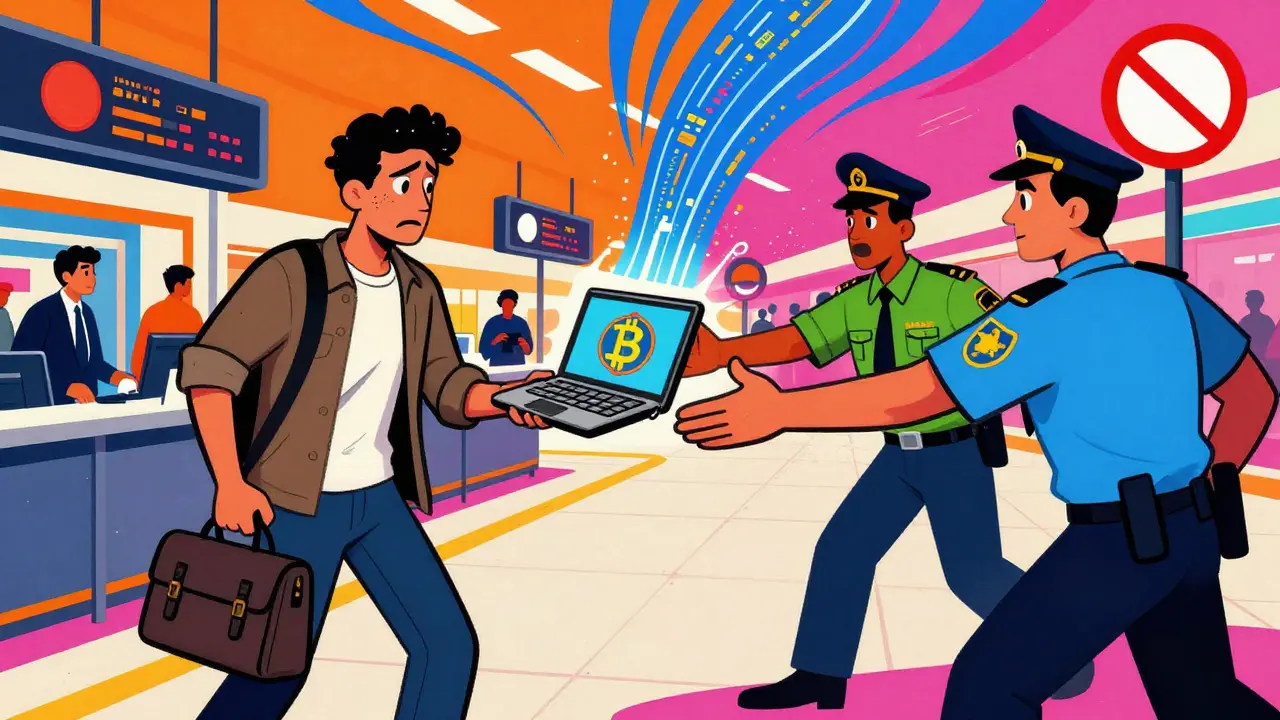
Imagine buying a laptop to mine Bitcoin, only to have customs seize it at the airport. Or perhaps you just want to send money to a friend abroad using USDT, but your bank account gets frozen because the transaction looks suspicious. For many people in Tunisia, this isn't a hypothetical nightmare-it's daily reality. As of 2026, Tunisia remains one of the few countries where almost every aspect of cryptocurrency trading is strictly illegal.
If you are holding digital assets or thinking about entering the market from North Africa, you need to understand that the rules here are not just strict; they are criminal. This guide breaks down exactly what is forbidden, who enforces these bans, and what happens if you get caught. We will look at the specific laws, the penalties, and the narrow exceptions that exist within the regulatory sandbox.
The Core Law: The 2018 BCT Directive
To understand the risk, you first have to look at the source. The primary barrier is a directive issued by the Central Bank of Tunisia (BCT) in November 2018. This document did not just discourage crypto; it explicitly prohibited all transactions involving virtual currencies. Under this rule, no entity-whether an individual or a company-can use cryptocurrencies as a means of payment or exchange.
This prohibition is absolute. It covers buying, selling, mining, and even accepting crypto as payment for goods. Because the BCT controls the monetary policy, any attempt to bypass the official banking system to move value via blockchain networks is viewed as a violation of currency control regulations. This means there is no legal way to convert Tunisian dinars into Bitcoin or Ethereum through licensed channels.
| Activity | Legal Status | Enforcement Body |
|---|---|---|
| Buying/Selling Crypto | Illegal | BCT / CTAF |
| Mining (Importing Hardware) | Illegal | Customs Authorities |
| Accepting Crypto Payments | Illegal | BCT |
| Operating an Exchange | Illegal | BCT / CMF |
| ICO/Token Sales | Illegal (unless in sandbox) | CMF / BCT |
Who Is Watching? The Regulatory Trio
You might think that because crypto is decentralized, the government can't stop it. But in Tunisia, three major agencies work together to create a surveillance net that makes participation incredibly risky. Knowing who watches what helps you understand where the pressure points are.
First, there is the Central Bank of Tunisia (BCT). They are the main enforcer. Their job is to protect the national currency and prevent capital flight. If your bank sees a transfer that doesn't match standard trade patterns, the BCT steps in. Second, the Financial Market Council (CMF) oversees capital markets. While they don't regulate crypto directly (because it's banned), they would oversee any future security tokens if the law ever changed. Finally, the National Anti-Money-Laundering Commission (CTAF) monitors financial institutions for suspicious activity. Banks are legally required to report any transaction that looks like it involves virtual assets to the CTAF.
This triad ensures that whether you try to buy crypto online, mine it at home, or sell it peer-to-peer, there is an agency with jurisdiction over your actions. The CTAF, in particular, has become more aggressive in recent years, working closely with international bodies to track illicit flows.

The Penalties: Fines and Prison Time
What happens if you break these rules? The consequences are severe and backed by the Code of Currency Control. Violations are not treated as minor administrative errors; they are criminal offenses. Individuals found engaging in unauthorized crypto activities face fines and imprisonment of up to five years.
For businesses, the stakes are even higher. Companies cannot record crypto assets on their local accounting books. If authorities discover profits generated from illegal crypto trading, those funds are subject to immediate seizure. Additionally, operating an unlicensed exchange or marketing tokens carries the same maximum penalty of five years in prison plus significant financial fines. There is no "first-time offender" leniency for serious violations under the current framework.
One critical detail is the treatment of equipment. Customs officers actively monitor imports for ASIC miners and high-end GPUs. If you try to bring mining rigs into the country without proper declaration (which is impossible since mining is banned), the equipment will be confiscated. You lose both the hardware and the investment, potentially facing charges on top of that.
The Sandbox Exception: What Is Actually Allowed?
It’s not entirely black and white. The BCT has created a regulatory sandbox for fintech startups. This allows certain companies to test blockchain-based solutions under strict supervision. However, this is not a loophole for traders. Participants must apply, undergo rigorous vetting, and operate within closed-loop pilots with limited users and transaction volumes.
Startups like VFunder (crowdfunding) and Hydro E-Blocks (carbon tracking) have operated within this framework. But notice what they do: they focus on supply chain transparency or internal record-keeping, not on issuing tradable tokens to the public. Even then, most of these companies host their infrastructure offshore to minimize legal exposure. If you are an individual user, the sandbox does not apply to you. You cannot join a sandbox pilot to trade Bitcoin.
The government is also exploring its own central bank digital currency (CBDC), known as the E-Dinar. While proof-of-concept stages have been discussed under the Digital Tunisia 2025 project, no public rollout has occurred. Until then, private cryptocurrencies remain outside the legal boundary.

How People Navigate the Ban (And Why It’s Dangerous)
Despite the ban, demand for crypto in Tunisia has grown. Many users turn to peer-to-peer (P2P) platforms, VPNs, and offshore exchanges to access global markets. Some use encrypted messaging apps to arrange cash-in-hand trades. While these methods seem discreet, they carry enormous legal risks.
Banks monitor outgoing transfers closely. If you send money to a known P2P merchant or an offshore wallet address, your account may be flagged. In several documented cases, individuals have had their accounts frozen pending investigation. The CTAF requires banks to file Suspicious Transaction Reports (STRs) for any activity that deviates from normal behavior. Using a VPN does not hide your IP address from your bank; it only masks it from the website you are visiting. Your financial footprint remains visible.
Furthermore, the lack of legal recourse is a major issue. If a P2P seller scams you, you cannot go to court. If your offshore exchange freezes your funds, you have no protection. The underground nature of the market means you are entirely on your own. Many Tunisian entrepreneurs have chosen to relocate to more crypto-friendly jurisdictions like Canada or Switzerland, leading to a brain drain that hurts the local tech ecosystem.
Future Outlook: Will the Rules Change?
As of mid-2026, there is no indication that the ban will be lifted soon. Parliamentary discussions have touched on classifying crypto as "virtual assets" subject to FATF travel-rule requirements, but this is still theoretical. The government remains firm on maintaining capital controls to protect the dinar. However, global pressure and regional competition may force gradual liberalization in the long term. For now, the safest approach is complete avoidance of direct crypto interactions while residing in Tunisia.
Is it legal to hold cryptocurrency in Tunisia?
No. Holding cryptocurrency is considered a violation of the 2018 BCT directive. While possession itself may not always trigger immediate arrest, any transaction involving acquisition or disposal is illegal, and discovered holdings can be seized.
Can I mine Bitcoin in Tunisia?
Mining is illegal. Importing mining hardware is prohibited by customs, and exchanging mined coins for Tunisian dinars violates currency control laws. Equipment is subject to confiscation, and operators face fines and potential imprisonment.
What is the penalty for crypto trading in Tunisia?
Violations can result in fines and imprisonment of up to five years under the Code of Currency Control. Profits from illegal activities are also subject to seizure by authorities.
Are there any legal ways to use blockchain technology in Tunisia?
Yes, but only through the BCT's regulatory sandbox for approved fintech startups. These projects focus on non-monetary applications like supply chain tracking and must operate under strict limits. Public token sales and trading are not allowed.
Will my bank block crypto-related transactions?
Yes. Tunisian banks are legally required to deny crypto-related transfers and report suspicious activities to the CTAF. Accounts involved in such transactions may be frozen or closed.
Write a comment