Imagine holding a physical key to your front door. You know that if you lose it, someone else might find it and get in. Now imagine that key is a 256-bit number, and the "door" is a digital vault on a global network. This is the reality of blockchain security, where the relationship between cryptographic keys and addresses determines whether your assets are safe or gone forever.
Most users see only the address when sending funds, but behind that string of characters lies a complex mathematical structure involving private keys, public keys, and hashing algorithms. Understanding this hierarchy isn't just for developers; it's essential for anyone managing digital assets. If you don't understand how these elements connect, you're flying blind regarding your own financial security.
The Core Triad: Private Key, Public Key, and Address
To grasp the system, you need to break it down into three distinct components. Think of them as layers of an onion, each derived from the one before it, but with different functions.
- Private Key: The ultimate secret. It is a randomly generated number that proves ownership. If you have it, you control the funds. If someone else has it, they control the funds too. There is no password reset button here.
- Public Key: Derived mathematically from the private key. It acts like a fingerprint. Anyone can see it, but nobody can reverse-engineer the private key from it easily.
- Address: A human-readable version of the public key. It’s what you share to receive payments. It’s shorter and less prone to error than the raw public key data.
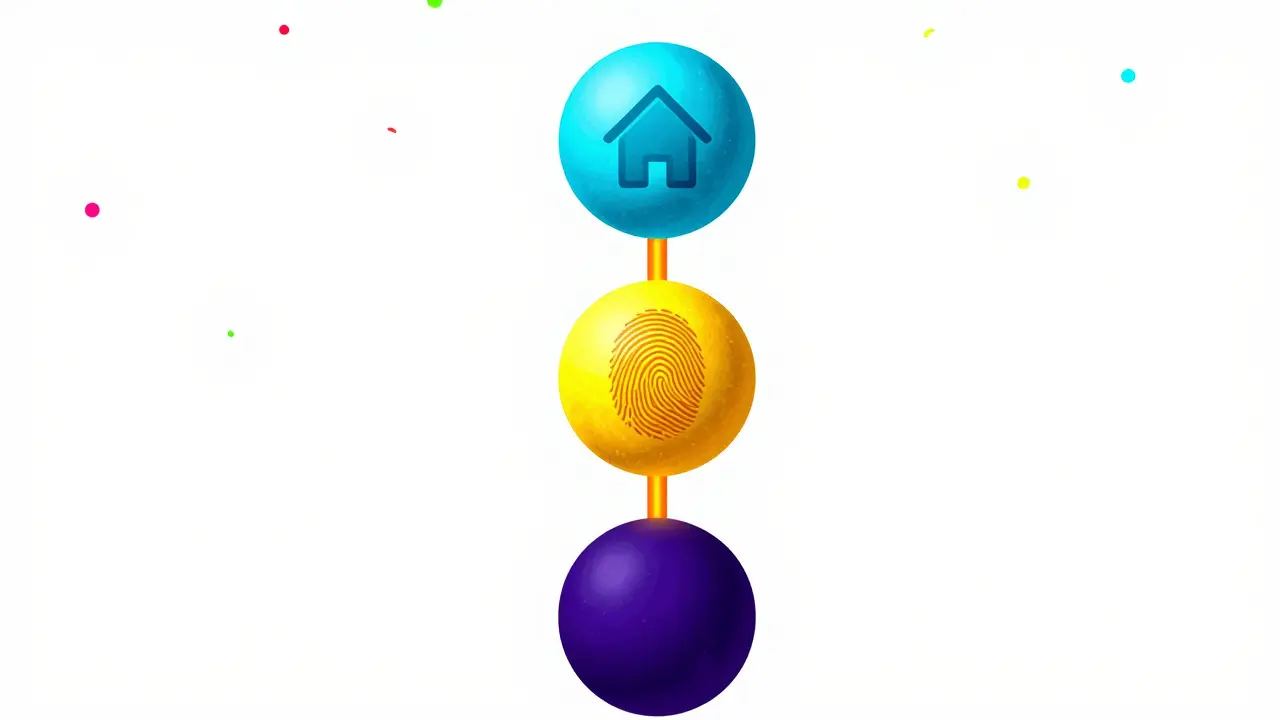
The critical insight here is directionality. You can go from Private Key → Public Key → Address. But going backwards? That’s computationally impossible with current technology. This one-way function is the backbone of decentralized finance.
How the Math Actually Works
You don’t need a PhD in mathematics to understand the logic, but knowing the basics helps demystify the process. In systems like Bitcoin, the private key is used with Elliptic Curve Cryptography (ECC) to generate the public key. Specifically, it uses a curve called secp256k1.
- Generation: A secure random number generator creates a private key (a large integer).
- Multiplication: This number is multiplied by a fixed base point on the elliptic curve to produce the public key (a pair of coordinates).
- Hashing: The public key is hashed using SHA-256 and then RIPEMD-160 to create a unique identifier.
- Encoding: Finally, this hash is encoded into a Base58Check format (for Bitcoin) or Bech32 (for newer standards) to create the familiar address string.
Why all these steps? Each layer adds a specific type of security. ECC ensures the link between keys is strong but irreversible. Hashing compresses the data and prevents pattern recognition. Encoding makes it easy for humans to read and type without mistakes.
| Component | Function | Secrecy Level | Analogy |
|---|---|---|---|
| Private Key | Signs transactions to prove ownership | Absolute Secret | Your actual house key |
| Public Key | Verifies signatures; locks funds | Public Information | Your mailbox slot number |
| Address | Human-friendly receiving endpoint | Public Information | Your street address |
Why You Can't Just Guess Someone's Key
A common misconception is that if addresses are public, maybe we can brute-force the private key. The answer is a resounding no, thanks to the sheer size of the number space. A standard Bitcoin private key is 256 bits long. That means there are roughly 115 quintillion quintillion possible combinations.
If you had a supercomputer that could test one billion keys per second, it would still take longer than the age of the universe to find a match with reasonable probability. This isn't just theoretical; it’s why billions of dollars move daily on open networks without mass theft via guessing. The security doesn't come from hiding the math-it comes from the computational difficulty of reversing it.
Wallets, Seeds, and Recovery
This is where theory meets practice. Most modern wallets use Hierarchical Deterministic (HD) standards. Instead of generating random keys for every transaction, they start with a single master seed-usually represented as a phrase of 12 or 24 words, known as a mnemonic.
This seed is the root of your entire financial tree. From it, your wallet software derives hundreds or thousands of private keys and their corresponding addresses. This offers two huge benefits:
- Backup Simplicity: You only need to back up one phrase to recover everything. Lose your phone? Write down the 12 words, install a new app, and you’re back in business.
- Privacy: You can use a new address for every transaction without revealing that they belong to the same person. Without the seed, an observer sees unrelated addresses, not a connected portfolio.
However, this convenience brings risk. If you write your seed on a sticky note and stick it to your monitor, you’ve defeated the purpose of cryptography. The most robust method is storing the seed offline, often engraved on metal plates to resist fire and water damage. Never store it digitally in an unencrypted cloud drive.
Security Pitfalls to Avoid
Understanding the relationship between keys and addresses highlights specific vulnerabilities. Here are the most common ways people mess up:
- Reusing Addresses: While not strictly dangerous, reusing the same address for multiple deposits allows observers to link your spending patterns. For maximum privacy, use a fresh address for each incoming payment.
- Online Seed Storage: Keeping your recovery phrase in a text file or email exposes it to malware and phishing attacks. Offline storage is non-negotiable for serious holdings.
- Ignoring Network Differences: Not all blockchains use the same key formats. Sending Bitcoin to an Ethereum address won't work because the underlying curve and encoding differ. Always double-check the network before sending.
- Trusting Third Parties Blindly: When using custodial wallets (like exchanges), you don't hold the private key-they do. Your "address" is just a login ID. True self-custody requires you to control the private key directly.
The Future of Key Management
As quantum computing advances, some worry that today's elliptic curve cryptography might eventually be cracked. Researchers are already working on post-quantum algorithms that will maintain the same key-address relationship but use different mathematical foundations. Until then, the current system remains robust. The core principle stays the same: keep the private key secret, share the address freely, and trust the math to protect your assets.
Write a comment