Imagine you are about to buy a rare digital asset. The image looks right. The name matches the project you follow on social media. But is it real? In the world of non-fungible tokens (NFTs), "real" means more than just a pretty picture. It means the token lives on the correct smart contract address, managed by the legitimate creators, not a scammer who copied the metadata.
This is where collection verification comes in. When an NFT marketplace like OpenSea or LooksRare puts a blue checkmark next to a collection name, they are signaling trust. But how do they decide who gets that badge? The answer isn't simple. There is no single global standard. Instead, each platform uses its own mix of technical checks, volume thresholds, and manual reviews. Understanding these processes helps you spot fakes and understand why some projects get verified while others don't.
The Core Problem: Impersonation and Trust
At its heart, NFT verification solves one major problem: impersonation. Because anyone can deploy a smart contract on Ethereum or other blockchains, bad actors often create fake versions of popular collections. They copy the website, the Twitter handle, and even the token names. If you buy from the wrong contract, your money goes to a stranger, and you end up with a worthless JPEG.
In 2022 alone, Chainalysis reported that NFT impersonation scams cost victims over $142 million. This financial loss drove marketplaces to tighten their rules. Verification became less of a luxury and more of a necessity. However, because there is no universal protocol, platforms had to invent their own methods. This leads to a fragmented landscape where a collection might be verified on one site but not another.
Volume-Based Verification: The LooksRare Model
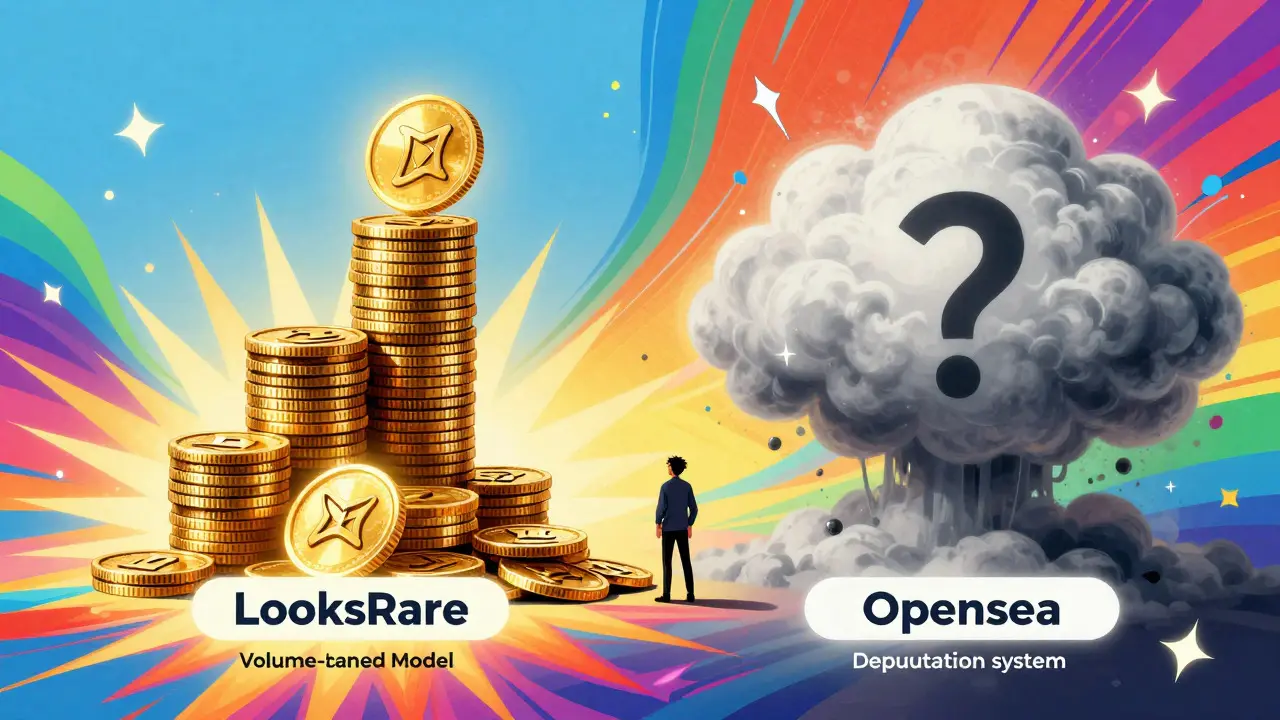
Some platforms prefer objective data over subjective judgment. LooksRare, for example, built its system around trading volume. Their logic is straightforward: if a collection has significant economic activity, it is likely legitimate. According to their documentation updated in July 2023, a collection needs to meet specific criteria to qualify for verification.
The primary threshold is 250 ETH in trading volume specifically on the LooksRare platform. Private sales don't count. This creates a clear, measurable bar. Alternatively, a collection can qualify with 500+ ETH in volume across the entire NFT ecosystem. This approach removes human bias from the initial screening. You either have the volume, or you don't.
However, this model has a downside. It favors established projects and disadvantages new creators. A survey by NonFungible.com found that 78% of creators felt this system was economically exclusionary. New projects struggle to reach 250 ETH without first having verification to build trust. It is a chicken-and-egg problem. Furthermore, high volume doesn't always mean quality; it can sometimes indicate wash trading, where owners trade among themselves to inflate numbers.
Reputation-Based Verification: The OpenSea Approach
OpenSea, the largest NFT marketplace with roughly 65% market share, takes a different path. Their process resembles Instagram's blue checkmark system. It relies heavily on reputation, media presence, and community identity rather than just raw trading numbers.
To get verified on OpenSea, a project must demonstrate credibility. This usually means having coverage in major news outlets, identifiable founders, and an active community. The exact criteria are opaque, which frustrates many creators. Success rates are estimated to be below 5%. One creator on Reddit documented an eight-month journey involving multiple rejections despite having 300 ETH in volume and press coverage.
Why does OpenSea keep it vague? Alex Atallah, co-founder of OpenSea, stated in a 2022 interview that verification is about preventing scams, not endorsing projects. By keeping the bar high and the criteria flexible, they can adapt to new types of fraud. But for users, this lack of transparency makes it hard to know what to expect. Processing times can range from four to twelve weeks, leaving creators in limbo.
| Platform | Primary Criterion | Transparency Level | Average Processing Time |
|---|---|---|---|
| OpenSea | Reputation & Media Presence | Low (Opaque) | 4-12 Weeks |
| LooksRare | Trading Volume (250+ ETH) | High (Objective) | 3-7 Business Days |
| Blur | Documentation Submission | Medium | Undisclosed |
Technical Verification: Smart Contracts and APIs
Beneath the user interface, verification involves technical checks. Marketplaces use APIs to query blockchain data. For instance, developers using Moralis can programmatically access verified collection data. This allows third-party tools to display verification status automatically.
When you submit a request, the platform checks the smart contract address against their database. They verify that the person requesting verification controls the wallet associated with the contract. This prevents random users from claiming ownership of famous projects. Some platforms also check for malicious code patterns in the contract source code.
For advanced applications, zero-knowledge proofs offer a futuristic solution. Proposed by the Ethereum Research community in May 2023, this method uses cryptography to validate transactions without revealing sensitive data. It checks parameters like Token ID, Amount, and Nullifier Hashes to prevent double-spending and ensure authenticity. While technically superior, this approach is complex and expensive in terms of gas fees, limiting its current adoption.

The Role of Manual Review
No algorithm is perfect. Every major platform retains a human element. After automated checks pass, a team member reviews the application. They look for red flags: suspicious social media accounts, plagiarized artwork, or inconsistent branding.
This manual step is crucial for catching sophisticated scams that mimic legitimate projects perfectly. However, it is also the bottleneck. Dr. Sarah Jamie Lewis, a cryptography researcher, criticized this model at the 2022 NFT.NYC conference, arguing that manual verification creates single points of failure. With thousands of new collections minted daily, human reviewers cannot scale effectively. This leads to long wait times and inconsistent decisions.
Future Trends: Standardization and Privacy
The industry is moving toward hybrid models. Platforms are combining volume metrics with technical validation and manual review. The Allium NFT Standards Group suggested this approach in their September 2023 white paper. Additionally, regulatory pressure from bodies like the SEC and upcoming EU MiCA regulations will force stricter standards.
We may see decentralized verification systems emerge, such as those proposed by the Ethereum Name Service (ENS). These would allow holders to prove ownership of authenticated collections directly through their domain names, reducing reliance on centralized marketplace badges. As technology evolves, verification will become faster, cheaper, and more secure, protecting both buyers and creators in the digital asset space.
What is the main purpose of NFT collection verification?
The primary purpose is to prevent impersonation scams. It assures users that the NFT collection they are viewing is the authentic one created by the original artists, linked to the correct smart contract address.
How much volume is needed to get verified on LooksRare?
LooksRare requires a minimum of 250 ETH in trading volume on their platform, or 500+ ETH across the broader NFT ecosystem, excluding private sales.
Is OpenSea verification easier than LooksRare?
Not necessarily. OpenSea's process is more opaque and reputation-based, with success rates under 5%. LooksRare has clearer volume requirements but can be difficult for new projects to achieve without existing traction.
Can a verified collection still be a scam?
Yes. Verification confirms the identity of the contract owner and legitimacy of the project structure, but it does not guarantee the artistic value or future price performance of the NFTs.
What role do zero-knowledge proofs play in verification?
Zero-knowledge proofs offer a privacy-focused technical method to validate transaction authenticity and prevent double-spending without exposing user data, though adoption is currently limited due to complexity.
Write a comment