
You place a trade. The market moves against you by just 2%. Suddenly, your entire position vanishes. Your collateral is gone. This isn't a glitch; it's liquidation. For many new traders in the cryptocurrency space, liquidation feels like a sudden theft. In reality, it is a mechanical safety valve designed to protect exchanges from negative balances. Understanding how this mechanism works is the single most important skill for anyone using leverage.
Leveraged trading allows you to control a large position with a small amount of capital. If you have $1,000 and use 10x leverage, you control $10,000 worth of Bitcoin. This amplifies gains, but it also amplifies losses. Liquidation is the process where the exchange forcibly closes your position because your remaining funds can no longer cover the potential losses of that open trade. It prevents you from owing more money than you deposited.
The Core Mechanics: Initial vs. Maintenance Margin
To understand why liquidation happens, you need to distinguish between two types of margin. These are not just accounting terms; they are the boundaries of your survival in a trade.
However, keeping the position open requires less capital. This is called Maintenance Margin. It is the absolute minimum equity you must hold in your account to keep the trade alive. Most major exchanges, including Binance and Bybit, set this threshold very low, typically between 0.5% and 1% of the total position value, according to Flipster's 2025 comparative analysis.
Here is the danger zone: As long as your account equity stays above the maintenance margin, you are safe. The moment your equity drops below this line, the liquidation engine triggers. You do not get a phone call. You do not get a warning email. The algorithm acts instantly.
Calculating Your Liquidation Price
Every time you open a leveraged trade, there is a specific price point where your position will be closed. This is your liquidation price. It is dynamic, meaning it changes if you add more collateral or if funding rates shift.
The formula differs slightly depending on whether you are going long (buying) or short (selling), but the logic remains consistent:
- For Long Positions: Liquidation Price = Entry Price × (1 - Initial Margin Rate + Maintenance Margin Rate)
- For Short Positions: Liquidation Price = Entry Price × (1 + Initial Margin Rate - Maintenance Margin Rate)
Let’s look at a concrete example. Imagine you buy Bitcoin at $60,000 using 10x leverage. Your initial margin rate is 10%. If the maintenance margin is 0.5%, your liquidation price would be roughly $54,300. That means if Bitcoin drops by about 9.5%, you lose everything. Now, imagine you used 20x leverage instead. Your initial margin drops to 5%. Your liquidation price jumps to approximately $57,800. A mere 3.7% drop wipes you out.
This inverse relationship is critical: higher leverage drastically reduces the price movement required to trigger liquidation. As Bitstamp’s 2024 educational material notes, high leverage traders are often liquidated during normal market noise, not even during significant trend reversals.
Mark Price vs. Last Traded Price: Why You Got Liquidated "Early"
If you have ever been liquidated while looking at your screen and seeing the price was still above your calculated liquidation level, you encountered the difference between Mark Price and Last Traded Price. This is the number one source of confusion for retail traders.
Exchanges do not use the last traded price (the price of the most recent transaction) to determine liquidations. They use Mark Price. Mark price is an index price calculated from multiple spot markets and futures markets to reflect the true fair value of the asset. It includes an adjustment for basis (the difference between spot and futures prices).
Why does this matter? Because the last traded price can be manipulated. A large trader can dump a massive order on one exchange, causing the price to spike down temporarily. If exchanges used the last traded price, innocent traders would be liquidated by these "wicks." Mark price filters out this noise. However, during extreme volatility, mark price can still deviate significantly from what you see on a simple chart, leading to unexpected closures.

Centralized Exchanges vs. DeFi Protocols
Not all liquidations work the same way. The platform you choose dictates the mechanics of your risk.
| Platform Type | Liquidation Trigger | Penalty Structure | Price Source |
|---|---|---|---|
| Binance Futures | Mark Price breaches liquidation threshold | No explicit fee; cost absorbed via worse execution price | Internal Mark Price Index |
| Bybit | Partial liquidation starts at 100% maintenance margin usage | No explicit fee; aggressive partial closure | Mark Price with volatility adjustments |
| Kraken | Higher maintenance margin requirement (1.5%) | Standard fees apply | Index Price |
| Aave (DeFi) | Health Factor drops below 1.0 | Collateral sold at 5-15% discount to liquidators | Chainlink Oracles |
In centralized exchanges (CEXs) like Binance and Bybit, the exchange takes over your position and sells it into the market. They may charge a liquidation fee, though many have moved to hiding this cost in the spread. In Decentralized Finance (DeFi) protocols like Aave or Compound, the process is different. When you are undercollateralized, other users (liquidators) step in to repay part of your debt. In return, they buy your collateral at a discount-often 5% to 15% below market value. This creates a harsher penalty for DeFi users compared to CEX traders.
The Psychology of Liquidation Clusters
Liquidations don't happen in a vacuum. They create feedback loops. According to Dr. Carol Alexander, Professor of Finance at the University of Sussex, crypto liquidation mechanisms are 30-40% more sensitive to volatility than traditional futures markets due to 24/7 trading and thinner order books.
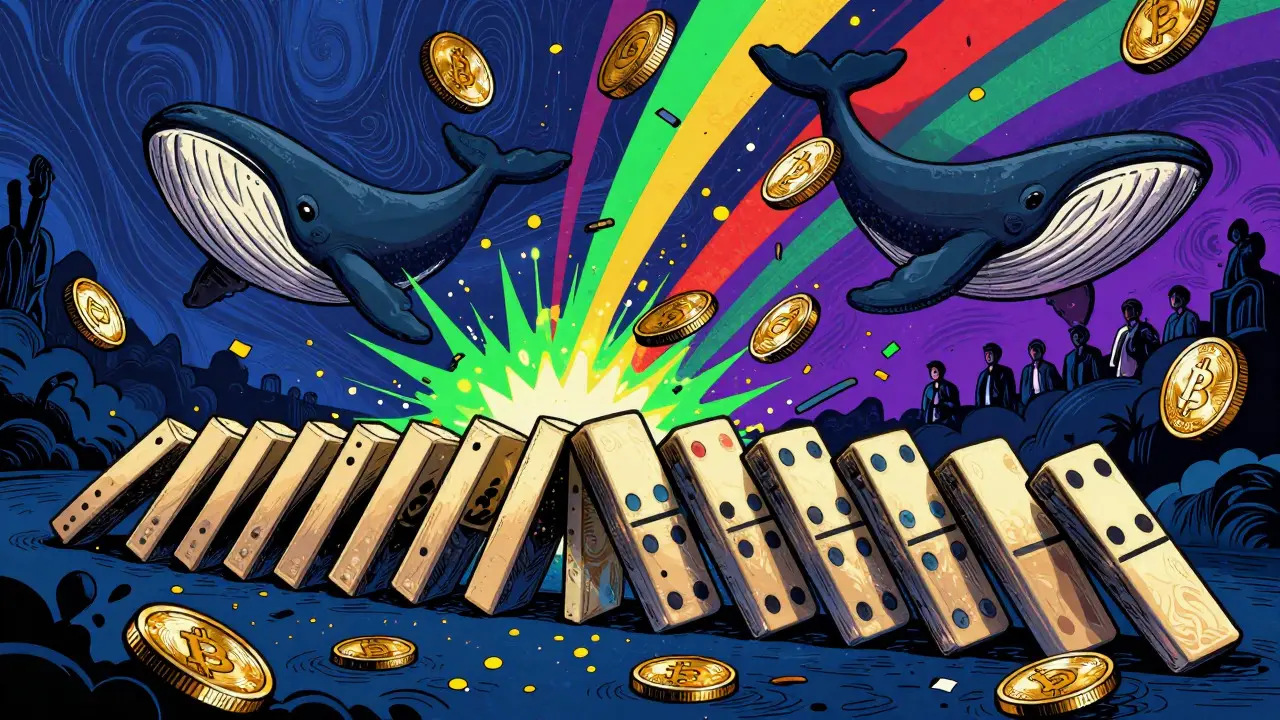
When prices hit key technical levels, many traders have their stop-losses and liquidation prices clustered together. As Deribit Insights reported in March 2025, 78.3% of liquidations occur within 1.5% of major support or resistance levels. When these positions are forced to sell, they push the price further down, triggering more liquidations. This cascade can move prices 5-7% beyond fundamental values in seconds.
This phenomenon explains why markets often seem to "hunt" liquidity. Whales and algorithms know where retail traders have placed their stops. By pushing the price just enough to trigger these clusters, they can fill large orders at better prices before the market rebounds.
Risk Management Strategies to Avoid Liquidation
You cannot eliminate the risk of liquidation when using leverage, but you can manage it. Here are three proven strategies used by professional traders.
- Use Lower Leverage: Institutional traders typically use 2x to 5x leverage. Retail traders often use 15x to 25x. Fidelity Digital Assets’ 2025 report shows institutional liquidation rates are just 0.7%, compared to 18.3% for retail. Stick to 3x-5x max unless you are hedging.
- Add Collateral Proactively: Don’t wait until you are near the edge. If your trade goes against you, consider adding margin to lower your effective leverage and push the liquidation price further away. Maintain at least 20% excess collateral during high volatility periods.
- Set Stop-Loss Orders: A stop-loss should be placed at 70-80% of your distance to liquidation. This ensures you exit with some capital remaining rather than losing everything. Note that in fast-moving markets, slippage can cause your stop-loss to execute worse than expected, so leave buffer room.
Another advanced tactic is using cross-margin mode carefully. In cross-margin, your entire account balance supports the position. This gives you more breathing room but risks your whole account if the market turns sharply. Isolated margin limits the loss to the specific funds allocated to that trade, protecting the rest of your portfolio.
Recent Developments in 2025 and 2026
The industry has evolved rapidly following several high-profile liquidation cascades in 2023 and 2025. Major exchanges have implemented new safeguards.
In Q4 2025, Binance introduced "Dynamic Maintenance Margin," which adjusts requirements based on real-time volatility measured by the Crypto Volatility Index. Bybit launched "Liquidation Protection Zones" to prevent liquidations during brief, irrational price spikes lasting less than 500 milliseconds. Deribit updated its engine to use time-weighted average prices over 30 seconds rather than instantaneous prices.
Regulatory pressure is also mounting. The U.S. CFTC issued guidance in September 2025 requiring exchanges to implement "liquidation circuit breakers" during extreme volatility events. Meanwhile, the EU’s MiCA 2.0 draft legislation released in January 2026 proposes stricter transparency requirements for liquidation fees and triggers.
Looking ahead, the Ethereum Foundation’s Devcon 7 presentation outlined EIP-7293 for "Standardized Liquidation Oracles." This aims to create consistent liquidation triggers across DeFi platforms, reducing fragmentation and arbitrage opportunities for malicious actors.
What is the difference between auto-deleveraging (ADL) and liquidation?
Liquidation occurs when the exchange closes your position to prevent negative balance. Auto-deleveraging (ADL) happens when the liquidation engine cannot close your position fast enough (e.g., during extreme illiquidity). In ADL, the exchange matches your losing position with profitable positions held by other traders, effectively unwinding both sides. ADL is rare but results in immediate profit reduction for highly leveraged winners.
Does funding rate affect my liquidation price?
Yes. Funding rates are periodic payments exchanged between long and short traders to keep the perpetual swap price aligned with the spot price. If you pay a positive funding rate, your account balance decreases slightly every 8 hours (on most exchanges). This reduction in equity brings you closer to your maintenance margin, effectively lowering your liquidation price over time. Conversely, receiving funding raises your liquidation price.
Can I avoid liquidation by adding more margin?
Yes, provided you act before the liquidation engine triggers. Adding margin increases your account equity, which lowers your margin ratio and pushes the liquidation price further away from the current market price. However, you must do this quickly. Once the system detects your equity is below maintenance margin, it may initiate partial liquidation before you can intervene.
Why did I get liquidated even though the price didn't reach my calculated liquidation price?
This usually happens due to the difference between the last traded price and the mark price. Exchanges use mark price for liquidations to prevent manipulation. Additionally, rapid price movements can cause slippage, where the actual execution price is worse than the trigger price. Finally, if funding rates shifted significantly during your holding period, your liquidation price would have changed dynamically without you noticing.
Is isolated margin safer than cross margin?
Isolated margin is generally safer for beginners because it limits your maximum loss to the funds allocated to that specific position. In cross margin, your entire account balance is used as collateral. While this provides a larger buffer against liquidation, a severe adverse move can wipe out your entire account balance, not just the trade's initial margin.
Write a comment