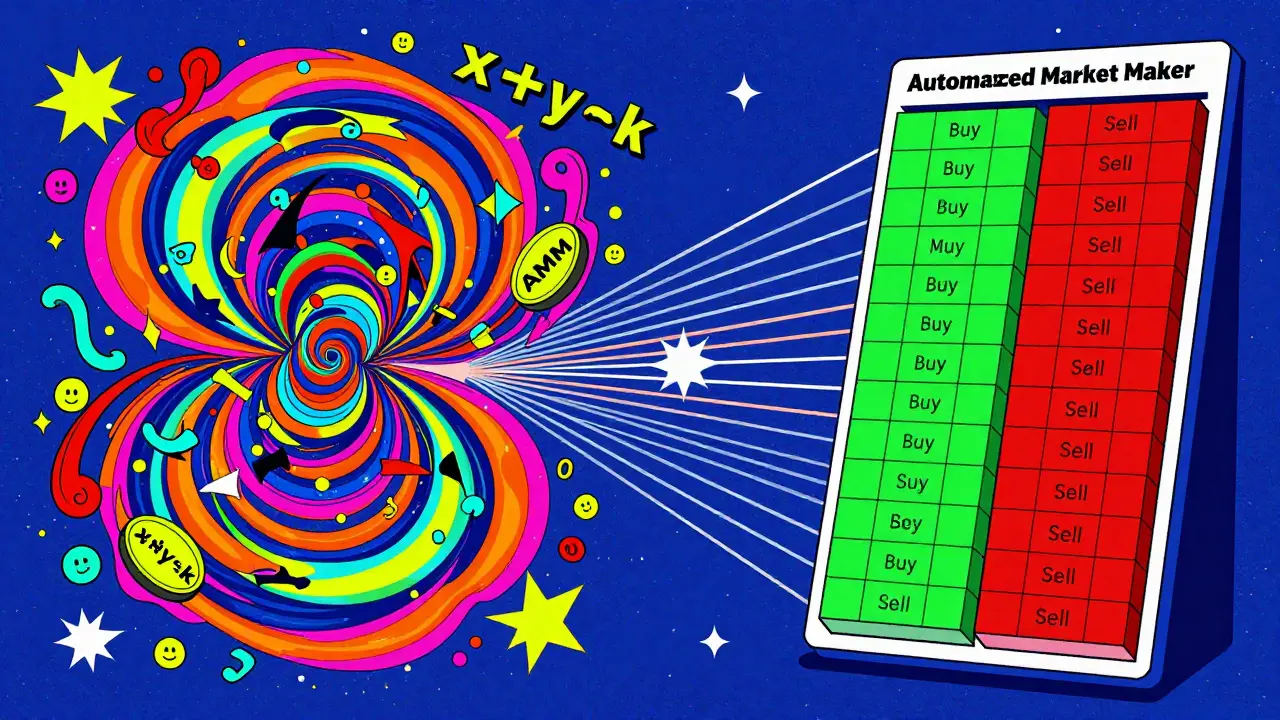
Imagine trying to buy a house. You don't just throw money into a generic pool and hope someone sells you a home at a fair price. You list your offer, wait for the right seller, and negotiate based on what others are willing to pay. That is exactly how a decentralized exchange order book is a digital ledger used in decentralized exchanges to list and manage buy and sell orders without central authority intervention works. It brings the familiar mechanics of traditional stock trading into the wild west of cryptocurrency.
If you have only traded on platforms like Uniswap, you are used to Automated Market Makers (AMMs). In those systems, you swap tokens against a liquidity pool, and the price is determined by a math formula. But order book DEXs operate differently. They match buyers and sellers directly. This distinction matters if you want precise entry points, lower slippage on large trades, or simply more control over your capital.
How Order Book DEXs Actually Function
At its core, an order book is a real-time list of all buy and sell orders for a specific trading pair. Think of it as two lists side-by-side. On one side, you have bids (people wanting to buy), sorted from highest price to lowest. On the other, you have asks (people wanting to sell), sorted from lowest price to highest.
When the highest bid meets the lowest ask, a trade happens. This process is handled by a matching engine. In centralized exchanges like Binance, this engine runs on powerful servers. In decentralized exchanges, the approach varies:
- Fully On-Chain: Every order and match is recorded on the blockchain. This is the most decentralized option but often slow and expensive due to gas fees.
- Off-Chain Matching with On-Chain Settlement: The matching happens off-chain for speed, but the final settlement occurs on the blockchain. This is the model used by dYdX is a leading decentralized exchange that utilizes Layer 2 technology for high-speed order book trading.
- Hybrid Models: These combine elements of both, often using atomic swaps or decentralized node networks to process orders.
The key takeaway is that unlike AMMs, where your order gets executed pro-rata against a pool, your order in an order book retains its identity. It sits there until it is filled. This allows for much finer control over your trades.
Order Book DEXs vs. Automated Market Makers (AMMs)
To understand why order books matter, you need to see how they differ from the dominant AMM model. Most retail crypto traders interact with AMMs daily. Here is the breakdown:
| Feature | Order Book DEX | Automated Market Maker (AMM) |
|---|---|---|
| Pricing Mechanism | Direct buyer-seller interaction | Mathematical formula (e.g., x*y=k) |
| Liquidity Structure | Discrete limit orders | Pooled liquidity |
| Price Discovery | High precision, market-driven | Formulaic, can lag behind spot markets |
| User Control | Set exact prices, cancel anytime | Accept current pool price |
| Best For | Large trades, professional strategies | Small swaps, long-tail assets |
In an AMM, if you want to buy Bitcoin, you pull it out of a pool. The price changes based on how much you take. In an order book, you place a limit order saying, "I will buy Bitcoin at $60,000." If no one sells at that price, nothing happens. Your funds stay safe in your wallet (or smart contract) until the condition is met. This reduces the risk of buying at a bad price during volatile moments.

The Liquidity Challenge and Market Makers
Here is the catch: order books need liquidity to work well. In traditional finance, market makers are firms paid to keep the books deep. In DeFi, this is harder. Without enough participants placing limit orders, the "spread" (the difference between the best buy and sell price) widens.
If the spread is wide, you might have to accept a worse price to execute immediately. As noted by industry analysts, "the lower the trading volume, the wider the spread." This makes order book DEXs less efficient for obscure tokens with low trading volume. For these assets, AMMs remain superior because they aggregate all available liquidity into one pot.
However, for major pairs like ETH/USDC or BTC/USDT, order book DEXs are thriving. Platforms incentivize market makers through fee rebates. When you provide liquidity via limit orders, you often earn a portion of the trading fees generated by takers (those who execute market orders). This creates a sustainable ecosystem where liquidity providers are rewarded for keeping the market tight.
Top Platforms Using Order Book Technology
Not all DEXs use order books. In fact, most do not. But several major players have built robust infrastructure to support them. Understanding these platforms helps you choose the right tool for your trading style.
dYdX is a prominent decentralized exchange known for its advanced order book features and derivatives trading capabilities is perhaps the most famous example. Initially built on Ethereum Layer 2 using StarkEx, dYdX migrated to its own Cosmos-based chain in 2023 to enhance decentralization and speed. It offers a professional interface similar to centralized exchanges, supporting leverage and perpetual contracts.
Another notable name is Loopring is a protocol that uses zkRollup technology to enable fast and secure order book trading on Ethereum. By leveraging zero-knowledge proofs, Loopring processes thousands of transactions per second while settling on Ethereum mainnet. This makes it highly scalable and secure.
For those interested in cross-chain trading, AtomicDEX is a decentralized exchange developed by Komodo that uses atomic swaps for trustless trading across different blockchains offers a unique approach. It uses a decentralized network of nodes to process order books off-chain but ensures settlement on-chain via atomic swaps. This minimizes counterparty risk significantly.

Pros and Cons for Traders
Before you switch from your favorite AMM, consider the trade-offs. Order book DEXs are not for everyone. They require a bit more knowledge and patience.
Advantages:
- Precise Price Execution: You decide the price. No surprise slippage if you use limit orders.
- Better for Large Trades: Institutional traders prefer order books because they can slice large orders without moving the market price drastically, as they would in an AMM pool.
- Transparency: You can see the depth of the market. If you see a wall of sell orders above the current price, you know resistance is strong.
- No Impermanent Loss for Traders: While liquidity providers face impermanent loss, pure traders do not. You simply buy and sell assets.
Disadvantages:
- Learning Curve: Understanding bids, asks, spreads, and order types takes time. It is not as simple as clicking "Swap."">
- Liquidity Fragmentation: Liquidity is spread across many individual orders rather than pooled. Thin books can lead to failed trades or poor fills.
- Complexity: Some implementations rely on complex Layer 2 solutions or separate chains, which adds a layer of technical abstraction you need to trust.
The Future of Decentralized Trading
The landscape is shifting. According to market reports from late 2023, order book DEXs accounted for about 15% of total DEX volume, with projections suggesting this could rise to 25-30% by 2025 as institutional interest grows. Why? Because institutions demand the tools they already use in TradFi.
We are seeing a convergence. Hybrid models are emerging that try to give users the simplicity of AMMs with the efficiency of order books. For example, some protocols now allow you to set limit orders that get routed to AMMs if the order book is too thin. This best-of-both-worlds approach is likely the future.
As Layer 2 solutions become faster and cheaper, the friction of on-chain order books will disappear. We may soon see fully on-chain order books that rival centralized exchanges in speed, without sacrificing custody of your funds. For now, if you are serious about trading, learning how to read an order book is a skill that will serve you well, whether you are on a DEX or a CEX.
What is the main difference between an order book DEX and an AMM?
An order book DEX matches individual buy and sell orders from users directly, allowing for precise price setting. An AMM uses a mathematical formula and a pooled liquidity reservoir to determine prices automatically, executing trades instantly against the pool.
Are order book DEXs safer than AMMs?
Safety depends on implementation. Both models carry smart contract risks. However, order book DEXs often allow users to retain custody of funds until the moment of execution (in non-custodial models), whereas AMMs require depositing funds into a pool. Order books also reduce the risk of front-running by bots compared to transparent AMM pools.
Can I use limit orders on any DEX?
No. Limit orders are a feature of order book DEXs like dYdX, Loopring, or AtomicDEX. Most popular DEXs like Uniswap or PancakeSwap are AMMs and only support immediate market swaps at the current pool price.
Why are spreads wider on some DEXs?
Wider spreads indicate low liquidity. If few people are placing limit orders near the current market price, you must accept a worse price to execute a trade immediately. This is common for low-volume assets on order book DEXs.
Is dYdX truly decentralized?
dYdX has moved towards greater decentralization by launching its own Cosmos-based chain with a decentralized validator set. While it started with a more centralized Layer 2 architecture, its current v4 iteration aims to be fully decentralized, though it still relies on a specific chain ecosystem.
Write a comment