Over 20 million Russians use cryptocurrency - even though it’s illegal to pay for goods with it
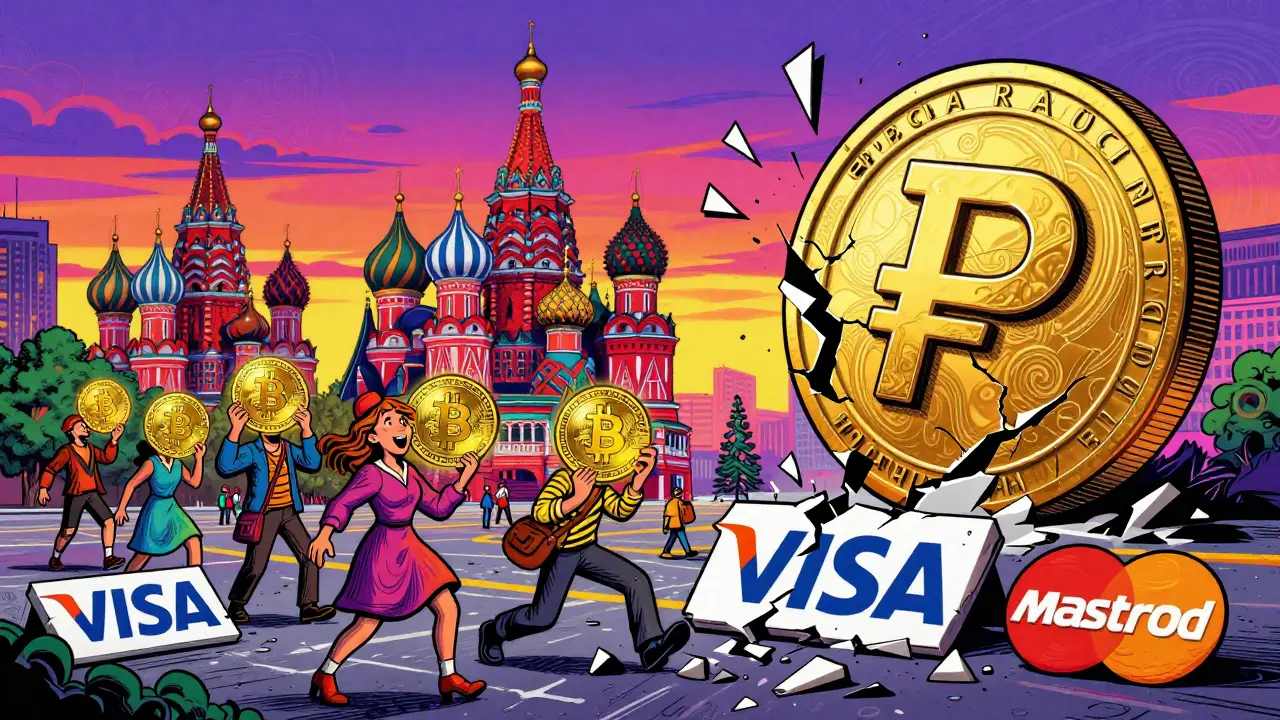
In Russia, you can own Bitcoin. You can trade Ether. You can send USDT to a contractor in Turkey. But you can’t use any of it to buy groceries, pay for a taxi, or order coffee online. That’s the strange reality of crypto in Russia today. While the government officially bans cryptocurrencies as payment, millions of people use them anyway - not because they’re tech fanatics, but because they have to.
The numbers don’t lie. As of March 2025, Russians held over 827 billion rubles ($10.15 billion) in cryptocurrency across exchange wallets. That’s up 27% from the year before. Around 13.6% of the population - roughly 20 million people - are actively holding or trading digital assets. Bitcoin makes up 62% of those holdings. Ether is second at 22%. The rest? Mostly USDT and USDC, the stablecoins that keep value steady when the ruble wobbles.
Why? Because after Western payment systems like Visa, Mastercard, and SWIFT cut off access in 2022, Russians needed an alternative. Crypto wasn’t just a luxury anymore - it became a lifeline.
Why Russians turned to crypto: sanctions, not speculation
Before 2022, crypto in Russia was mostly about speculation. People bought Bitcoin hoping it would go up. After sanctions hit, it became about survival.
Business owners couldn’t pay for cloud services, software licenses, or international freelancers. Banks wouldn’t process cross-border transfers. So they turned to peer-to-peer (P2P) platforms. A software developer in Novosibirsk started paying his developer in India with USDT instead of wire transfers. A small import-export company in Rostov began using Bitcoin to buy machinery from Kazakhstan. Transaction fees dropped from 5% with banks to under 0.5% with crypto. Settlement time went from days to minutes.
One user on Reddit, CryptoMoscow2025, put it simply: “Since Western payment systems blocked us, Bitcoin became essential for importing business software and paying international contractors.” That’s not a fringe opinion - it’s the norm for thousands of small businesses.
Chainalysis ranked Russia #8 globally for retail crypto value received. That means Russians are receiving more crypto from abroad than almost any other country. And #4 for institutional adoption - meaning companies, not just individuals, are using it to move money. That’s unusual. In most countries, institutions lag behind retail. In Russia, they’re leading.
The legal gray zone: You can own it, but you can’t spend it
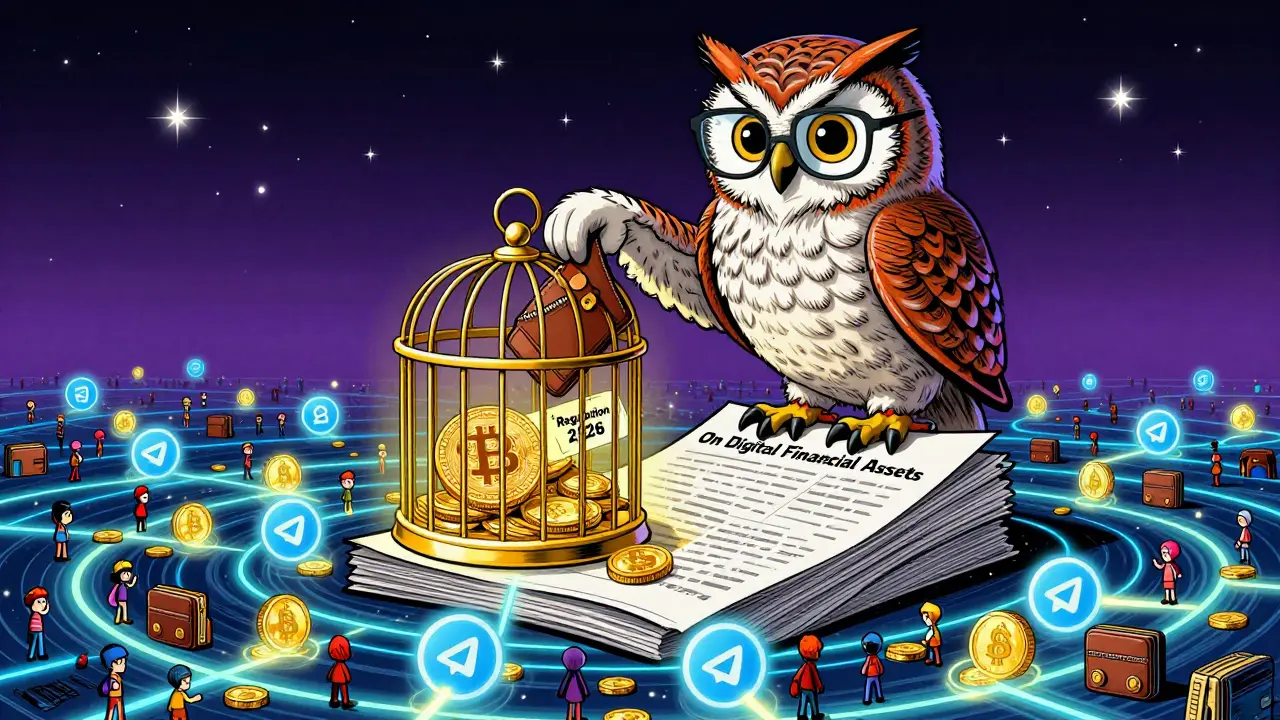
Russia’s “On Digital Financial Assets” law, passed in 2021, created a contradiction that still defines the market today. It says you can hold, trade, and transfer cryptocurrencies. But you can’t use them to pay for goods or services. Merchants who try to accept crypto risk fines or legal action.
The result? Less than 0.5% of Russian businesses accept crypto as payment. Compare that to the global average of 3.5%. That’s not because Russians don’t want to use it - it’s because the law won’t let them.
This legal ambiguity creates real pain. A user on Banki.ru, SberbankCryptoUser, lost 250,000 rubles ($2,700) when their exchange account was frozen for three weeks during a compliance check. They missed a market opportunity. No one apologized. No one compensated them. Under Russian law, they had no recourse.
Even worse, regulatory changes happen every few months. In 2025, there were an average of 2.3 major policy shifts per quarter. One day, a platform is allowed to operate. The next, it’s blocked. Users don’t get warnings. They just wake up to a frozen account and no explanation.

How Russians actually use crypto: P2P, wallets, and underground networks
With no regulated exchanges and international platforms like Binance and Coinbase blocked, Russians built their own system.
They use domestic platforms like BitPrepay and EXMO - smaller, less polished, but still functional. Most transactions happen through P2P marketplaces, where buyers and sellers trade directly. You pay in rubles via Sberbank or Tinkoff, and the seller sends crypto to your wallet. It’s slow. It’s risky. But it works.
Wallet security is a major concern. Over 68% of new users need help setting up their first wallet. Many don’t know how to store private keys safely. Scams are common. But the urgency of needing to move money overrides the fear.
Telegram groups are the real backbone of the ecosystem. There are over 450,000 members across major Russian crypto channels. These aren’t just chat rooms - they’re support networks, news hubs, and warning systems. If a platform freezes accounts, someone posts about it within minutes. If a new stablecoin emerges, users test it and share results.
And then there’s the rise of decentralized finance (DeFi). Russia ranks #52 globally for DeFi adoption - far behind leaders like Jordan or Vietnam. Why? Because most DeFi platforms require international access, which is blocked. Russians can’t easily connect wallets to Uniswap or Aave. So they stick to what’s available: P2P, stablecoins, and simple swaps.
What’s changing in 2026: The Bank of Russia’s quiet revolution
For years, the Bank of Russia called crypto a threat. In 2023, they pushed for a complete ban. But by October 2025, their tone shifted.
Deputy Finance Minister Ivan Chebeskov said: “About 20 million Russians now use crypto. We must address it - not resist it - to secure economic and technological benefits.” That’s not a casual comment. It’s a policy pivot.
The Bank of Russia announced plans to allow banks to handle cryptocurrency transactions - under strict capital and reserve requirements. That means Sberbank or VTB could soon offer crypto custody services. Not trading. Not buying. But holding and transferring digital assets on behalf of customers.
They’re also running a nationwide survey from January to February 2026 to map out how much crypto Russians hold, where it’s stored, and how it’s used. This isn’t just data collection - it’s the first step toward regulation, not prohibition.
What’s next? A possible revision of the “On Digital Financial Assets” law during the 2026 parliamentary session. The goal? Bring crypto into the formal financial system - not to ban it, but to control it.
The future: Growth, risk, and geopolitical stakes
Statista predicts Russia’s crypto market revenue will hit $2.3 billion in 2025. By the end of 2026, user numbers could jump to 23.5 million - 16% of the population. That’s faster growth than most Western nations.
But risks are high. The U.S. Treasury has signaled “heightened scrutiny” of Russian crypto activity. Any platform helping Russians move crypto could face sanctions. The Atlantic Council warns that if Russia builds its own financial infrastructure - independent of the West - it could reshape global finance.
For ordinary Russians, it’s not about ideology. It’s about access. They’re not trying to overthrow the banking system. They’re just trying to pay their bills, buy tools, and keep their businesses alive.
The government knows this. That’s why they’re moving from resistance to regulation. They can’t stop crypto. So they’re trying to control it - before someone else does.
What this means for you
If you’re a Russian citizen: Crypto is a tool. Learn how to use it safely. Stick to stablecoins for transfers. Use P2P platforms with good reviews. Never keep large amounts on exchanges. Always back up your keys.
If you’re a foreigner doing business with Russia: Accepting crypto from Russian partners is possible - but risky. Use USDT or USDC. Require clear documentation. Avoid platforms that have been sanctioned. Know that transactions can be frozen without warning.
If you’re watching from afar: Russia’s crypto story isn’t about speculation. It’s about adaptation under pressure. It’s what happens when a country is cut off from the global financial system - and its people find a way to keep trading.
Is cryptocurrency legal in Russia?
Yes and no. You can legally own, trade, and transfer cryptocurrency in Russia. But you cannot use it to pay for goods or services. The 2021 “On Digital Financial Assets” law allows ownership but bans crypto as payment. This creates a legal gray area where most users operate in practice but risk penalties if caught using crypto for transactions.
Why is Russia ranked so high in crypto adoption?
Russia ranks #10 globally in crypto adoption because millions of people use it to bypass Western financial sanctions. After 2022, international payment systems like SWIFT and Visa stopped working for Russian users. Crypto became the only reliable way to send and receive money abroad - especially for small businesses, freelancers, and importers. Institutional adoption is especially strong, with companies using crypto for cross-border payments, pushing Russia to #4 globally in that category.
Can I use Bitcoin to buy something in Russia?
Technically, no. Russian law prohibits using cryptocurrency as payment for goods or services. While some informal merchants may accept it, doing so carries legal risk. Almost no official stores, restaurants, or online retailers accept crypto. Most transactions happen through peer-to-peer exchanges, where you pay in rubles and receive crypto - not the other way around.
What’s the most popular cryptocurrency in Russia?
Bitcoin is the most held cryptocurrency in Russia, making up 62% of all crypto wallet balances. Ether is second at 22%, and stablecoins like USDT and USDC make up the remaining 15.9%. Stablecoins are especially popular because they hold steady value, making them ideal for cross-border payments and avoiding ruble inflation.
Are Russian crypto exchanges safe?
Safety varies. Domestic exchanges like BitPrepay and EXMO are operational but lack strong regulatory oversight. Many users report account freezes, slow support, and unclear policies. The most secure method is using a personal wallet (like Trust Wallet or Exodus) and trading via P2P platforms. Avoid keeping large sums on exchanges - they can be frozen without warning due to regulatory changes or sanctions.
Is crypto adoption growing or shrinking in Russia?
It’s growing. From March 2024 to March 2025, crypto holdings increased by 27%, from 651 billion to 827 billion rubles. User numbers rose from 18 million to 20 million. Projections suggest 23.5 million users by the end of 2026. Growth is driven by sanctions, inflation, and the lack of alternatives - not speculation. Even with regulatory uncertainty, demand keeps rising because people have no other options.
Write a comment