You hold some xDAI, the native currency of the Gnosis Chain blockchain network. You want to use it in a decentralized finance protocol that demands an ERC-20 token. You try to connect your wallet, but the interface rejects your balance. Why? Because xDAI, by default, is not an ERC-20 token. It’s the "gas" for the chain, like ETH on Ethereum. This is where wxDai comes in. Wrapped XDAI is the solution that bridges this technical gap, allowing you to participate in the broader Ethereum ecosystem while staying on the fast, cheap Gnosis Chain.
This isn’t just a minor technicality; it’s the key to unlocking liquidity, governance power, and yield opportunities. If you’ve ever wondered why your stablecoin balance looks different in one app versus another, or why some protocols ask for "wxDai" instead of "xDAI," this guide breaks down exactly what wrapped tokens are, how they work, and why they matter for your portfolio in 2026.
The Core Problem: Native Tokens vs. Smart Contracts
To understand wxDai, you first have to understand the limitation of native coins. On any EVM-compatible chain like Gnosis Chain (formerly known as the xDai Chain), the native asset is used to pay for transaction fees. This asset doesn’t inherently follow the ERC-20 standard-the set of rules that defines how most cryptocurrencies behave.
ERC-20 tokens have specific functions like transfer(), approve(), and balanceOf(). Smart contracts in DeFi rely on these functions to move money around automatically. Since native xDAI lacks these functions, a smart contract can’t easily interact with it directly. Imagine trying to plug a European-style power cord into a US outlet without an adapter. It simply won’t fit.
wxDai is that adapter. It is an ERC-20 token that represents 1:1 backed xDAI. When you wrap your xDAI, you lock up the native coin and mint a new token that speaks the language of Ethereum smart contracts. This allows your funds to be used in lending protocols, automated market makers, and governance votes that require strict ERC-20 compliance.
How Does the Wrapping Process Work?
The mechanism behind wxDai is straightforward but powerful. It relies on a smart contract deployed on the Gnosis Chain. Here is the step-by-step flow:
- Deposit: You send your native xDAI to the official wxDai wrapping contract. The address for this contract on Gnosis Mainnet is
0xe91D153E0b41518A2Ce8Dd3D7944Fa863463a97d. - Minting: The contract verifies your deposit and mints an equivalent amount of wxDai tokens to your wallet address.
- Usage: You now hold wxDai, which behaves exactly like an ERC-20 token. You can approve spending limits, swap it on DEXs, or stake it.
- Unwrapping: When you’re done, you send the wxDai back to the contract. The tokens are burned (destroyed), and you receive your original native xDAI back.
This process is permissionless. Anyone can wrap or unwrap at any time. There is no central authority holding your funds; the code executes the exchange automatically. This ensures trustlessness-a core tenet of decentralized finance.
| Feature | Native xDAI | wxDai |
|---|---|---|
| Token Standard | Native Asset (No Standard) | ERC-20 |
| Primary Use | Paying Gas Fees | DeFi Interactions & Trading |
| Smart Contract Interaction | Limited | Fully Compatible |
| Value Peg | $1.00 USD | $1.00 USD (via xDAI backing) |
| Contract Address | N/A | 0xe91D...a97d |
Why Do You Need wxDai? Real-World Use Cases
If both tokens are pegged to $1.00, why bother converting? The answer lies in utility. In 2026, the DeFi landscape on Gnosis Chain is mature, and most advanced applications require ERC-20 compatibility.
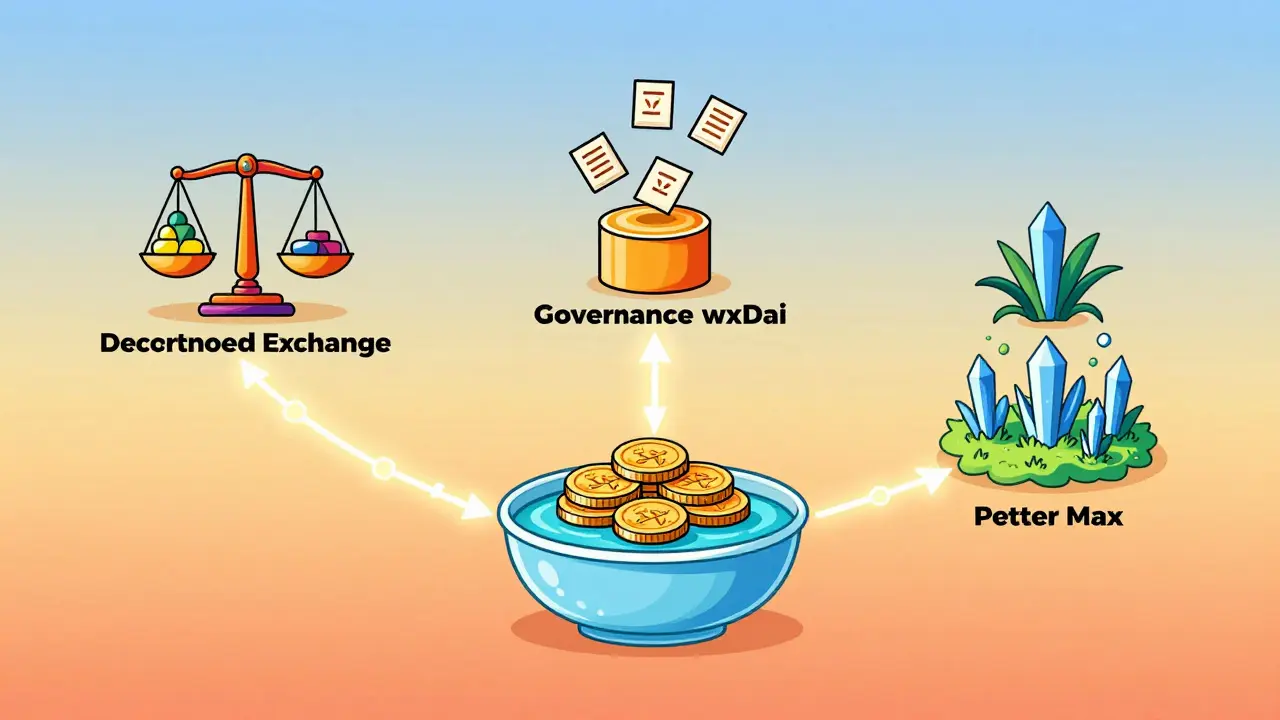
Decentralized Exchanges (DEXs): Platforms like Honeyswap and Swapr operate using liquidity pools. These pools are built on ERC-20 standards. To provide liquidity or swap assets efficiently, you often need to pair your stablecoin with other ERC-20 tokens. Using wxDai ensures seamless integration with these trading pairs.
DAO Governance: Many Decentralized Autonomous Organizations (DAOs) on Gnosis Chain use voting mechanisms that count ERC-20 token balances. If a DAO treasury holds xDAI, it might convert portions to wxDai to facilitate voting rewards or operational payments that require token transfers governed by smart contracts.
Yield Farming and Staking: Yield aggregators and staking protocols often accept ERC-20 deposits. By wrapping your xDAI into wxDai, you can deposit it into these pools to earn interest or rewards. Without wrapping, your capital would sit idle because the protocol’s smart contract couldn’t recognize the native balance.
Market Dynamics and Price Stability
As a stablecoin derivative, wxDai maintains a tight peg to the US Dollar. Data from major tracking platforms indicates wxDai trades consistently around $1.00. For instance, recent data shows prices fluctuating between $0.9998 and $1.003, reflecting minimal deviation. This stability is crucial for users who want to avoid the volatility associated with non-stable cryptocurrencies while still participating in DeFi.
It’s important to note that wxDai does not have its own independent value. Its worth is derived entirely from the underlying xDAI. Since xDAI itself is a stablecoin (part of the MakerDAO ecosystem, though now operating independently on Gnosis), the double-layer stability ensures that wxDai remains reliable for transactions and savings.
Historically, wxDai has seen highs of $1.20 during periods of extreme market stress or arbitrage opportunities, but these deviations are quickly corrected by bots and traders seeking profit. For the average user, you can treat wxDai as effectively equal to $1.00 USD.
How to Get wxDai: Step-by-Step Guide
Obtaining wxDai is simple if you already have xDAI. Here is how you do it using common tools:
- Using Wrap Eth: Connect your MetaMask wallet to the Gnosis Chain. Visit the Wrap Eth interface. Select "Wrap" and enter the amount of xDAI you wish to convert. Confirm the transaction. You will receive wxDai in return.
- Using Swapr or Honeyswap: Navigate to the swap interface. Set the input token to xDAI and the output token to wxDai. Execute the swap. Note that this method may involve a small fee due to liquidity pool mechanics, whereas direct wrapping via the contract is usually fee-neutral (except for gas).
Always ensure you are interacting with the correct contract address (0xe91D153E0b41518A2Ce8Dd3D7944Fa863463a97d) to avoid scams. Phishing sites often mimic legitimate interfaces. Double-check URLs and contract addresses before signing any transactions.
Risks and Considerations
While wxDai is a robust tool, it’s not without risks. Understanding these helps you manage your exposure.
Smart Contract Risk: Like all DeFi interactions, wxDai relies on code. If there were a bug in the wrapping contract, funds could theoretically be compromised. However, the wxDai contract has been audited and widely used for years, making this risk low but non-zero.
Depegging Events: Although rare, stablecoins can lose their peg. If xDAI were to depeg significantly from $1.00, wxDai would follow suit immediately since it is fully backed. Monitor the health of the Gnosis Chain ecosystem and the underlying collateral reserves of the xDAI system.
Liquidity Fragmentation: Sometimes, having two versions of the same asset (native and wrapped) can fragment liquidity. Always check which version a protocol requires before converting to save on unnecessary gas fees.
Is wxDai safe to hold?
Yes, wxDai is considered safe for holding within the DeFi context. It is fully backed 1:1 by xDAI, which is a well-established stablecoin. The main risks are smart contract vulnerabilities and potential depegging of the underlying xDAI, but historical performance shows high stability.
Can I trade wxDai on centralized exchanges?
Currently, wxDai is primarily traded on decentralized exchanges (DEXs) like Swapr and Honeyswap on the Gnosis Chain. Centralized exchange listings are limited and vary by region. Most users interact with wxDai directly in their wallets rather than through CEXs.
Do I need to pay fees to wrap xDAI?
You only pay the standard network gas fee for the transaction on Gnosis Chain, which is typically fractions of a cent. There is no additional service fee for using the official wrapping contract. However, swapping via a DEX may incur a small liquidity pool fee.
What happens if I lose my private keys?
If you lose access to your wallet, you lose access to both your native xDAI and your wxDai. Unlike bank accounts, there is no password reset. Always store your seed phrase securely. The wrapping contract does not hold custody of your funds in a way that allows recovery.
Why not just use USDC or USDT on Gnosis Chain?
USDC and USDT are excellent options, but wxDai offers deeper integration with the native Gnosis ecosystem. Some local protocols prefer wxDai for liquidity incentives or because it avoids cross-chain bridge risks associated with bridged assets. wxDai is also permissionless and community-governed.
Write a comment