You click "Mint." You don't know what you're buying. One second later, a unique image appears in your wallet. It might be a masterpiece with perfect gradients, or it might be a blob of black pixels that looks like a mistake. This is the thrill-and the terror-of generative art NFTs. Unlike traditional digital art where the artist sends you a finished JPEG, generative art is created by code at the exact moment you buy it. The artist builds the rules; the blockchain rolls the dice.
This isn't just random noise. It's a collision between human creativity and algorithmic randomness. To understand why this niche has exploded into billions of dollars of value (and then crashed), you need to look past the hype and understand the mechanics. How does code become art? Why do some pieces sell for millions while others sit worthless? And what makes an on-chain squiggle more valuable than a static image?
What Actually Is Generative Art?
Generative art is not new. In the 1960s, pioneers like Vera Molnár and Georg Nees used early computers to create geometric patterns. But back then, the output was static. Today, generative art NFTs combine those historical roots with modern blockchain technology. The core idea is simple: the artist writes a program (an algorithm) that defines parameters-colors, shapes, lines, opacity-but doesn't decide the final outcome.
When you mint a piece from a project like Art Blocks, you aren't buying a pre-made file. You are triggering a script. That script pulls variables from a pool defined by the artist. If the artist sets "Red" to have a 1% chance of appearing and "Blue" to have a 40% chance, the algorithm decides which one lands on your specific token ID. Even the artist cannot predict exactly what Token #3452 will look like until it is generated. This introduces true scarcity and unpredictability into digital ownership.
On-Chain vs. Off-Chain: The Technical Divide
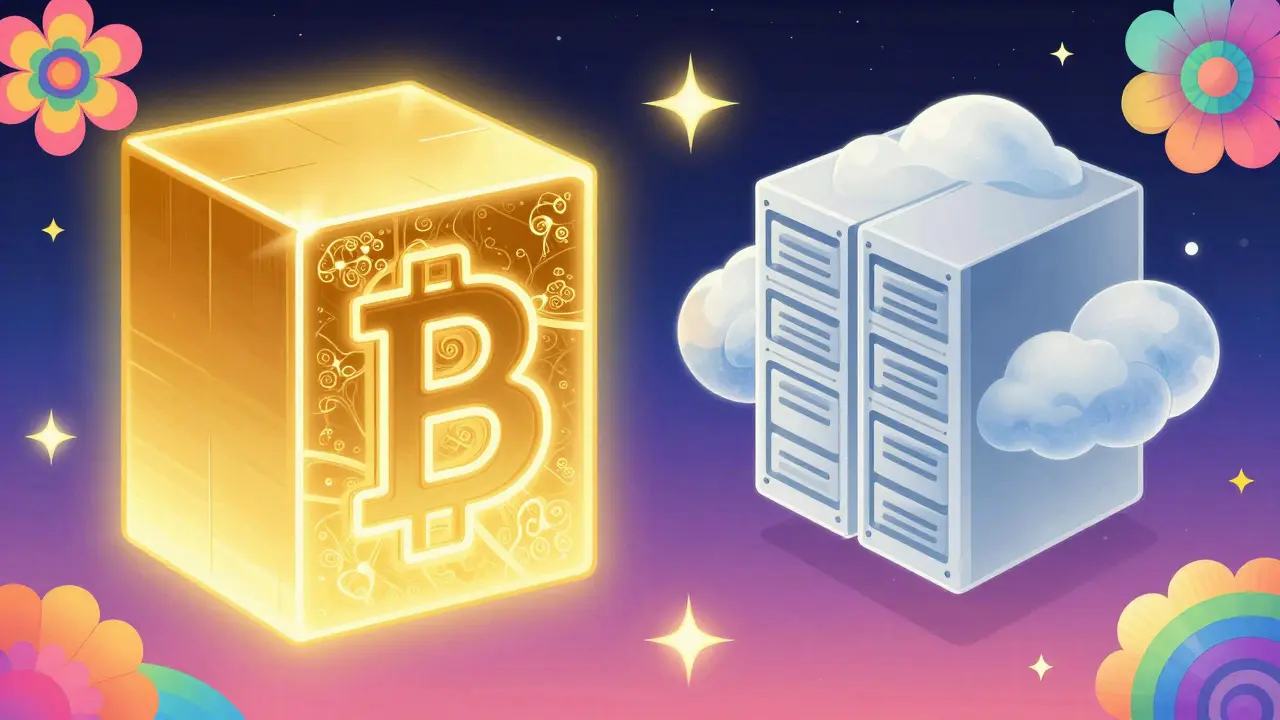
Not all generative NFTs are created equal. There is a massive difference between "off-chain" generation and "on-chain" generation. This distinction determines the long-term value and integrity of the artwork.
Off-Chain Generation: Projects like CryptoPunks were generated using code, but the images were created beforehand and stored on a central server. When you bought a Punk, you were buying a link to an image hosted elsewhere. If that server goes down, the art could disappear. The generation happened once, in the past.
On-Chain Generation: Platforms like Art Blocks store the actual rendering code on the Ethereum blockchain. When you mint, the code runs in your browser (or via a smart contract) using the seed data from the transaction. The image is rendered in real-time. This means the art is self-contained within the blockchain ecosystem. As long as Ethereum exists, the code can regenerate the image. This creates a permanent, immutable record of the artistic process, not just the result.
| Feature | On-Chain (e.g., Art Blocks) | Off-Chain (e.g., Early PFPs) |
|---|---|---|
| Generation Time | At moment of minting | Before launch (pre-rendered) |
| Storage | Code on Blockchain + Metadata on IPFS | Image files on Centralized Servers/IPFS |
| Uniqueness | True algorithmic uniqueness per mint | Fixed image assigned to token |
| Gas Costs | Higher (15-25% more due to complex contracts) | Standard minting fees |
| Permanence | High (code regenerates image) | Moderate (depends on host availability) |
How Artists Build These Worlds
If you want to create generative art, you don't necessarily need to be a master painter, but you do need to be a coder. The most common tool in the industry is p5.js, a JavaScript library designed for creative coding. It allows artists to draw shapes, manipulate colors, and apply randomness with simple commands.
The workflow typically looks like this:
- Define Parameters: The artist decides on variables. For example, "Line Thickness," "Color Palette," and "Number of Curves."
- Set Probabilities: They assign weights to these variables. Maybe thick lines are rare (2%) and thin lines are common (80%).
- Write the Script: Using p5.js or C++ (via openFrameworks), they write the code that draws the image based on these inputs.
- Test Locally: They run the code thousands of times on their own computer to ensure no "duds" (ugly outputs) slip through. This is called "dry running."
- Deploy On-Chain: The code is compiled and uploaded to the platform. The size must be tiny-often under 100KB-to fit within blockchain gas limits.
For non-coders, platforms like Async Art or fxhash offer no-code solutions where you upload layers (like PNGs of hats, eyes, and backgrounds) and set rarity percentages. However, the highest-valued works usually come from custom-coded algorithms because they allow for infinite variation rather than just stacking pre-made assets.
The Role of Rarity and Trait Distribution
In generative art, value is often tied to rarity. Because the output is random, collectors hunt for specific visual traits. This creates a secondary market dynamic similar to trading cards.
Consider a hypothetical collection of 10,000 "Space Dogs." The artist might define traits like:
- Background: Space (90%), Nebula (9%), Black Hole (1%)
- Accessories: None (50%), Laser Eyes (40%), Golden Crown (1%)
A dog with a "Black Hole" background and "Golden Crown" would be statistically extremely rare-perhaps only one or two exist in the entire collection. These "legendary" pieces command premium prices. However, this introduces risk. As collector communities on Reddit often warn, minting blindly without checking the trait distribution sheet can lead to disappointment. You might pay 1 ETH for a piece that turns out to be visually plain because the algorithm favored common traits.
Expert curators like Dr. Sarah Grant argue that the best generative art balances technical novelty with aesthetic depth. A rare trait is only valuable if it contributes to a beautiful composition. Otherwise, you're just collecting statistical anomalies, not art.
Market Realities: Hype, Crash, and Maturation
The generative art NFT market followed a dramatic arc. In 2021, projects like Tyler Hobbs' Fidenza sold for over $3 million. The total market volume for generative art peaked at $1.2 billion on Art Blocks alone. Collectors were euphoric, viewing these pieces as the future of digital ownership.
Then came the correction. By 2023, the broader NFT market contracted significantly. Speculative interest waned, and many low-effort projects lost their value. According to DappRadar data, generative art's share of the total NFT market dropped from 28% in 2021 to 15% in 2023. Many lesser-known collections now trade below their original mint price.
However, the sector is maturing rather than dying. Institutional recognition has grown. The Museum of Modern Art (MoMA) acquired Fidenza #813 in 2022, signaling that traditional art worlds are taking notice. Furthermore, the shift to Proof-of-Stake on Ethereum reduced the carbon footprint of minting by 99.95%, addressing one of the biggest criticisms of the space.
Today, the focus is shifting from speculation to artistic credibility. Platforms are introducing hybrid models, such as Art Blocks Editions, which allow established physical artists to release limited generative series. We are also seeing the rise of AI-integrated generative art, where machine learning models assist in creating more complex visual structures. About 65% of new projects in late 2023 incorporated some form of AI assistance.
Should You Collect or Create?
If you are looking to collect, approach generative art with caution. Do not mint blindly. Study the artist's previous work, understand the code's logic, and check community sentiment. Look for projects with strong curation, like those featured on Art Blocks Curated, rather than open submissions where quality varies wildly.
If you are an artist, expect a steep learning curve. Mastering p5.js and understanding blockchain constraints takes 6-12 months of dedicated study. Resources like The Coding Train’s YouTube tutorials are invaluable starting points. Remember: the code is your brush. If your algorithm is weak, your art will be too. Focus on creating systems that produce beauty, not just randomness.
Generative art NFTs represent a unique intersection of technology and creativity. They challenge our definitions of authorship, ownership, and value. While the financial hype may have cooled, the artistic innovation continues. Whether you see them as investments or cultural artifacts, one thing is clear: the canvas is no longer static. It is alive, coded, and forever changing.
What is the difference between generative art and AI art?
Generative art relies on deterministic algorithms written by the artist. The artist controls every parameter and rule. AI art uses machine learning models trained on vast datasets to generate images based on text prompts. While both use code, generative art is about system design, whereas AI art is about prompt engineering and model interpretation.
Why are on-chain generative NFTs more expensive to mint?
On-chain generation requires storing and executing complex smart contracts on the blockchain. This consumes more computational power, leading to higher "gas fees" on networks like Ethereum. Typically, these mints cost 15-25% more than standard off-chain NFT drops.
Can I create generative art without knowing how to code?
Yes, platforms like Async Art and fxhash offer no-code tools. You can upload image layers and set rarity percentages through a web interface. However, custom-coded art using tools like p5.js offers greater creative control and is generally more respected in the high-end market.
Is generative art considered real art by museums?
Yes. Major institutions like the Museum of Modern Art (MoMA) and Sotheby's have acquired and auctioned generative art NFTs. This indicates growing institutional acceptance of algorithmic creation as a legitimate art form.
What happens if the website hosting my generative NFT goes down?
If the art is truly on-chain (like Art Blocks), the code remains on the blockchain. You can regenerate the image using the smart contract even if the original website disappears. If it is off-chain, you rely on the permanence of the storage solution (like IPFS) and the continued operation of the project team.
Write a comment