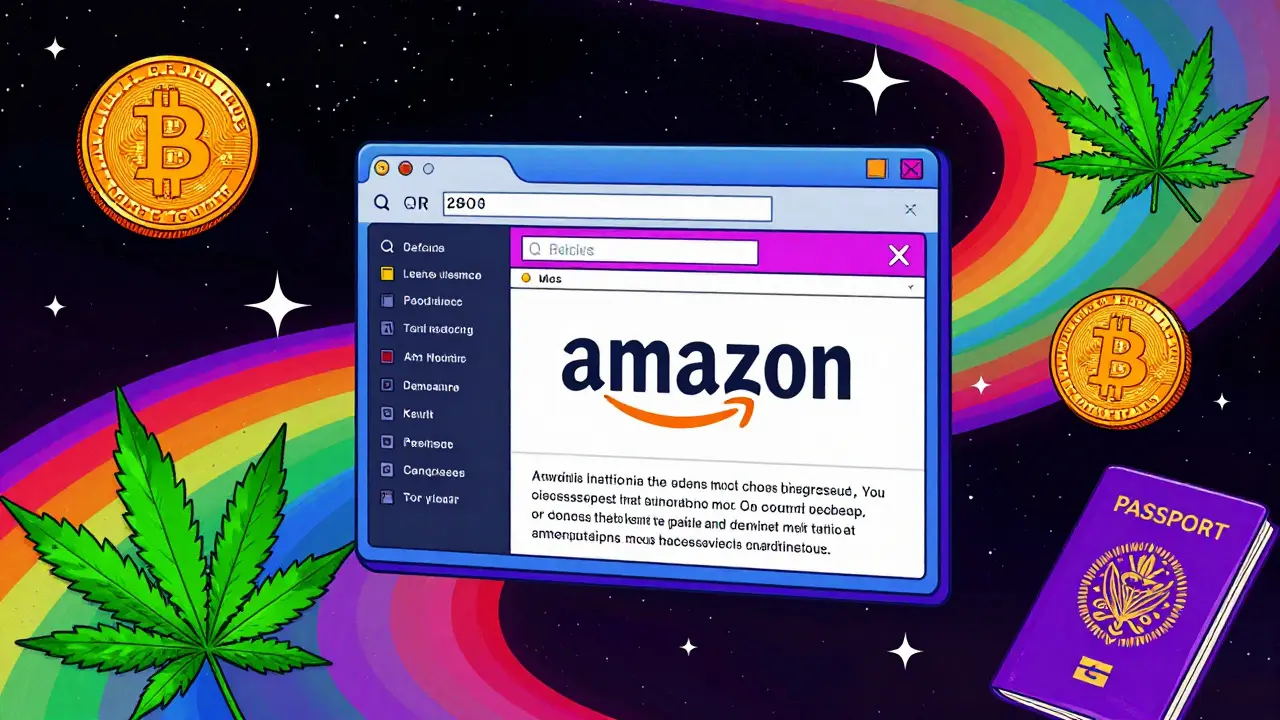
The name Silk Road still echoes in crypto circles - not because it was a real exchange, but because it was the first time most people heard Bitcoin used for anything beyond tech blogs. People often mistake Silk Road for a crypto exchange like Binance or Coinbase. It wasn’t. It was a darknet marketplace. And that difference changed everything.
What Silk Road Actually Was
Silk Road launched in February 2011 as a hidden website on the Tor network. You couldn’t find it through Google. You needed the Tor browser, a special tool that masked your location and identity. Once there, you could buy anything - from marijuana to fake passports to hacking tools - all paid for in Bitcoin. Sellers didn’t need IDs. Buyers didn’t need names. The whole system ran on anonymity.
It looked like Amazon. You searched for products, read reviews, checked seller ratings, and clicked ‘buy.’ The twist? Your money went into an escrow account held by Silk Road itself. Only after you confirmed you got the package did the funds release to the seller. That escrow system was revolutionary. It built trust in a place where no one knew who you were.
Between 2011 and 2013, Silk Road processed over 9.5 million BTC in sales. That’s roughly $183 million at the time. Adjusted for Bitcoin’s value today, it’s over $1.2 billion. The platform took an 8-12% cut on every transaction - about $13 million in commissions. That money didn’t go to a bank. It sat in Bitcoin wallets controlled by the site’s founder, Ross Ulbricht, who went by the alias ‘Dread Pirate Roberts.’
Why People Trusted It
Trust didn’t come from logos or customer service lines. It came from feedback. Sellers had to maintain high ratings. If you sold bad weed or didn’t ship on time, your reputation crashed. Buyers left detailed reviews. One user, ‘Chemist_420,’ wrote in 2012: ‘I’ve bought from 12 vendors. Every time, the product matched the description. Better than my local dealer.’
A 2022 study of 1,847 archived reviews found that 63% of products were drugs. But the top-rated vendors had 98% positive feedback. That’s higher than Amazon’s average. Why? Because sellers knew their livelihood depended on it. They didn’t cut corners. They communicated. They packaged carefully. They even offered refunds.
And then there was the privacy. In 2013, if you wanted to buy something without leaving a paper trail, Silk Road was the only option. No KYC. No ID scans. No bank records. Just Bitcoin and Tor. For users in countries with strict drug laws, or those avoiding surveillance, that was priceless.

Why It Collapsed
But anonymity wasn’t foolproof. The FBI tracked Ulbricht through a simple mistake: he logged into the Silk Road admin panel from his personal laptop in a San Francisco library. His IP address was logged. His typing patterns were matched. He was arrested on October 1, 2013.
The moment he was caught, the whole thing fell apart. Silk Road had no decentralized structure. No backup servers. No team. Just one man running everything. Within 24 hours, the site went dark.
The government seized 144,336 BTC from Silk Road’s wallets. At the time, that was worth $3.6 million. Today, in December 2025, it’s worth over $9 billion. The U.S. Marshals have been selling it off in batches since 2014. Each sale of 10,000 BTC causes a 2.3% dip in Bitcoin’s price, according to a 2024 University of Chicago study. That’s how much influence one marketplace had on the entire crypto market.
What Made It Different From Real Crypto Exchanges
Real exchanges like Coinbase or Binance let you buy Bitcoin with dollars. They require your driver’s license, your address, your Social Security number. They report to the IRS. They’re regulated. They’re safe - but not private.
Silk Road did the opposite. No ID. No reporting. No government oversight. You couldn’t trade Bitcoin for Ethereum there. You couldn’t cash out to your bank. You couldn’t even buy Bitcoin on Silk Road - you had to get it elsewhere first. It was a marketplace, not an exchange.
That’s why it didn’t survive. Legitimate exchanges grew because they solved a real problem: access. Silk Road solved a different problem: secrecy. And secrecy attracts criminals. That’s why regulators came down hard.
The Legacy of Silk Road
Silk Road didn’t die quietly. It inspired a wave of copycats - Silk Road 2.0, AlphaBay, Hansa, and dozens more. But none matched its scale. Silk Road 2.0 was hacked in 2014, losing $2.7 million in Bitcoin. AlphaBay was shut down in 2017. Each one had the same flaw: central control.
Modern darknet markets now use multi-signature escrow and decentralized servers to avoid single points of failure. They learned from Silk Road’s mistakes. But they still rely on the same core idea: anonymity + reputation + Bitcoin.
Even the Tor Project, the nonprofit behind the browser Silk Road used, admits it changed their design. Their 2025 report says Silk Road’s clean interface pushed them to improve usability for legitimate sites too - like the New York Times’ Tor mirror.
Academics still study it. The Carnegie Mellon Darknet Archive holds 97% of its 22 million pages. Researchers use it to understand how trust forms in lawless environments. Law enforcement uses it to train agents in blockchain forensics. And Bitcoin? It owes part of its early legitimacy to Silk Road. Without it, regulators might have ignored crypto for another decade.
Was It Worth It?
Some say Silk Road was a disaster - a criminal hub that scared off mainstream adoption. Others say it was a necessary experiment. It proved Bitcoin could work outside banks. It showed that people would pay for privacy. It proved that reputation systems could work without authority.
But the cost was high. The platform facilitated drug sales, fraud, and illegal data trading. The DEA called it ‘a global marketplace for vice.’ The EU’s 5th Anti-Money Laundering Directive in 2018 directly cited Silk Road when forcing exchanges to collect user data.
Today, you can’t visit Silk Road. The domain is seized. The servers are offline. The Bitcoin is gone - sold off by the U.S. government. But its fingerprints are everywhere: in every crypto exchange that now requires KYC, in every darknet market that uses multi-sig escrow, in every privacy advocate who still argues for anonymous transactions.
Silk Road wasn’t a crypto exchange. But it was the moment crypto stopped being just a tech curiosity - and became a force that governments had to reckon with.
Was Silk Road a cryptocurrency exchange?
No, Silk Road was not a cryptocurrency exchange. It was a darknet marketplace that accepted Bitcoin as payment for goods and services. Users had to buy Bitcoin separately from exchanges like Mt. Gox or Bitcoin ATMs before using Silk Road. The platform did not allow trading between cryptocurrencies or converting Bitcoin to fiat currency.
Who created Silk Road?
Silk Road was created by Ross Ulbricht, who operated under the pseudonym ‘Dread Pirate Roberts.’ He launched the site in February 2011 and ran it until his arrest in October 2013. Ulbricht was convicted in 2015 on charges including narcotics trafficking, money laundering, and computer hacking. He is currently serving a life sentence without parole.
How did Silk Road handle payments?
Silk Road used Bitcoin exclusively for all transactions. Buyers sent Bitcoin to an escrow account controlled by the platform. Once the buyer received the product and confirmed delivery, the funds were released to the seller, minus an 8-12% commission. This escrow system reduced fraud and built trust between anonymous parties.
Why did Silk Road shut down?
Silk Road shut down after its founder, Ross Ulbricht, was arrested by the FBI on October 1, 2013. He was caught when he logged into the admin panel from his personal laptop in a public library, exposing his IP address. The site had no backup systems or team - it was entirely controlled by one person. Once he was arrested, the platform went offline within 24 hours.
What happened to the Bitcoin seized from Silk Road?
The U.S. government seized 144,336 BTC from Silk Road’s wallets. At the time of seizure in 2013, it was worth $3.6 million. As of December 2025, that amount is worth over $9 billion. The U.S. Marshals Service has been selling the Bitcoin in 27 public auctions since 2014. The most recent sale, on November 28, 2025, netted $732 million. These sales have been shown to temporarily lower Bitcoin’s price by about 2.3% per 10,000 BTC sold.
Is there a modern version of Silk Road?
There is no direct successor to Silk Road, but several darknet markets have emerged since its shutdown, including AlphaBay, Hansa, and Incognito Market. Modern platforms have improved on Silk Road’s weaknesses - using decentralized servers, multi-signature escrow, and better encryption. However, none have matched its scale or cultural impact. Most have been shut down by law enforcement within a few years.
Write a comment