
When you invest in blockchain projects, you’re not just betting on one coin or one company. You’re betting on technology, regulation, adoption, and human behavior-all at once. That’s why risk management through diversification isn’t optional in crypto. It’s the difference between losing everything and surviving the next crash.
Most new crypto investors make the same mistake: they put 80% of their money into one or two coins because they sound promising. Bitcoin. Ethereum. Solana. Maybe a trending meme coin. But here’s the truth: no single blockchain asset is immune to collapse. When TerraUSD crashed in 2022, it didn’t just take down its own token-it dragged down entire DeFi ecosystems. When FTX fell, wallets connected to it vanished overnight. Even Bitcoin had a 70% drop in 2022. If your whole portfolio lives on one horse, you’re not investing-you’re gambling.
What Diversification Really Means in Crypto
Diversification in blockchain isn’t about owning 10 different tokens. It’s about spreading your exposure across different types of risk. Think of it like building a house. You don’t use only wood, even if it’s the best material. You need concrete for the foundation, steel for the frame, insulation for temperature, and glass for light. Each part handles a different kind of stress. The same goes for crypto.
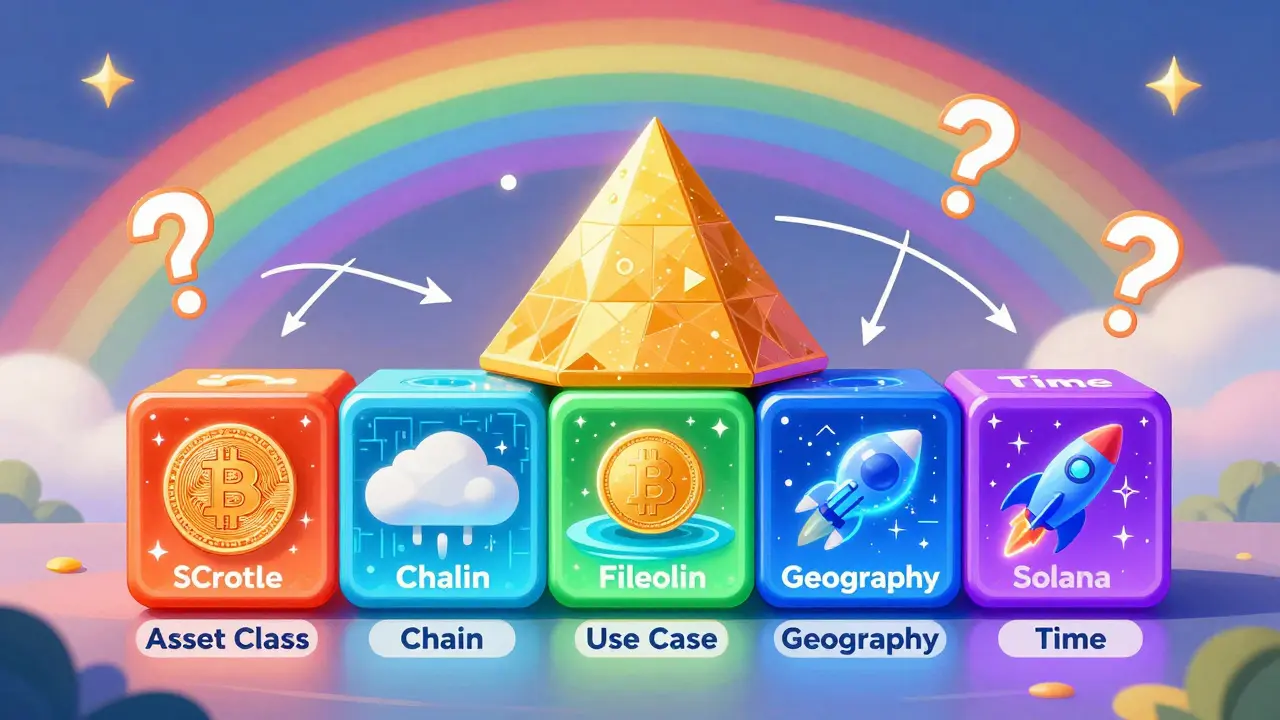
Effective diversification in blockchain breaks down into five key layers:
- Asset class diversification - Holding Bitcoin (store of value), Ethereum (smart contracts), stablecoins (liquidity), and DeFi tokens (yield) instead of just one type.
- Chain diversification - Not all your assets are on Ethereum. Some are on Solana, Polygon, Cosmos, or even Bitcoin Layer-2s like Lightning Network. Each has different security models, fees, and developer activity.
- Use case diversification - Some tokens are for payments (Dogecoin), others for identity (Civic), data storage (Filecoin), or AI-AI integration (SingularityNET). If one sector crashes, others might hold steady.
- Geographic exposure - Blockchain projects based in the U.S., Singapore, Switzerland, and Eastern Europe respond differently to regulation. A ban in one country doesn’t kill your whole portfolio.
- Time-based diversification - You don’t buy everything at once. Dollar-cost averaging across months reduces the chance of buying at a peak.
Here’s what most people miss: diversification works best when assets don’t move together. If Bitcoin goes down and Ethereum goes up, you’re balanced. If they both crash because of the same macro event (like a Fed rate hike), then you’re still exposed. That’s why you need assets with low or negative correlation.
Correlation Is Your Secret Weapon
Not all crypto assets are created equal when it comes to how they react to the market. Bitcoin and Ethereum often move together because they’re the two largest players. But look deeper: Filecoin (decentralized storage) and Chainlink (oracle network) have shown periods where they moved independently-even in the same bear market. Why? Because their value isn’t tied to speculation. It’s tied to real utility.
During the 2022-2023 crypto winter, Bitcoin lost 65%. Ethereum lost 68%. But Filecoin only dropped 42%. Why? Because cloud storage demand didn’t vanish. People still needed to store data. Similarly, Arweave, a permanent data storage token, actually gained value during that same period because it offered something Bitcoin and Ethereum couldn’t: permanence.
That’s the magic of diversification. You’re not trying to pick winners. You’re trying to own a mix where some things hold up when others break. It’s insurance, not speculation.
Why More Tokens ≠ Better Diversification
Some investors think owning 50 different coins means they’re diversified. They’re wrong. Owning 50 meme coins is just gambling with more dice. True diversification means crossing categories.
Here’s a real example: A portfolio with 70% Bitcoin, 20% Ethereum, and 10% stablecoins is more resilient than one with 10% each of 10 different Layer-1 tokens. Why? Because Bitcoin and Ethereum have proven liquidity, security, and adoption. The other 10 tokens? Many have no real users, no revenue, and no long-term roadmap.
Studies from the Canadian Institute of Actuaries show that portfolios with 50-60 assets in the same category (like all DeFi tokens) still suffer 80% of the same risks. That’s because they’re all exposed to the same smart contract vulnerabilities, liquidity crunches, and protocol hacks. True diversification means crossing boundaries-like mixing crypto with real-world assets (tokenized real estate or gold) or even non-crypto digital assets (NFTs tied to music rights or IP).
How to Build a Diversified Crypto Portfolio
Start simple. You don’t need to be a quant to build a smart portfolio. Here’s a practical approach:
- Assess your risk tolerance - Are you okay with 50% drops? If not, you need more stable assets.
- Allocate by function - Put 40-50% in Bitcoin (long-term store of value), 20-30% in Ethereum (core ecosystem), 10% in stablecoins (cash buffer), and 10-20% in high-conviction utility tokens (Filecoin, Chainlink, etc.).
- Use a wallet strategy - Keep Bitcoin in a hardware wallet. Keep Ethereum and DeFi tokens in a secure software wallet. Keep stablecoins on a reputable exchange for quick access.
- Rebalance quarterly - If Bitcoin jumps from 40% to 60% of your portfolio, sell 10% and buy more stablecoins or utility tokens. You’re not timing the market-you’re locking in gains and rebalancing risk.
- Add non-crypto exposure - Even 5-10% in tokenized gold or real estate ETFs can act as a shock absorber when crypto tanks.
Don’t chase trends. If a new coin launches and promises 1000% returns, ignore it. Focus on projects with real users, clear tokenomics, and open-source code. Diversification doesn’t mean buying everything-it means buying the right mix.
What Diversification Can’t Do
Let’s be clear: diversification won’t save you from a total market collapse. If governments shut down crypto exchanges globally, or if quantum computing breaks ECDSA encryption overnight, even the most diversified portfolio will suffer. But those are tail risks-extremely rare.
Diversification also won’t protect you from poor choices. If you invest in a token with no team, no audit, and no roadmap, it doesn’t matter how many other assets you own. That one bad bet can still wipe out your gains.
And diversification isn’t a substitute for research. You still need to understand what each asset does, who runs it, and how it makes money. You can’t diversify blindly.

The Future of Diversification in Blockchain
Things are changing fast. AI now helps track correlation between crypto assets in real time. Platforms like CoinMetrics and Kaiko show how Bitcoin reacts to U.S. inflation data versus how Solana reacts to developer activity. That means you can build smarter portfolios than ever before.
ESG factors are also becoming part of diversification. Tokens tied to renewable energy mining (like those on Chia or Algorand) are gaining traction because they’re less vulnerable to regulatory backlash. Meanwhile, tokenized carbon credits and green infrastructure projects are emerging as new asset classes.
And don’t forget: institutional adoption is changing the game. BlackRock, Fidelity, and others are now offering crypto ETFs with built-in diversification. You don’t have to pick coins yourself-you can buy a basket that already balances Bitcoin, Ethereum, and other assets.
For individual investors, this means access to professional-grade diversification tools. You can now use apps like CoinJar or Crypto.com to auto-allocate across 10+ assets with one click. No PhD needed.
Final Thought: Diversify Like a Pro
The best investors in crypto aren’t the ones who bought Bitcoin at $1,000. They’re the ones who held through the crashes, didn’t panic-sell, and kept adding to their portfolio over time. They didn’t chase hype. They built systems.
Diversification is that system. It’s not flashy. It doesn’t make headlines. But it’s what keeps you in the game when everyone else is gone.
If you want to survive the next five years of crypto, don’t look for the next moonshot. Look for balance. Spread your risk. Own different kinds of value. And let time do the heavy lifting.
Can you diversify risk in crypto without owning Bitcoin?
Yes, but it’s riskier. Bitcoin is the most established crypto asset with the lowest correlation to other markets. Without it, you’re relying entirely on altcoins, which are more volatile and more exposed to ecosystem-specific risks like DeFi hacks or exchange failures. A portfolio of only altcoins has historically underperformed compared to one that includes Bitcoin as a core holding.
How many crypto assets should I own for proper diversification?
There’s no magic number. What matters is diversity of function, not quantity. A portfolio with 5 well-chosen assets across different categories (e.g., Bitcoin, Ethereum, a stablecoin, a utility token, and a tokenized real-world asset) is better than one with 20 meme coins. Focus on low correlation between holdings, not the count.
Does diversification protect me from hacks or scams?
Not directly. If you send funds to a scam contract, diversification won’t undo that loss. But it does limit the damage. If one project gets hacked and your tokens in it drop to zero, your other holdings can still grow and offset the loss. It’s about absorbing shocks, not preventing them.
Should I include stablecoins in my diversified portfolio?
Absolutely. Stablecoins act as your portfolio’s shock absorber. During market panic, they preserve value so you can buy more crypto at lower prices. They’re not a growth asset, but they’re essential for managing volatility. Aim for 5-15% of your portfolio in reputable stablecoins like USDC or DAI.
Is geographic diversification still useful in crypto?
Yes. While crypto is global, regulation isn’t. A ban in one country (like China’s past restrictions) can cause panic selling in that region, creating buying opportunities elsewhere. Projects based in jurisdictions with clear, favorable regulations (like Switzerland or Singapore) often have more stable valuations and better access to institutional capital.
How often should I rebalance my crypto portfolio?
Every 3 to 6 months is ideal. More often than that, and you’re trading instead of investing. Less often, and you risk becoming overly exposed to one asset that’s surged. Rebalancing forces you to sell high and buy low-without emotions. Set a calendar reminder and stick to it.
Write a comment