
The Hidden War in Your Wallet
When you send Bitcoin, it’s not as private as you think. Every transaction is recorded forever on a public ledger. Someone, somewhere, can trace where that money came from and where it went. That’s not a bug-it’s how Bitcoin was designed. But over the last decade, a quiet war has been brewing between those who want to keep their finances secret and those who demand to see every move. This isn’t science fiction. It’s happening right now, in real-time, on the blockchain.
How Privacy Tech Got Its Footing
Bitcoin’s pseudo-anonymity didn’t last long. Researchers quickly showed that with enough data, you could link wallet addresses to real people. Did you buy coffee with Bitcoin? Someone could track that purchase back to your name if they had access to the exchange you used. That’s when privacy-focused coins stepped in.
Monero became the gold standard. It hides the sender, the receiver, and even the amount sent. How? Ring signatures mix your transaction with others so it’s impossible to tell which one is yours. Stealth addresses generate a one-time address for every payment, so no one can see where funds are going. RingCT encrypts the transaction value. Together, they make Monero transactions fundamentally untraceable.
Zcash took a different path. It uses zero-knowledge proofs-specifically zk-SNARKs-to prove a transaction is valid without revealing any details. Think of it like a sealed envelope. You can verify the envelope contains money without opening it. Zcash lets users choose between public and private transactions, giving flexibility but also opening a backdoor for regulators.
These aren’t theoretical. Monero processes over 200,000 transactions daily. Zcash has processed more than 10 million private transactions since its launch. They work. And they’re not just for criminals. People in countries with capital controls, oppressive regimes, or unstable banks use them to protect savings from seizure or surveillance.
The Surveillance Side of the Fight
While privacy tech evolved, so did the tools to break it. Companies like Chainalysis, Elliptic, and CipherTrace built entire businesses around tracking crypto. They don’t need to crack encryption. They just need patterns.
Here’s how it works: When you send Bitcoin from an exchange to a wallet, that wallet gets tagged. If that wallet later sends funds to another wallet, and that wallet connects to a known exchange, the whole chain becomes visible. These companies use clustering algorithms to group hundreds of addresses under one entity-like a darknet market or a ransomware operator. They combine this with timing analysis: if two transactions happen within seconds of each other, they’re likely from the same user.
Machine learning now plays a huge role. Models trained on millions of transactions can predict whether a wallet belongs to a mixer, a gambling site, or a terrorist network. In 2023, Chainalysis reported it could trace over 85% of Bitcoin transactions back to real-world identities with moderate confidence. That number keeps rising.
The legal system is catching up. In 2025, the U.S. Department of Justice charged the founders of Samourai Wallet with operating an unlicensed money service business. Why? Because Samourai offered features like CoinJoin (a mixing tool) and post-mix address rotation-exactly the kind of tools that make tracking impossible. The government didn’t accuse them of laundering money. They accused them of building tools that made laundering easier.
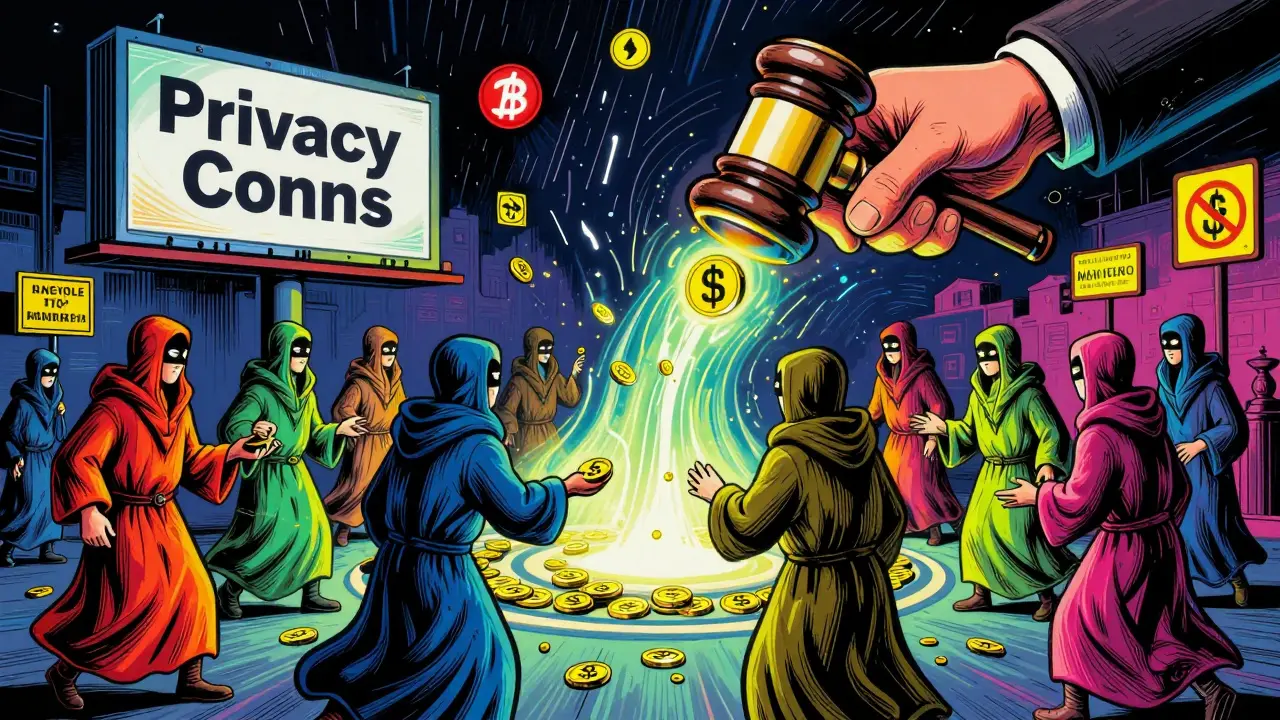
Regulation Isn’t Just a Threat-It’s a Weapon
Exchanges don’t have to be told to delist privacy coins. They do it to survive. In 2024, Binance, Kraken, and Coinbase removed Monero and Zcash from their platforms after receiving formal warnings from U.S. regulators. The message was clear: if you list privacy coins, you risk losing your license.
Some countries went further. China banned all cryptocurrencies in 2021, but specifically targeted privacy coins in 2023, calling them “high-risk financial instruments.” Saudi Arabia and Qatar followed. Russia, which once flirted with crypto as a way to bypass sanctions, now requires all wallets to be registered with the central bank-effectively killing anonymity.
The result? Monero’s market cap dropped from a peak of $5 billion in 2021 to under $800 million in early 2026. Zcash followed a similar path. Meanwhile, Bitcoin and Ethereum grew. Why? Because they’re easier to regulate. You can’t tax what you can’t see-but regulators can tax what they can trace.
Smart Contracts and the Privacy Paradox
It’s not just about coins. Smart contracts are the next battleground. Imagine a company using Ethereum to pay suppliers. They want to hide how much they’re paying each vendor-maybe because they’re negotiating secret deals. But regulators need to know the total value of transactions to prevent tax evasion.
Some teams are building hybrid systems. For example, Tornado Cash-style mixers are now being integrated into DeFi protocols to allow users to anonymize their deposits before lending or staking. But regulators are watching. In 2025, the EU passed rules requiring all DeFi platforms to implement “transaction visibility controls”-meaning they must be able to provide transaction data to authorities upon request.
The conflict here is deeper than technology. It’s about trust. Do you trust banks and governments to protect your data? Or do you trust code and cryptography? The answer determines which side of this war you’re on.

The Philosophical Divide
Edward Snowden once said, “Privacy is not an exception. Privacy is the rule.” That line resonates with millions who see financial privacy as a basic human right-not a loophole for criminals.
But here’s the uncomfortable truth: privacy tools are used for bad things too. Ransomware gangs demand Monero. Darknet markets run on Zcash. Sanctioned entities use coin mixers to bypass global controls. The data doesn’t lie: in 2024, privacy coins accounted for 12% of all illicit crypto transactions, even though they represented less than 1% of total volume.
That’s the paradox. The same tech that protects dissidents in Iran also protects drug traffickers in Mexico. The same feature that lets a whistleblower hide their income also lets a terrorist fund a bomb. There’s no clean line.
What’s Next? Quantum, AI, and the Future of Trust
Quantum computing looms on the horizon. Current cryptography-used by both privacy coins and surveillance tools-could be broken in minutes by a powerful enough quantum machine. That means today’s unbreakable privacy tech might become useless overnight. The race is on to build quantum-resistant algorithms. Monero’s team is already testing lattice-based cryptography. Zcash is exploring post-quantum zk-SNARKs.
AI is accelerating both sides. On the privacy side, AI can generate fake transaction patterns to confuse tracking tools. On the surveillance side, AI can detect anomalies in real-time-like a wallet that suddenly sends tiny amounts to 500 different addresses. That’s a mixer. And AI can flag it in seconds.
Some researchers are exploring alternatives to blockchain entirely. Projects like Obyte use Directed Acyclic Graphs (DAGs) to eliminate miners and validators. No central authority. No public ledger. Just peer-to-peer, censorship-resistant transactions. They’re still experimental, but they represent a radical shift: privacy not as a feature, but as the default.
The Real Question
This isn’t just about crypto. It’s about power. Who controls your money? The state? The bank? Or you?
Right now, the surveillance side is winning. Exchanges comply. Regulators tighten rules. Privacy coins shrink. But the tools still exist. They’re just harder to use. You can’t buy Monero on Coinbase, but you can still trade it on decentralized exchanges. You just need to know where to look.
One thing is certain: this arms race won’t end. Technology will keep evolving. Laws will keep changing. And somewhere, someone will always want to send money without being watched.
And somewhere else, someone will always want to know who sent it.
Can you really trace Monero transactions?
No, not reliably. Monero’s ring signatures, stealth addresses, and RingCT encryption are designed to make tracking impossible. While researchers have tried for years, no one has proven a practical way to trace Monero transactions without access to private keys or compromised nodes. Unlike Bitcoin, Monero’s privacy is built into every transaction by default.
Why did exchanges stop listing privacy coins?
Exchanges delisted privacy coins because regulators threatened to revoke their licenses. The U.S. Financial Crimes Enforcement Network (FinCEN) and the EU’s AMLD6 directive explicitly warned platforms that offering Monero or Zcash could be seen as aiding money laundering. Faced with fines, legal action, or loss of banking access, exchanges chose compliance over user privacy.
Are privacy coins illegal?
No, privacy coins are not illegal in most countries. However, their use is heavily restricted. In the U.S., owning Monero is legal, but using it to evade taxes or launder money is not. Some countries like China and Saudi Arabia have banned them outright. The legality depends on how you use them-not the technology itself.
Can blockchain analysis companies track Zcash shielded transactions?
No, not if the transaction is fully shielded. Zcash allows users to choose between transparent (z-addr) and shielded (t-addr) addresses. Shielded transactions use zk-SNARKs to hide sender, receiver, and amount. While some analytics firms claim they can detect patterns in how shielded funds are moved, they cannot identify the parties involved or the value transferred. The cryptographic proof ensures privacy.
Is there a middle ground between privacy and regulation?
Yes-but it’s still being built. Some projects are experimenting with selective transparency: allowing regulators to view specific transactions under court order without exposing the whole ledger. Others are developing privacy-preserving audit trails where only authorized parties can decrypt transaction details. These are early-stage ideas, but they point to a future where privacy and compliance aren’t opposites-they can coexist.
Write a comment