
Pakistan just gave 2,000 megawatts of electricity to crypto miners. Here’s what’s really going on.
In May 2025, Pakistan announced it would allocate 2,000 MW of surplus electricity to Bitcoin mining and AI data centers. That’s not a small number. It’s more than the entire power output of some countries. And it’s happening in a nation where millions still face blackouts, electricity bills are high, and power plants sit mostly idle.
The move isn’t random. Pakistan has roughly 7,000 MW of unused electricity capacity - mostly from coal plants running at just 15% of their potential. Instead of letting that power go to waste, the government decided to turn it into revenue. At current Bitcoin prices, that 2,000 MW could generate up to 17,000 BTC per year - worth around $1.8 billion. That’s not just a tech experiment. It’s an economic lifeline.
Why is Pakistan doing this?
Pakistan’s economy is under pressure. The country spends 2.8 trillion Pakistani rupees ($10 billion) every year just to keep coal plants running, even when no one’s using the power. That’s money burned on infrastructure that doesn’t earn anything back.
Crypto mining changes that. Bitcoin miners don’t care when the power is cheap - they just need it to be cheap. And Pakistan’s plan offers electricity at 23-24 Pakistani rupees per kWh, or about $0.08. That’s half the price miners pay in Texas and far below the $0.12-$0.15 average in Europe. For mining companies, this isn’t just profitable - it’s a golden ticket.
The government isn’t just handing out power. It’s building a new industry. The Pakistan Crypto Council, formed in March 2025 under Finance Minister Muhammad Aurangzeb and Special Assistant Bilal Bin Saqib, is managing the rollout. They’re working with local telecom firms like PTCL and Multinet, who already run data centers in Lahore, Karachi, and Islamabad. New facilities are popping up, including a 1MW solar-powered center at the University of Turbat.
How does this compare to other countries?
China banned crypto mining in 2021 and sent miners scrambling. The U.S. and Kazakhstan became the new hubs - but they’re crowded, expensive, and regulated. Pakistan is different. It’s not competing for power. It’s using what’s already sitting there.
Other countries with surplus power - like Iran or Venezuela - tried crypto mining before. But they lacked structure. Pakistan is trying to do it right. They’ve created a formal policy framework for digital assets (April 2025), appointed Binance co-founder Changpeng Zhao as a strategic adviser, and even unveiled a government-backed Bitcoin reserve at the Bitcoin 2025 conference.
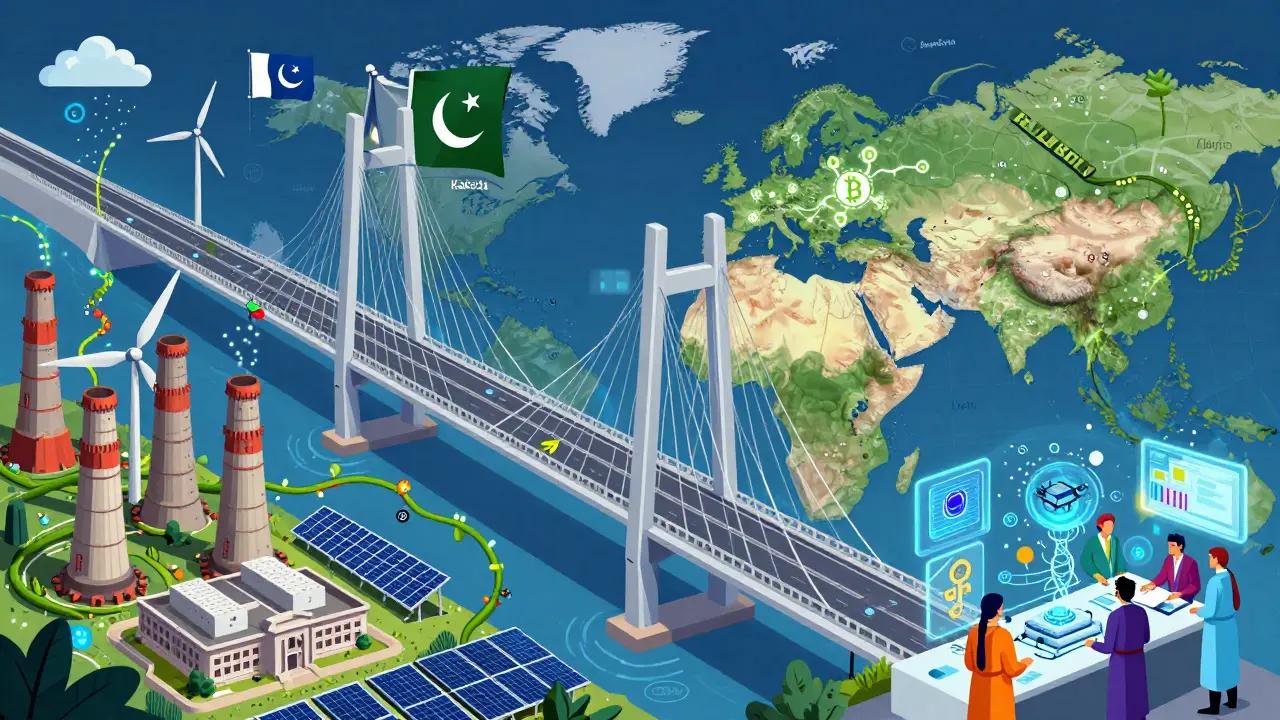
It’s not just about mining. Pakistan sees itself as a future digital bridge between Asia, Europe, and the Middle East. With its location and cheap power, it could become a global hub for AI data centers too - not just Bitcoin.
But the IMF is worried. Why?
Not everyone is cheering. The International Monetary Fund (IMF) is pushing back hard. Their main concern? Subsidies.
When the government gives away electricity at $0.08/kWh, it’s not just helping miners. It’s undercutting everyone else - factories, hospitals, households. The IMF argues this creates an unfair advantage and could destabilize the entire energy grid. They’ve asked: How will Pakistan ever charge market rates later? And what happens when the miners leave?
Pakistan’s Power Division says they’re still in talks with the IMF. Both sides agree the project needs to be sustainable. But the government won’t back down. They’ve already spent billions keeping idle plants alive. Mining is the only way they see to turn that loss into profit.
The IMF’s stance isn’t just about economics - it’s about control. They’ve warned Pakistan before that subsidies without reform lead to bigger deficits. But Pakistan’s leaders believe this time is different. They’re not just handing out money. They’re building infrastructure, creating jobs, and attracting foreign capital.
Who’s actually running these mines?
The government isn’t operating the rigs. They’re licensing companies. International mining firms are already lining up. Some are based in the U.S., others in the UAE and Singapore. They’ll set up large-scale operations near coal plants in Sindh and Punjab, where the surplus power is cheapest and most available.
Local tech firms are getting in too. Vision Telecom and Cybernet are upgrading their data centers to handle mining rigs. Universities are starting courses in blockchain and grid management. The goal? Train 10,000 local engineers by 2027.
It’s not just about electricity. It’s about technology transfer. Miners bring in high-efficiency ASICs, cooling systems, and real-time monitoring software. That knowledge stays in Pakistan - even if the profits go overseas.

What about the environment?
Most of Pakistan’s surplus power comes from coal. That’s a problem. Burning coal to mine Bitcoin isn’t exactly green. But here’s the twist: Pakistan is already planning to pair mining with renewables.
The 1MW solar project at Turbat is just the start. Future phases will integrate wind and hydropower. The government’s long-term goal is to shift mining to renewable sources by 2030. That’s ambitious, but not impossible. Solar costs have dropped 80% since 2015. With foreign investment, Pakistan could become one of the first countries to use crypto mining to accelerate its green transition.
Still, critics point out: Why not use that power for homes and factories first? The answer? Because the money from mining can pay for those upgrades. Every dollar earned from Bitcoin mining can fund grid modernization, battery storage, or solar farms. It’s a trade-off - but one Pakistan believes it can win.
What’s next?
Phase 1 - the 2,000 MW allocation - starts in early 2026. If it works, Phase 2 could double that. Some analysts think Pakistan could eventually host 10,000 MW of mining capacity.
But success depends on three things:
- Getting the IMF to accept the subsidy model - or finding a way to phase it out without scaring off investors.
- Building a stable, modern grid that can handle 2,000 MW of continuous, high-load demand without blackouts.
- Attracting enough international miners to make the project profitable at scale.
If all three happen, Pakistan could become the world’s largest government-backed crypto mining hub. It would be a first. No other country has tried this at this scale.
If any of them fail? The project could collapse - leaving behind idle rigs, broken promises, and a deeper energy crisis.
Is this a good idea?
It’s risky. But it’s also bold. Pakistan isn’t waiting for permission. It’s not asking for handouts. It’s using what it has - wasted power - to build something new.
Other countries with surplus energy - Egypt, Nigeria, Indonesia - are watching closely. If Pakistan succeeds, they’ll copy it. If it fails, they’ll avoid it.
For now, the world is watching. And for the first time, a developing nation is betting its economic future on Bitcoin.
Is crypto mining legal in Pakistan?
Yes. In April 2025, Pakistan launched its first official cryptocurrency policy framework, making it legal to operate mining and digital asset businesses under government licensing. The Pakistan Crypto Council regulates all operations, ensuring compliance with FATF guidelines and anti-money laundering rules.
How much electricity does Bitcoin mining use in Pakistan?
The government has allocated exactly 2,000 megawatts (MW) for crypto mining and AI data centers. This is not the total national usage - it’s a controlled, targeted allocation from surplus capacity. For context, 2,000 MW can power about 1.5 million homes, but miners use power 24/7, making it more efficient for industrial use than residential.
Why is the electricity rate so low for miners?
The rate is set at 23-24 Pakistani rupees per kWh ($0.08) to attract international investment. It’s below market rates to make Pakistan competitive against the U.S., Kazakhstan, and Canada. The government argues this is a temporary incentive to jumpstart an industry that will eventually pay for grid upgrades and create jobs.
Will this cause more blackouts in Pakistan?
No - at least not intentionally. The 2,000 MW comes from surplus capacity that’s already unused. Power plants are running at only 15% capacity. The government is using excess output that would otherwise be wasted. However, grid stability is a concern. If too many miners connect at once, or if infrastructure isn’t upgraded, localized outages could happen. That’s why the rollout is being phased.
How much money will Pakistan make from this?
At current Bitcoin prices, the 2,000 MW allocation could generate up to $1.8 billion in Bitcoin annually. After accounting for operational costs, experts estimate Pakistan could earn $500 million per year in net revenue - from licensing fees, taxes, and foreign investment. That’s more than what the country earns from some major exports.
Is this just a way to launder money?
No. Pakistan’s framework requires all mining operators to register with the Pakistan Crypto Council and comply with FATF’s travel rule. Transactions are monitored, and KYC/AML checks are mandatory. The government is actively working to exit the FATF grey list, so it has strong incentives to prevent abuse. The system is designed to be transparent - not secretive.
What happens if Bitcoin’s price crashes?
The project isn’t built on Bitcoin’s price alone. It’s built on electricity that’s otherwise wasted. Even if Bitcoin drops, the mining rigs can be repurposed for AI computing, cloud services, or blockchain verification. The infrastructure stays useful. Pakistan’s goal isn’t to gamble on crypto - it’s to use crypto as a bridge to a digital economy.
Write a comment