By July 1, 2027, you won’t be able to trade Monero or Zcash on any exchange based in the European Union. It’s not a rumor. It’s not a proposal. It’s the law. The EU has officially banned privacy coins under its new Anti-Money Laundering Regulation (AMLR), and there’s no turning back. This isn’t about cracking down on criminals-it’s about shutting down technology that makes transactions untraceable. And if you hold Monero or Zcash, you need to understand what this means for you.
Why the EU is Banning Privacy Coins
The EU isn’t targeting Monero and Zcash because they’re popular. They’re banning them because they work too well. Monero uses ring signatures and stealth addresses to hide who sent what, to whom, and how much. Zcash uses zero-knowledge proofs to encrypt transaction details entirely. These aren’t flaws-they’re the whole point. But regulators see them as red flags. Under Regulation 2024/1624, the EU says any crypto asset that hides transaction data violates its core rule: all financial activity must be traceable. That’s the same standard applied to banks, wire transfers, and credit cards. Privacy coins break that rule. So, under Article 79 of the new law, any crypto service provider licensed in the EU-exchanges, wallets, custodians-must stop handling them entirely. The European Crypto Initiative confirmed this isn’t open for debate. Even though technical details are still being polished, the ban itself is final. There’s no loophole. No exception. No grandfathering. If it’s a privacy coin, it’s banned from EU-regulated platforms by mid-2027.What This Means for Exchanges and Wallets
Imagine you run a crypto exchange in Germany. You’ve offered Monero since 2020. You’ve got thousands of users trading it weekly. Under the new rules, you have two choices: stop offering Monero and Zcash, or lose your license. No middle ground. The law forces all crypto-asset service providers (CASPs) to verify the identity of anyone sending or receiving over €1,000 in crypto. That’s the same rule that applies to cash deposits over €10,000 in traditional banks. Privacy coins make this impossible. You can’t verify an identity if you can’t see who sent the money or where it went. That’s why major EU-based platforms like Bitpanda, Kraken EU, and Coinbase Europe have already started preparing for the cutoff. They’re removing Monero and Zcash from their trading pairs. They’re updating their compliance software. They’re training staff. They know the deadline is real-and the penalties for non-compliance are steep.Can You Still Own Monero or Zcash After 2027?
Yes. But not easily. The ban doesn’t make it illegal to hold privacy coins. It doesn’t fine you for keeping XMR or ZEC in your personal wallet. What it does is cut off the legal pathways to buy, sell, or trade them within the EU. No EU exchange will list them. No EU bank will let you convert them to euros. No EU wallet app will support them. That means if you want to keep your privacy coins, you’ll need to use non-EU services. You’ll have to use decentralized exchanges like Uniswap or PancakeSwap (if they support them), or peer-to-peer platforms like Bisq or LocalMonero. You’ll need to send funds through wallets that don’t require KYC-like Monero’s official GUI wallet or Zcash’s ZecWallet. This creates a split: legal, regulated crypto inside the EU, and private, unregulated crypto outside it. Your coins won’t vanish. But your ability to move them freely will shrink.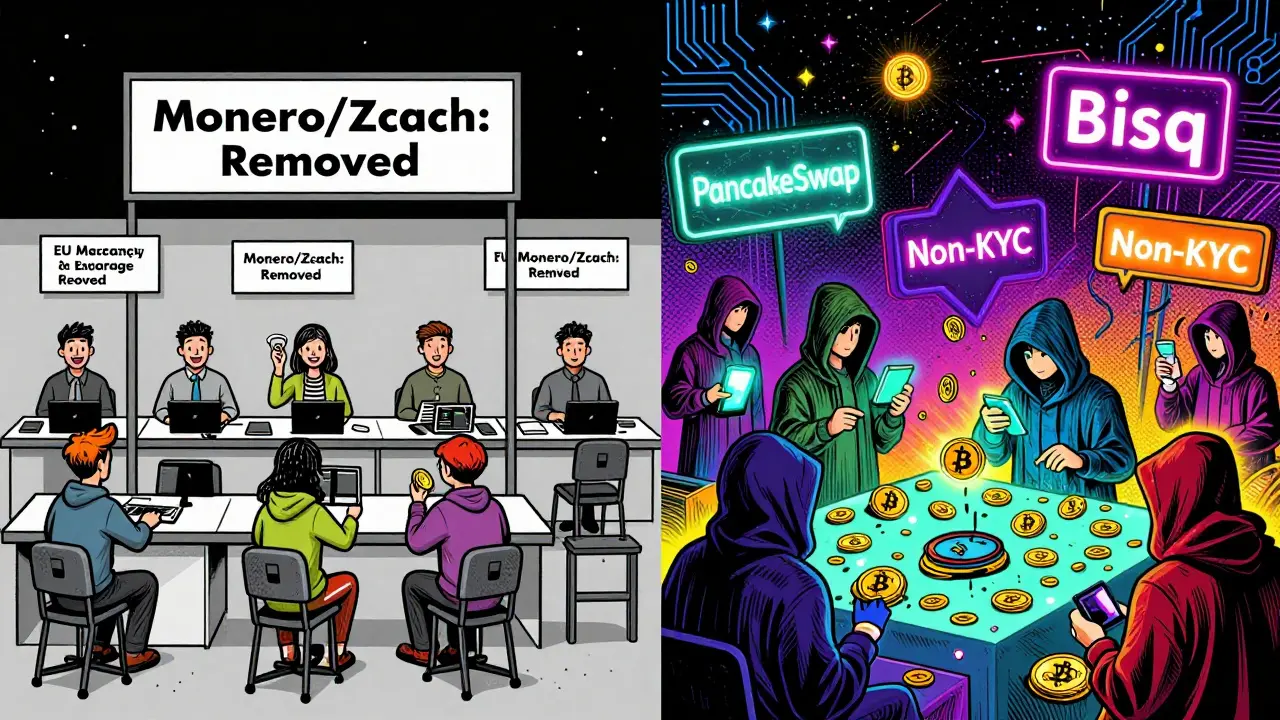
What About Other Privacy Coins?
Monero and Zcash are the biggest names, but they’re not alone. Dash, Verge, and Pirate Chain are also caught in the net. The regulation doesn’t name specific coins-it bans any asset designed to obscure transaction data. So if a new privacy coin pops up after 2027, it’ll be blocked the moment it tries to connect to an EU-regulated service. Even coins that offer optional privacy-like Bitcoin with CoinJoin mixers-are under scrutiny. Regulators aren’t banning them yet, but they’re watching. The EU’s goal is to eliminate anonymity, not just the most obvious examples.How Will the Ban Be Enforced?
The EU isn’t sending police to your home to check your wallet. Enforcement will happen at the institutional level. A new agency called AMLA (Anti-Money Laundering Authority) will oversee the largest crypto firms-those serving more than 10,000 customers or handling over €50 million in transactions. These firms will be required to report any attempt to process privacy coin transactions. If they fail, they face fines up to 5% of their global revenue or €10 million-whichever is higher. Smaller platforms will be monitored too, but with less intensity. The system is tiered: big players get the most scrutiny. But even small exchanges can’t afford to ignore the rules. One violation could cost them their license. The European Banking Authority is still writing the fine print-how exactly to detect shielded transactions, how to audit decentralized protocols, what counts as “reasonable effort” to block privacy coins. But the direction is clear: no anonymity, no exceptions.
What’s the Global Impact?
The EU isn’t acting alone. The U.S., UK, Canada, and Australia have all signaled they’re watching closely. The EU’s approach is the most comprehensive so far-banning privacy coins at the service provider level, not just restricting them. If this works, other countries will copy it. If it causes market chaos, they’ll hesitate. But the precedent is set: financial privacy is now seen as a risk, not a right, in the eyes of major regulators. For privacy coin developers, this is a wake-up call. The future of these coins may lie in non-EU jurisdictions-Switzerland, Singapore, or even decentralized networks that operate outside national control. But for users in Europe, the window for easy access is closing.What Should You Do Now?
If you own Monero or Zcash and live in the EU:- Don’t panic. Your coins aren’t being seized.
- Don’t wait until 2027. Start planning now.
- If you want to keep them, move them to a non-EU wallet or decentralized exchange.
- If you want to cash out, do it before mid-2027 while EU exchanges still support them.
- Don’t try to hide your coins. Regulators aren’t hunting individuals-but they’re tracking large transfers.
Is This the End of Privacy Coins?
No. But it’s the end of their easy access in the world’s largest regulated market. Privacy coins aren’t going away. They’re just being pushed underground-literally. They’ll still trade on peer-to-peer networks, in darknet markets, and on exchanges based in places like Malta, Gibraltar, or Hong Kong. But for the average EU citizen, the convenience of buying Monero on Coinbase or trading Zcash on Binance EU is over. The EU believes this will make the financial system safer. Privacy advocates say it’s a step toward surveillance capitalism. Both sides have a point. But the law doesn’t care about opinions. It cares about compliance. By 2027, Monero and Zcash won’t be banned in the world. But they’ll be banned from the EU’s financial system. And for millions of Europeans, that’s the same thing.Will I get fined for holding Monero or Zcash after 2027?
No. The EU ban targets service providers-not individual holders. You won’t be fined for owning privacy coins in your personal wallet. But you won’t be able to trade them on any EU-regulated exchange or platform after July 1, 2027. If you try to convert them to euros through a bank or licensed crypto service, they’ll refuse.
Can I still use Monero or Zcash on decentralized exchanges after 2027?
Yes, but with risks. Decentralized exchanges like Uniswap or PancakeSwap aren’t regulated by the EU, so they’re not legally required to block privacy coins. However, if you connect a wallet linked to your identity (like one tied to a KYC’d exchange), you could still be flagged. Use non-KYC wallets like Monero’s official GUI or ZecWallet, and avoid linking your real identity to transactions.
What happens to my Monero if I use a EU-based wallet after 2027?
Your wallet won’t disappear, but it will stop working for trading or converting your coins. Most EU-based wallets will remove privacy coin support by mid-2027. You’ll still be able to see your balance, but you won’t be able to send or receive Monero or Zcash through that app. You’ll need to switch to a non-EU wallet to keep transacting.
Is there a chance the ban will be delayed or reversed?
No. The core ban on privacy coins is written into Regulation 2024/1624, which was adopted by the European Parliament in May 2024. While some technical details are still being finalized, the prohibition itself is locked in. Even the European Crypto Initiative says the framework is final. Any delays will be logistical-not legal.
How does this affect Bitcoin?
Bitcoin is unaffected because its transactions are public and traceable. Every Bitcoin transaction is recorded on a global ledger. Regulators can track where coins move, even if they’re mixed. Privacy coins, by contrast, are designed to hide this information. That’s why Bitcoin is allowed-and Monero isn’t.
Can I move my privacy coins to a non-EU country before 2027?
Yes, and many people are doing it. You can transfer your Monero or Zcash to a wallet hosted outside the EU-like in Switzerland, Singapore, or even a hardware wallet stored in a non-EU jurisdiction. As long as you don’t use an EU-regulated service to trade or cash out, you’re not breaking any rules. Just make sure your transfer method doesn’t involve an EU-based intermediary.
Write a comment