
Before EIP-1559, paying for Ethereum transactions felt like bidding in an auction you didn’t understand. You’d set a gas fee, hope it was high enough, and watch as your transaction sat stuck for hours-or got rejected outright. Some users paid twice what they needed. Others missed out entirely. Then, in August 2021, Ethereum’s London hard fork changed everything. EIP-1559 didn’t just tweak the fee system-it rebuilt it from the ground up. At its core was one radical idea: burn part of every transaction fee. No more giving it to miners. No more hoarding it. Just erase it. And that simple act started shifting Ethereum’s entire economic foundation.
How EIP-1559 Changed the Fee Game
EIP-1559 introduced two fees instead of one. The first is the base fee. It’s not set by users. It’s not set by miners. It’s calculated automatically by the network based on how full the last block was. If the block was over 50% full, the base fee goes up. If it was under, it drops. The adjustment is capped at 12.5% per block, so prices don’t spike out of control. This makes fees predictable. Wallets can now show you exactly what you’ll pay before you confirm.The second fee is the priority fee, or tip. This is what you add on top to convince miners to prioritize your transaction. It’s optional, but useful during busy times. Think of it like a tip for a delivery driver who’s swamped. You don’t have to give it, but if you want your pizza fast, you do.
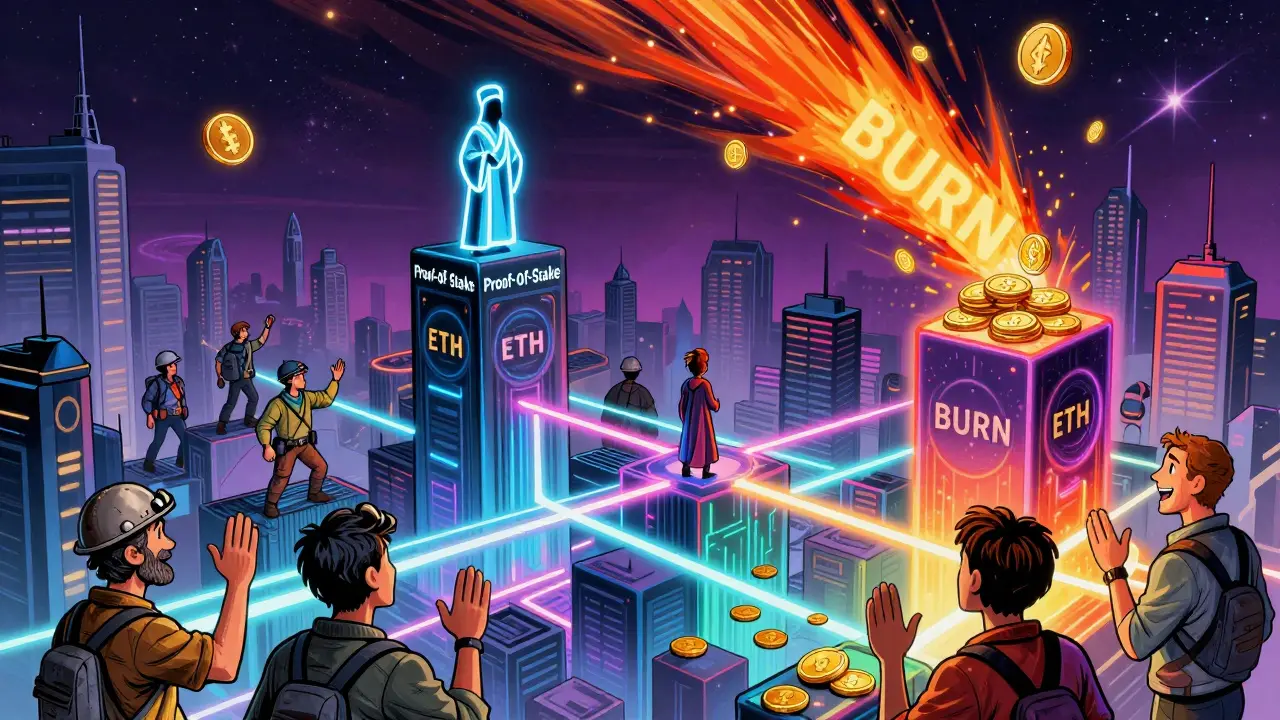
Here’s the key part: the base fee gets burned. It’s permanently removed from circulation. The priority fee? That still goes to miners. So miners still get paid, but they no longer control the main source of fee revenue. That’s a massive shift. Before EIP-1559, miners made money every time someone sent ETH. Now, their income is mostly from block rewards-and even those are shrinking as Ethereum moves fully to proof-of-stake.
What Does ‘Burning’ Actually Mean?
Burning isn’t magic. It’s math. When you send a transaction, your wallet sends a max fee (what you’re willing to pay) and a max priority fee (your tip). The network calculates the actual base fee from the last block. Then it does this:- Base fee is taken out and destroyed.
- Priority fee (up to your max tip) goes to the miner.
- Any leftover ETH? Refunded to you.
For example: if the base fee is 100 gwei and you set a max fee of 150 gwei with a max tip of 10 gwei, you’ll pay 110 gwei total. 100 gwei burns. 10 gwei goes to the miner. The other 40 gwei? Back in your wallet. No one keeps it. No one hoards it. It’s gone.
This burning happens on every single transaction. And it adds up. According to data from Blocknative and Etherscan, over 2.5 million ETH was burned in the first 18 months after EIP-1559 launched. That’s more than $8 billion at the time. Since then, burn rates have fluctuated with network usage, but the trend holds: during high-demand periods like NFT mints or DeFi surges, thousands of ETH vanish daily.
Why Burning ETH Matters
Ethereum’s total supply used to grow slowly. New ETH was minted as block rewards. EIP-1559 flipped that. Now, ETH is being destroyed faster than it’s created-when the network is busy enough.Let’s say 10,000 ETH are issued daily as staking rewards. If 12,000 ETH are burned in fees, Ethereum’s supply drops by 2,000 ETH that day. That’s deflation. And it’s not theoretical. In 2022, Ethereum went deflationary for over 200 consecutive days. Even today, during peak usage, the network burns more ETH than it creates. This makes ETH unique among major cryptocurrencies. Bitcoin’s supply is capped at 21 million. Ethereum’s supply is dynamic-but it’s trending downward.
This isn’t just a side effect. It’s a feature. EIP-1559 turned Ethereum into a monetary asset with built-in scarcity. When demand grows, ETH becomes scarcer. That’s not a bug-it’s a design choice. And it’s why many investors now see ETH as a store of value, not just a utility token.
What About Miners?
When EIP-1559 launched, miners were worried. And they had a point. Before, they got all the fees. Now, they get only the tip. That’s a fraction of what they used to earn. In 2021, transaction fees made up nearly 30% of miner revenue. By 2023, that number dropped below 5%.Some argued this would hurt Ethereum’s security. After all, miners need incentives to keep the network running. But Ethereum had already started transitioning to proof-of-stake. Miners were being replaced by validators. So the loss of fee revenue wasn’t a crisis-it was a transition. By the time the Merge happened in September 2022, mining was already dead. Validators now earn rewards from staking, not fees. And the burning mechanism? It still works. The base fee burns regardless of consensus.
So miners didn’t lose out-they were phased out. And the network got stronger.
Real-World Impact: Wallets, Users, and DeFi
For everyday users, EIP-1559 was a game-changer. Before, you had to guess the right gas price. Now, MetaMask, Trust Wallet, and others show you an estimated fee based on the last block’s base fee. No more frantic manual adjustments. No more overpaying by 500%.DeFi protocols saw immediate improvements. Uniswap reported a 29% drop in failed transactions because users stopped setting too-low fees. Liquity’s data showed transaction success rates jumped by 18% in the six months after launch. Reddit users in r/ethereum started posting fewer “why is my transaction stuck?” questions. Consensys found user support tickets about gas fees dropped by 37% in a year.
Even tax agencies took notice. The IRS issued guidance in 2023: burning ETH is not a taxable event. You don’t owe capital gains on ETH that disappears. That’s huge. It means users don’t need to track every burn. It’s treated like a fee, not a sale.

How EIP-1559 Influenced Other Chains
EIP-1559 didn’t stay on Ethereum. It became a blueprint. Polygon adopted a version called EIP-1559++, which burns fees but also allocates a portion to a treasury. BNB Chain followed suit. Solana, while not using the exact model, now burns a portion of transaction fees to stabilize its economy. Even new chains like Arbitrum and Optimism built their fee systems around burning.Why? Because it works. It makes fees predictable. It reduces user friction. And it introduces scarcity. These are things every blockchain wants. EIP-1559 proved you could fix a broken fee market without breaking the network.
What’s Next? EIP-4844 and Beyond
EIP-1559 isn’t the end. It’s the foundation. The next big upgrade, EIP-4844 (Proto-Danksharding), will introduce blob transactions-cheap data storage for Layer 2 rollups. These will have their own fee market, separate from regular ETH transfers. But here’s the twist: EIP-4844 will still burn the base fee. The mechanism stays.As more activity moves to Layer 2s like zkSync and StarkNet, Ethereum mainnet may see fewer transactions. But the burning? It’ll keep going. Even if mainnet usage drops, the value of ETH could rise because the supply is shrinking. That’s the quiet power of EIP-1559.
Some researchers are now asking: should the base fee adjustment be faster during extreme congestion? Right now, it takes 20 blocks (about 5 minutes) to double the fee. Could it be 10? 5? The community is debating it. But the core idea remains: burn the base fee. Keep the system fair. Make ETH scarcer.
Final Thoughts: A Quiet Revolution
EIP-1559 didn’t make headlines like the Merge. No one threw a party. But it changed Ethereum more than most upgrades. It turned a chaotic, unpredictable fee system into something smooth and reliable. It made ETH deflationary under normal conditions. It gave users control back. And it forced the entire industry to rethink how fees should work.Today, when you send ETH, you don’t think about auctions or gas wars. You just click ‘confirm’. The network handles the rest. That’s the real win. Not the numbers burned. Not the math. But the silence. The calm. The fact that you don’t have to worry anymore.
Is EIP-1559 still active after the Merge?
Yes. EIP-1559 continues to operate exactly as before. The Merge replaced mining with proof-of-stake, but it didn’t change the fee burning mechanism. The base fee is still calculated and burned on every transaction. Miners are gone, but the burn remains. Validators still receive the priority fee (tip), and the base fee still disappears from circulation.
Does burning ETH make it more valuable?
It can. Burning reduces the total supply of ETH. If demand stays steady or grows while supply shrinks, price pressure tends to rise. This isn’t guaranteed-market sentiment, macro trends, and adoption matter too. But since EIP-1559, ETH has gone deflationary multiple times, especially during high-activity periods like NFT launches or DeFi spikes. Over time, this scarcity could make ETH a stronger store of value.
Can I see how much ETH is being burned?
Yes. Websites like ethereumprice.org/eth-burn and Etherscan track real-time burn rates. You can see how many ETH were burned in the last hour, day, or since EIP-1559 launched. As of early 2026, over 4.8 million ETH have been burned since August 2021. That’s roughly 4% of ETH’s original supply.
Do I need to do anything differently to use EIP-1559?
No. If you’re using a modern wallet like MetaMask, Trust Wallet, or Coinbase Wallet, EIP-1559 is already handled for you. Your wallet automatically sets the max fee and max priority fee based on network conditions. You just see one estimated fee and click confirm. You don’t need to understand base fees or tips. The system works in the background.
Why doesn’t Bitcoin burn fees like Ethereum?
Bitcoin’s design is intentionally different. Its block reward halves every four years, and transaction fees are meant to eventually replace it as miners’ main income. Burning fees would remove that future incentive. Ethereum chose a different path: use fees to create scarcity, not to sustain miners. Bitcoin prioritizes miner revenue stability. Ethereum prioritizes monetary policy and user experience.
Write a comment