Crypto Exchange Availability Checker
Exchange Availability in
Major Exchanges
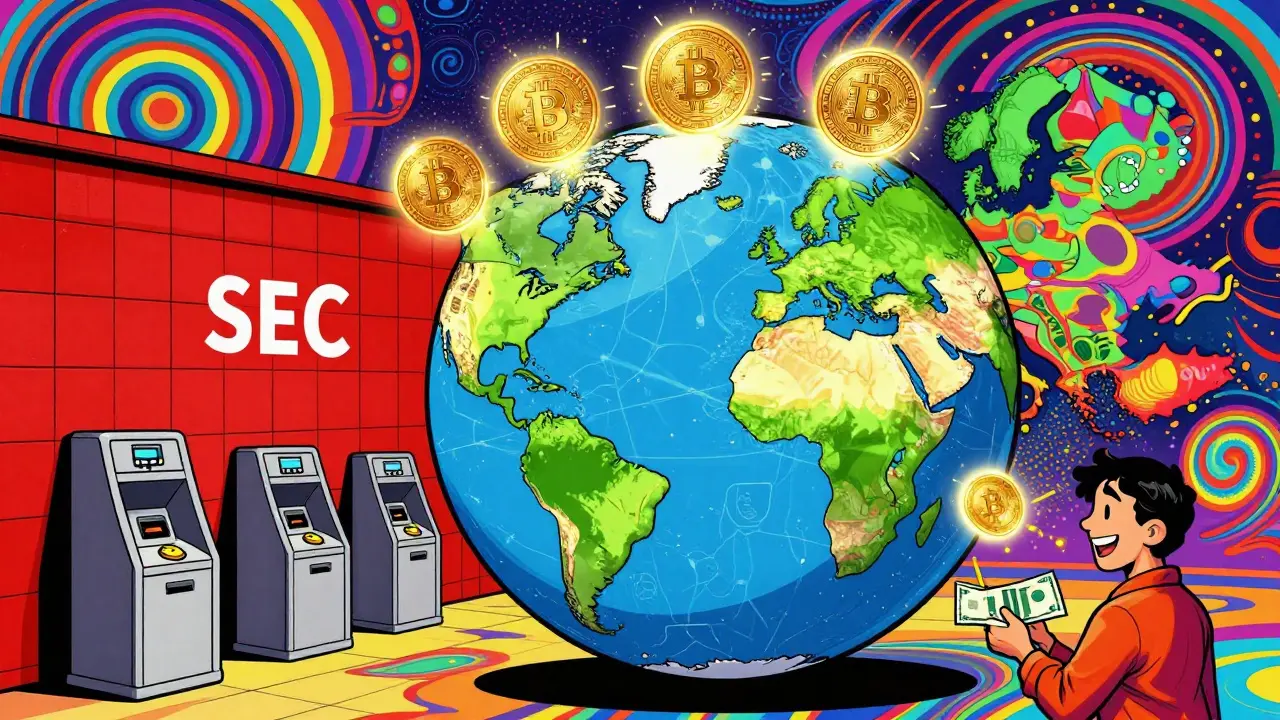
Not all crypto exchanges work everywhere. If you're traveling, moving countries, or just trying to buy Bitcoin, you might hit a wall - not because of your internet, but because of the law. In some places, you can trade any coin you want. In others, even popular platforms like Binance are completely blocked. This isn't about tech limits. It's about crypto exchange availability - and it changes depending on where you live.
Why Some Exchanges Don't Work in Your Country
Crypto exchanges don't pick regions randomly. They follow rules - or get punished. In the U.S., the SEC, DOJ, and Treasury Department treat crypto like a minefield. Binance paid $4 billion in 2023 to settle charges it failed to stop money laundering and didn't protect users from theft. Its founder pleaded guilty. As a result, Binance fully exited the U.S. market and launched Binance.US, a separate platform with fewer coins and stricter rules. You can't use the global Binance site from America - and if you try, you'll get blocked. Other countries take similar steps. South Korea requires exchanges to register with financial regulators and prove they have anti-money laundering systems. Japan demands licenses from its Financial Services Agency. If an exchange doesn't meet those standards, it can't legally operate there. That’s why you’ll find Binance.KR, a local version with only approved coins, instead of the full global platform. In places with weak or unclear rules, exchanges often avoid the market entirely. Why risk fines or shutdowns if the legal path is muddy? That’s why you won’t find major exchanges in many African or Latin American countries - not because people don’t want to trade, but because the platforms won’t risk operating without clear regulations.Where Crypto Exchanges Are Widely Available
Some regions are crypto-friendly by design. Eastern Europe leads the pack. Ukraine tops the 2025 Global Crypto Adoption Index - not just because of war, but because its government quietly embraced crypto as a financial alternative. Banks are unreliable, inflation is high, and remittances from abroad are critical. Crypto fills the gap. Exchanges like Binance, Bybit, and KuCoin operate openly there, with local payment options and even tax clarity. Moldova and Georgia follow closely. Both have low barriers to entry for crypto businesses. They don’t ban crypto - they regulate it lightly. That’s why you’ll see more crypto ATMs and local exchange offices in Tbilisi or Chișinău than in many Western capitals. Asia has mixed results. Hong Kong and Singapore have clear, pro-crypto rules. Exchanges set up offices there because they know exactly what’s allowed. Vietnam and South Korea have massive retail adoption, but strict KYC rules. You can trade, but you need government-issued ID and local bank accounts. Meanwhile, China banned crypto exchanges entirely in 2021. Even using foreign platforms is technically illegal - though many still do, using VPNs and peer-to-peer markets.Where Crypto Exchanges Are Blocked or Restricted
The U.S. isn’t the only place with heavy restrictions. Nigeria banned banks from processing crypto transactions in 2021, forcing users into P2P platforms like Paxful and LocalBitcoins. While not illegal to hold crypto, the banking blockade makes buying and selling harder. India slapped a 30% tax on crypto gains in 2022, which didn’t ban trading but scared off many exchanges. Most global platforms left or scaled back operations. Russia is a special case. After sanctions hit in 2022, Russians turned to crypto to move money abroad. The government didn’t ban it - it tried to control it. In 2023, Russia passed a law requiring all crypto transactions to go through state-approved exchanges. That meant Binance, Kraken, and Coinbase couldn’t operate unless they partnered with Russian state banks - which they refused to do. So Russians use OTC desks, peer-to-peer apps, or offshore platforms - often with higher fees and more risk. Even in the EU, things get messy. Germany requires exchanges to register with BaFin, France demands AML compliance, and the Netherlands has strict reporting rules. Exchanges like Bitstamp and Kraken operate across the bloc, but they must tailor services per country. You can’t just sign up for the same account everywhere - your country of residence determines what coins you can trade and how you deposit money.
Market Leaders and Regional Versions
Binance still controls nearly 40% of global trading volume, but it doesn’t operate as one platform anymore. It runs at least six regional versions: Binance.com (global), Binance.US (U.S.), Binance TR (Turkey), Binance.KR (South Korea), Binance.ae (UAE), and Binance SG (Singapore). Each has different coin lists, payment methods, and compliance rules. If you’re in Turkey, you can trade Turkish Lira pairs. In the U.S., you can’t trade tokens the SEC considers securities. Gate.io, the second-largest exchange, grew 14.4% month-over-month in 2025, partly because it filled gaps left by Binance’s retreat. It’s available in more countries than most, but still avoids the U.S., Canada, and Australia due to regulatory pressure. Bitget and MEXC follow similar patterns - broad global access, but with clear exclusions. This fragmentation isn’t a bug - it’s a survival tactic. Exchanges that try to be everywhere end up getting shut down. Those that adapt regionally survive. That’s why you’ll find local exchanges thriving in places like Nigeria (Naira-based platforms), Brazil (Binance Brasil), and India (ZebPay, CoinSwitch). They know local laws, local banks, and local user needs.Spot Trading Dominates - But Not Everywhere
Spot trading - buying and selling crypto directly - makes up 61.3% of global exchange volume in 2025. Why? Because it’s simple. You don’t need to understand leverage, futures, or margin. You just buy Bitcoin with your local currency and hold it. That’s why spot platforms are the most widely available globally. Derivatives trading - betting on price swings without owning the coin - is popular in places like South Korea and Singapore. But in the U.S., the SEC has cracked down hard on derivatives. Most exchanges removed them entirely. That’s why Binance.US offers only spot trading. If you want to trade futures, you have to use a non-U.S. platform - which may not be legal for you to access. This split affects what you can do. In Ukraine, you can buy Bitcoin with a bank transfer and sell it for hryvnia the same day. In the U.S., you might need to wait days for a bank wire, and you can’t trade certain altcoins at all. Your experience isn’t just about preference - it’s about location.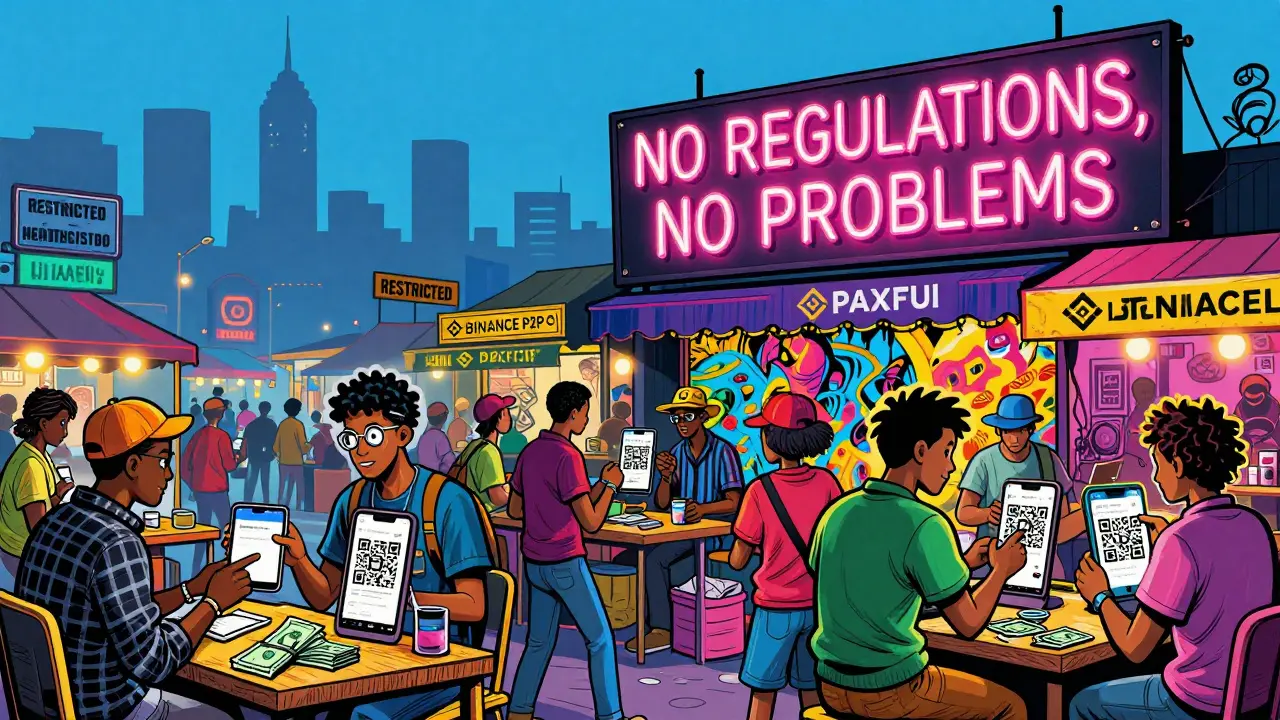
What This Means for You
If you’re moving countries, check your new region’s rules before you bring your crypto portfolio. Your Binance account from Germany won’t work in the U.S. Your Coinbase account from Canada won’t let you trade in Nigeria. You might need to create a new account, verify your identity again, and start from scratch. If you’re in a country with limited exchange options, peer-to-peer (P2P) platforms like Paxful, LocalBitcoins, or Binance P2P are your lifeline. You trade directly with other people using cash, bank transfers, or mobile money. It’s slower, riskier, and often more expensive - but it’s often the only way. Don’t assume global platforms work everywhere. Even if you see a logo like Binance or Kraken, it might be a different legal entity with different rules. Always check the website’s footer - it’ll say which jurisdiction it operates under. If it says "Binance.US" or "Binance TR," you’re on the local version. The global site won’t let you log in from restricted regions.What’s Next for Global Crypto Access
The global crypto exchange market is expected to hit $122.63 billion by 2032. But growth won’t be even. Countries with clear rules - like the UAE, Singapore, and Switzerland - will attract more exchanges. Places with bans or confusion - like the U.S., India, and Nigeria - will see slower adoption or rely on informal networks. Decentralized exchanges (DEXs) like Uniswap and PancakeSwap are growing fast because they don’t need licenses. You trade directly from your wallet. No KYC. No regional blocks. But they’re harder to use, lack customer support, and don’t let you buy crypto with a credit card. They’re a workaround, not a solution. The future of crypto access isn’t about better apps. It’s about better laws. Until governments stop treating crypto as a threat and start treating it as a financial tool, availability will stay patchy. Until then, your location still decides what you can trade - and how.Can I use Binance if I live in the United States?
No. Binance.com is blocked for U.S. users. You can only use Binance.US, which is a separate platform with fewer coins, stricter rules, and no access to derivatives or certain altcoins. Trying to use the global site from the U.S. will result in your account being locked or frozen.
Which countries have the most crypto exchange options?
Ukraine, Moldova, Georgia, Singapore, Hong Kong, and the UAE lead in exchange availability. These regions have clear, supportive regulations that attract global platforms. Exchanges operate openly there with full coin lists, local payment options, and customer support.
Why can’t I trade certain coins in my country?
Regulators classify some tokens as securities - like stocks - and ban their trading. The U.S. SEC, for example, considers many altcoins securities, so exchanges remove them to stay compliant. Even if the coin is popular globally, your local exchange might not offer it because of legal risk.
Is it legal to use a VPN to access a crypto exchange?
It’s technically possible, but legally risky. Many exchanges block VPN traffic and may freeze accounts if they detect it. In countries like China or Russia, using a VPN to access crypto platforms violates local laws and could lead to fines or legal action. Even in the U.S., bypassing regional restrictions may violate terms of service and expose you to tax or compliance issues.
What’s the safest way to trade crypto in a restricted country?
Use peer-to-peer (P2P) platforms like Binance P2P, Paxful, or LocalBitcoins. These let you trade directly with others using local payment methods like bank transfers or mobile money. While slower and less liquid, they avoid the need for a licensed exchange. Always use escrow services and never send money before receiving crypto.
Write a comment