
When you stake your crypto on a proof-of-stake blockchain, you're not just earning rewards-you're also taking on responsibility. And if you mess up, you can get slashed. That means losing part, or even all, of the tokens you put up as collateral. It’s not a rumor. It’s not a scare tactic. It’s built into the code. And it happens more often than most new stakers realize.
Slashing isn’t punishment for being bad. It’s a security feature. It exists because blockchains like Ethereum, Cosmos, and Polkadot need to stop bad actors from breaking the rules. If someone tries to double-sign a block or goes offline for too long, the network automatically takes away a chunk of their stake. This isn’t optional. It’s how the system stays secure.
What Exactly Is Slashing?
Slashing is an automated penalty triggered when a validator violates the rules of the consensus protocol. Validators are nodes that propose and attest to new blocks. To become one, you lock up (or "stake") a certain amount of tokens-like 32 ETH on Ethereum. In return, you earn rewards for doing your job correctly. But if you fail, you lose part of that stake. That’s slashing.
The concept was first used in Tendermint (2014) and became mainstream with Cosmos in 2019. Ethereum adopted it after the Merge in September 2022. Now, over 90% of new PoS networks include some form of slashing. The goal? Make it too expensive to cheat. If attacking the network costs more than you’d gain, no one tries.
Two Main Ways Validators Get Slashed
There are two types of violations that trigger slashing: safety and liveness. One is a serious crime. The other is more like a traffic ticket.
- Safety violations - These happen when a validator does something that breaks the consensus rules permanently. The most common is double-signing: proposing or attesting to two different blocks at the same height. This could let an attacker create a fork. It’s like trying to cash two checks from the same account. The network treats this as malicious intent. Penalties are severe. On Ethereum, you lose at least 1 ETH, plus more if other validators are slashed around the same time. Cosmos goes further: double-signing gets you tombstoned-permanently banned from validating again.
- Liveness violations - These occur when a validator goes offline or misses too many attestations. It’s not cheating-it’s just not doing your job. On Ethereum, you need to submit an attestation at least once every 17.4 hours (128 epochs). Miss that too often, and you start losing rewards. Keep missing, and you enter an "inactivity leak," where your stake slowly drains over weeks. Cosmos uses a 10,000-block threshold before penalties kick in. Polkadot starts at 0.1% for minor downtime.
The Most Common Causes of Slashing
Most slashings aren’t caused by hackers. They’re caused by humans.
- Configuration errors - 34% of all slashing incidents come from wrong settings. Running the wrong version of a client, misconfiguring ports, or mixing up execution and consensus clients can trigger double-signing. One validator lost 1.2 ETH because they didn’t update their validator client after a hard fork.
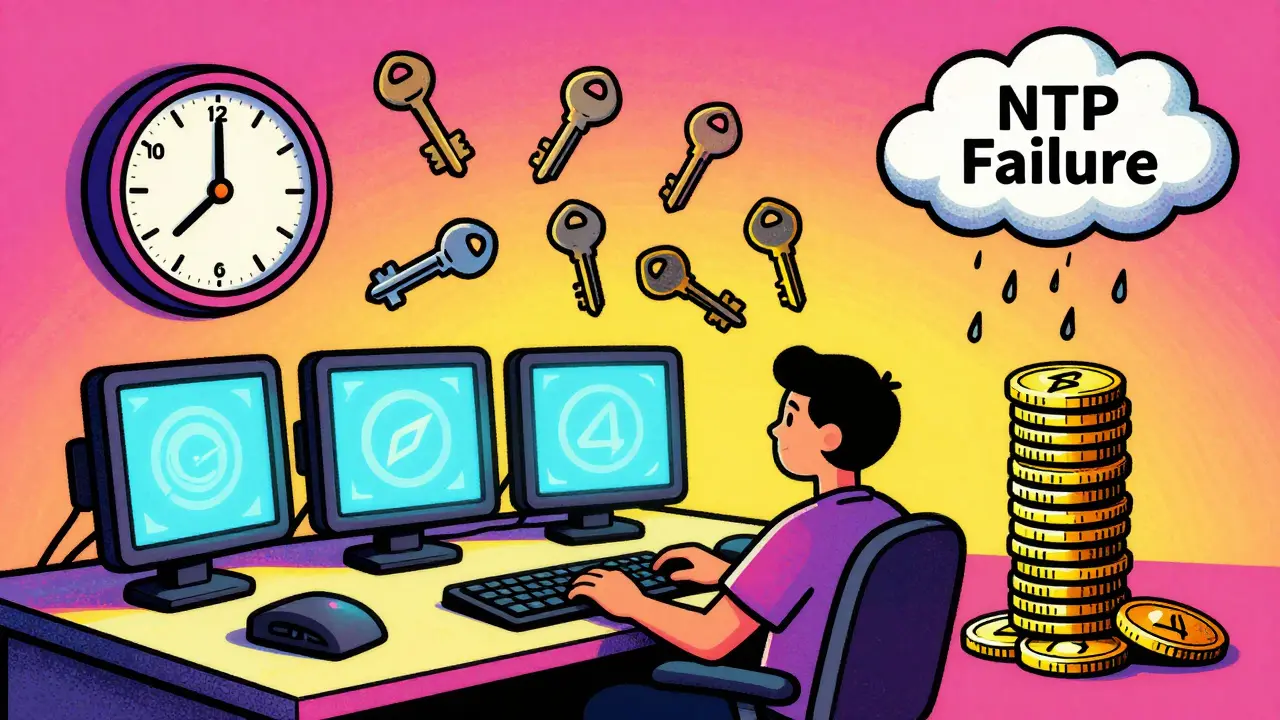
- Time sync issues - Validators rely on precise timestamps. If your server’s clock is off by even a few seconds, your attestations might be rejected or duplicated. A validator named "StakeHound" lost 3.5 ETH because their NTP server failed during a power outage.
- Key management mistakes - If you accidentally use the same signing key on two different machines, you’re asking for trouble. This is how double-signing happens unintentionally. One operator lost 2.3 ETH because they copied their validator keys to a backup machine without disabling the original.
- Client bugs - Even the best setups can break. In April 2022, a bug in the Lighthouse consensus client caused 275 validators to slash each other simultaneously. Over 1,000 ETH was lost. That’s not user error-that’s a software flaw.
- Infrastructure outages - If your VPS crashes, your internet cuts out, or your power goes down, you’re offline. Cosmos validators who set up redundant nodes avoided slashing entirely during an ISP outage by switching to a backup.
How Slashing Compares Across Networks
Not all blockchains slash the same way.
| Network | Double-Signing Penalty | Downtime Penalty | Special Features |
|---|---|---|---|
| Ethereum | Minimum 1 ETH + up to 100% of stake | Starts at 0.5 ETH per epoch after 128 missed attestations | Dynamic penalties increase if many validators are slashed at once |
| Cosmos Hub | 5% of stake + tombstoning (permanent ban) | 0.01% after 10,000 missed blocks | Tombstoning removes validator forever |
| Polkadot | 0.1% to 30% depending on severity | 0.1% for minor downtime | Collective slashing penalizes entire groups during widespread outages |
| ZetaChain | 5% + removal after 3 violations | 1% per downtime event | Hybrid model with clear thresholds |
Ethereum’s system is the most complex. Penalties scale based on how many others are being slashed. That’s designed to stop coordinated attacks. But it also means you can lose more than expected. Cosmos is simpler: double-sign, and you’re out for good. Polkadot’s collective slashing can hurt honest validators during a regional outage. ZetaChain tries to strike a middle ground.
Real-World Slashing Stats
As of November 2023, Ethereum had recorded 1,428 slashing incidents affecting 1,872 validators. The average loss was 1.85 ETH per incident-around $3,330 at the time.
- 68.2% of slashings were due to double-signing
- 27.4% came from inactivity leaks (missing attestations)
- Only 4.4% were from configuration errors
Wait-that last one seems low. But that’s misleading. Most configuration errors lead to double-signing or missed attestations. The real problem? Operators don’t know they’re at risk until it’s too late.
Stakin’s 2023 report found that 78% of slashing incidents were preventable. That means nearly four out of five validators lost money because they didn’t follow basic rules.
How to Avoid Getting Slashed
You can’t eliminate risk entirely. But you can cut it by 90%.
- Use monitoring tools - Set up alerts for downtime, client crashes, and clock drift. Use services like Blockchair, Beaconcha.in, or custom scripts with Telegram or SMS notifications.
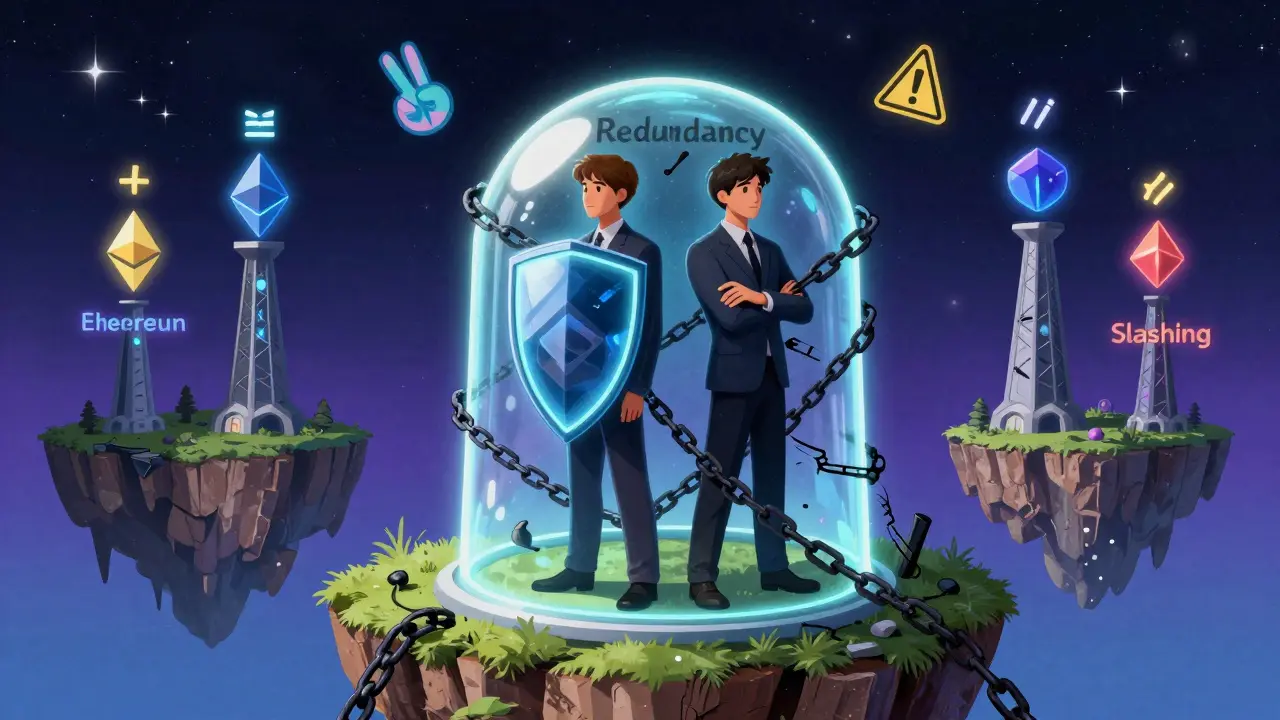
- Run redundant infrastructure - Don’t rely on one server. Run a backup validator on a different cloud provider (e.g., AWS + DigitalOcean). Use separate internet connections if possible.
- Keep software updated - Subscribe to official client release notes. Ethereum has over 10 active clients. Make sure you’re on the latest stable version.
- Test your failover - Every 3 months, shut down your main validator and see if your backup kicks in. If it doesn’t, fix it before you’re penalized.
- Never reuse signing keys - Each validator should have its own unique key pair. Copying keys between machines is a recipe for disaster.
- Sync your time properly - Use NTP servers. Check your clock regularly. A 5-second drift can cause missed attestations.
One Cosmos validator, "NodeAstronaut," avoided a $4,000 penalty by having a backup node. They missed 9,998 blocks due to an ISP outage. Their backup handled the rest. No slashing. Just peace of mind.
The Bigger Picture: Why Slashing Matters
Slashing isn’t just about punishing bad behavior. It’s about aligning incentives. It turns security into a market. Validators compete to be the most reliable. The best ones earn more. The sloppy ones get punished.
Without slashing, a network is vulnerable. Attackers could rent hardware, run a few validators, and try to double-spend. With slashing, that attack costs millions. It’s not worth it.
But there’s a dark side. Overly harsh slashing can push out small operators. If you only have 32 ETH staked and lose 5% to a glitch, that’s a huge blow. That’s why experts like Dr. Emin Gün Sirer warn that "aggressive slashing centralizes staking"-only big players with deep pockets can afford the risk.
That’s why new upgrades are coming. Ethereum’s Dencun upgrade in early 2024 will reduce the minimum slashing penalty from 1 ETH to 0.5 ETH. Polkadot introduced slashing insurance pools. Some networks are testing machine learning to adjust penalties based on network conditions.
Slashing is here to stay. But it’s evolving. The goal isn’t to scare people away. It’s to make the network bulletproof-for everyone.
What’s Next?
If you’re staking now, check your setup. Are you monitoring your validator? Are your clients updated? Is your time synced? Have you tested your backup?
If you’re thinking about staking, don’t skip the learning curve. It takes about 87 hours of study on average to understand slashing risks fully. There are free courses from Consensys, Validator Academy, and Ethereum’s own Staking Launchpad. Don’t guess. Learn.
Slashing isn’t a bug. It’s a feature. And if you treat it like one, you’ll pay for it.
Can you get slashed for just going offline?
Yes, but only after prolonged downtime. On Ethereum, you need to miss attestations for over 17 hours to start losing rewards. After several days of inactivity, your stake begins to drain slowly through "inactivity leaks." On Cosmos, you must miss 10,000 consecutive blocks (about 20 days) before penalties begin. It’s not instant-it’s a warning system.
Do all PoS blockchains slash the same way?
No. Ethereum uses dynamic penalties that increase when many validators are slashed at once, making coordinated attacks harder. Cosmos uses "tombstoning"-permanent removal-for double-signing. Polkadot has collective slashing that can penalize entire groups during outages. Each network designs slashing based on its security goals and risk tolerance.
Is slashing only for malicious validators?
No. Most slashings happen because of honest mistakes: outdated software, misconfigured clients, time sync errors, or hardware failures. Slashing isn’t about intent-it’s about behavior. If your validator acts in a way that threatens consensus, you get penalized, regardless of whether you meant to.
Can you recover from being slashed?
On most networks, yes-if you weren’t tombstoned. You can keep staking with your remaining balance. Ethereum and Polkadot allow you to continue validating after a penalty. Cosmos removes you permanently for double-signing. You’d need to re-stake with new keys and start over. Recovery is possible, but you’ll lose rewards until your stake rebuilds.
Are there tools to prevent slashing?
Yes. Monitoring tools like Beaconcha.in, Blockchair, and custom dashboards show real-time validator health. Services like Stakin and Blockdaemon offer automated alerts and redundancy setups. Many validators use Telegram bots to get instant notifications when their node goes down. The best defense is early detection.
Write a comment