When you look at a crypto price chart, you’re not just seeing lines or bars-you’re seeing a story written in price, time, and emotion. Candlestick patterns turn raw price data into visual signals that reveal what buyers and sellers are really thinking. Unlike traditional markets, crypto trades 24/7, so every candlestick reflects real-time tension between greed and fear-no market open, no closing bell, just constant pressure. And in this wild environment, candlesticks aren’t just useful-they’re essential.
What Exactly Is a Candlestick?
Each candlestick shows four key numbers: the open, high, low, and close price for a specific time window-whether that’s 1 minute, 1 hour, or 1 day. The thick middle part is the body. If it’s green, the close was higher than the open-buyers won that period. If it’s red, the close was lower-sellers took control. The thin lines above and below the body are the wicks (or shadows). Long upper wicks mean price pushed up but got rejected. Long lower wicks mean price dropped but bounced back.On Coinbase Pro, the default is a 6-hour chart with 5-minute candles, but most traders switch to 15-minute, 1-hour, or daily views depending on their strategy. The time frame you pick changes everything. A pattern that works on a daily chart might be noise on a 5-minute chart.
Reversal Patterns: When the Tide Turns
These are the patterns traders watch for when they think a trend might flip. They’re not magic, but they’re reliable when they show up in context.- Bullish Engulfing: A red candle, then a larger green candle that completely covers the previous body. This means sellers lost control overnight, and buyers stormed back. Seen often after a multi-day drop in Bitcoin or Ethereum.
- Bearish Engulfing: The opposite. A green candle followed by a bigger red one. It’s a clear sign that buyers gave up and sellers took over. This often shows up after a rapid pump, especially when social media hype fades.
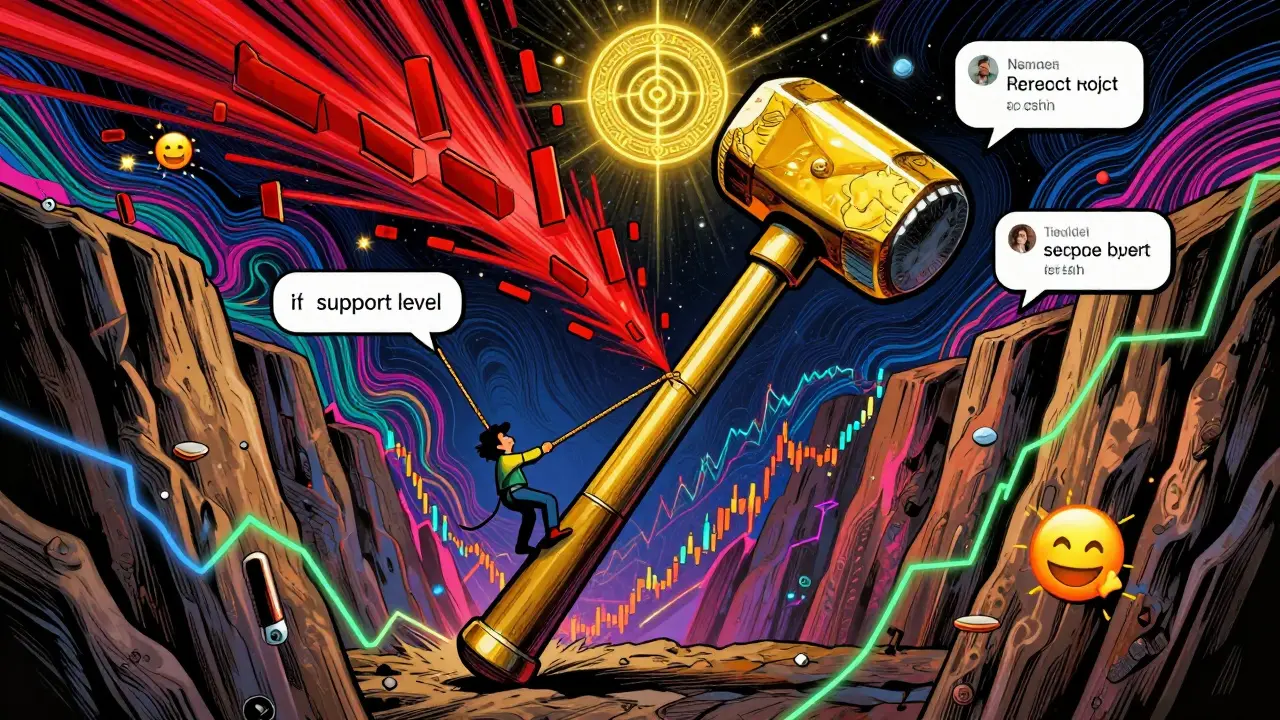
- Hammer: A small body near the top of the candle with a long lower wick. It looks like a hammer hitting the bottom. It means price dropped hard but recovered, suggesting buyers stepped in. Common in crypto after a sharp sell-off driven by panic.
- Shooting Star: Looks like a hammer flipped upside down-small body near the bottom, long upper wick. It happens after a rally. Buyers pushed price up, but sellers crushed it back down. A warning sign.
- Dark Cloud Cover: A green candle, then a red candle that opens above the prior close but closes below the midpoint of the green body. It’s not a full engulfing, but it’s still a strong signal that momentum is shifting.
These patterns work best when they appear after a clear trend. A bullish engulfing after a 10% drop in Solana is far more meaningful than one that pops up in the middle of a sideways range.
Continuation Patterns: The Pause That Refreshes
Not every pattern means a reversal. Sometimes, the market just catches its breath.- Doji: The open and close are almost the same. The body is tiny-sometimes just a line. The wicks can be long or short. It looks like a cross or plus sign. This means neither buyers nor sellers could gain the upper hand. It’s indecision made visible. Alone, it’s neutral. But when it shows up after a big move, it’s a red flag: the trend might be losing steam.
- Spinning Top: Similar to a doji, but with a slightly larger body and equal-length wicks. It’s the market treading water. Volume usually drops during these patterns. In crypto, they often appear right before a breakout-especially on lower time frames like 15-minute charts.
These patterns don’t tell you which way the market will go next. But they tell you it’s holding its breath. That’s valuable. It means you shouldn’t rush into a trade. Wait for confirmation.
Advanced Patterns: Beyond the Basics
Once you’ve mastered the simple ones, you’ll start seeing more complex formations. These are rarer but more powerful when they appear.- Three White Soldiers: Three long green candles, each opening within the body of the previous one and closing near its high. It’s pure bullish momentum. Seen after Bitcoin bottoms out following a prolonged bear market. Institutional buyers often step in here.
- Three Black Crows: The bearish version. Three long red candles, each closing lower than the last. It’s a sign of relentless selling. This pattern often follows a pump fueled by influencer hype-then the truth sets in.
- Falling Three Methods: A big red candle, then three small green candles that don’t reverse the trend, then another big red candle. It looks like bulls tried to rally, but sellers crushed them again. Common in altcoin dumps.
- Bearish Mat Hold: A large red candle, followed by three small green candles that stay within the range of the first candle, then another big red candle. It’s a classic trap. Traders think the downtrend is over, but sellers come back hard.
These patterns are less common in crypto than in stocks, but when they show up on daily or weekly charts, they’re often followed by strong moves. The key is volume. If the final candle in any of these patterns has high volume, the signal is stronger.
Why Crypto Makes Candlesticks Trickier
Crypto isn’t just a faster version of the stock market. It’s a different animal.- 24/7 Trading: No overnight gaps. That means patterns form continuously, and false signals are more frequent. A doji at 3 a.m. UTC might mean nothing if it’s just a quiet hour.
- Extreme Volatility: A 20% swing in an hour isn’t rare. That can turn a doji into a hammer-or a hammer into noise.
- Leverage: 10x, 50x, even 100x leverage is common. That means small moves trigger cascading liquidations. A bullish engulfing might be amplified by a short squeeze, making it look stronger than it is.
- Social Media: A tweet from a big influencer can spike volume and create a fake breakout pattern. Traders chase it, then get trapped.
That’s why relying on candlesticks alone is a recipe for losses. You need context. Check the volume. Look at the broader trend. See if there’s news-like a Bitcoin ETF approval or a major exchange listing. A bullish engulfing on a low-volume day after a 30% drop? Maybe real. A bullish engulfing on high volume right after a Elon Musk tweet? Probably a trap.
How to Trade These Patterns
Knowing the pattern is only half the battle. You need a plan.- Wait for confirmation. Don’t jump in when the second candle forms. Wait for the next candle to close. If the bullish engulfing is followed by another green candle, that’s confirmation.
- Use support and resistance. A hammer near a major support level is far more reliable than one in the middle of nowhere.
- Check volume. A breakout or reversal with low volume is weak. High volume? That’s conviction.
- Set stop-losses. For a bullish engulfing, place your stop below the low of the pattern. For a bearish engulfing, place it above the high.
- Use multiple time frames. Look at the daily chart for the trend. Use the 4-hour or 1-hour chart to time your entry.
One trader I know waits for three things before entering: a confirmed candlestick pattern, a breakout above a 20-day moving average, and rising volume on the exchange. He’s not always right, but he’s rarely caught in a trap.
The Future of Candlestick Patterns in Crypto
AI and algorithmic trading are changing how patterns are used. Bots now scan thousands of charts in seconds, hunting for dojis, engulfings, and spinning tops. That means patterns that worked last year might be less reliable today.But here’s the twist: the more bots use them, the more humans start to react to them. So even if bots trigger the pattern, humans still follow. That’s why they still matter.
The next evolution? Combining candlesticks with on-chain data. If a bullish engulfing shows up right after a spike in wallet addresses or a drop in exchange outflows, that’s a much stronger signal. Some traders now overlay social sentiment scores from Twitter or Reddit onto their charts. That’s the future.
For now, candlestick patterns are still one of the most accessible tools for retail traders. You don’t need a PhD in math. You just need patience, discipline, and the ability to read price action without emotion.
Common Mistakes to Avoid
- Chasing every pattern. Not every doji means a reversal. Most are noise.
- Ignoring the bigger trend. A bullish pattern in a strong downtrend is likely a trap.
- Trading without volume. Volume is the heartbeat of the market. If it’s flat, the pattern is weak.
- Using too small time frames. 1-minute candles are gambling. Stick to 15-minute or higher for real signals.
- Forgetting fundamentals. A perfect bullish engulfing won’t save you if the project’s team just vanished or the token is being dumped by whales.
Pattern recognition isn’t about perfection. It’s about probability. You don’t need to win every trade. You just need to win more than you lose.
Are candlestick patterns reliable in crypto markets?
Yes-but only when used correctly. Crypto’s volatility and 24/7 nature create more false signals than traditional markets. Candlestick patterns work best when combined with volume analysis, support/resistance levels, and broader market context. A pattern alone isn’t enough. Always wait for confirmation and avoid trading them in low-volume conditions.
Which candlestick pattern is the most reliable for crypto trading?
The bullish and bearish engulfing patterns are among the most reliable, especially on daily or 4-hour charts. They clearly show a shift in control between buyers and sellers. Hammer and shooting star patterns are also strong when they appear at key support or resistance levels. However, reliability increases when these patterns are confirmed by rising volume and alignment with the larger trend.
Can I use candlestick patterns on 1-minute charts?
You can, but you shouldn’t rely on them. 1-minute charts are filled with noise from short-term traders, bots, and order flow imbalances. Patterns here are often false and can lead to overtrading. For meaningful signals, stick to 15-minute, 1-hour, or daily charts. If you trade on lower time frames, use them only for entry timing-not for identifying the trend.
Do I need to use other indicators with candlesticks?
Absolutely. Candlesticks show emotion, but not context. Combine them with volume, moving averages (like the 20-day or 50-day), RSI for overbought/oversold conditions, and key support/resistance levels. In crypto, also check on-chain metrics like exchange outflows or active addresses. Patterns with supporting data are far more likely to succeed.
Why do candlestick patterns sometimes fail in crypto?
Crypto markets are driven by hype, news, and leverage-not just fundamentals. A pattern might look perfect, but a single tweet, regulatory announcement, or liquidation cascade can override it. Also, because crypto is still young, patterns haven’t been tested over decades like in stock markets. High-frequency trading bots also exploit common patterns, making them less predictable. Always treat them as probabilities, not guarantees.
Write a comment