
Imagine trying to move your own money, but your bank treats your digital wallet like a crime scene. For millions of people across Africa, this isn't a hypothetical-it's their daily reality. While the world talks about the future of finance, many African nations are stuck in a tug-of-war between citizens who want digital freedom and central banks that are terrified of losing control. The result? A fragmented map where one country welcomes you with a license, and another threatens to freeze your account if you even mention the word "Bitcoin."
The core problem isn't necessarily that crypto is illegal-in many cases, it isn't. The real wall is the banking restrictions is a set of regulatory barriers preventing traditional financial institutions from facilitating cryptocurrency transactions. When banks are forbidden from processing crypto-related payments, the "on-ramp" and "off-ramp" (the way you turn cash into crypto and vice versa) vanish. This forces users into a shadow economy of peer-to-peer trades and cash meetings, which are often riskier and more expensive.
The Regulatory Spectrum: From Open Doors to Closed Vaults
Africa isn't a monolith; its approach to digital assets is a patchwork of three distinct strategies: the regulators, the discouragers, and the prohibitors.
South Africa is currently the gold standard for the "regulator" approach. Instead of fighting the tide, they've integrated digital assets into their existing financial system. By recognizing crypto as financial products under the Financial Advisory and Intermediary Services (FAIS) Act, they've moved the industry out of the shadows. Now, Virtual Asset Service Providers (VASPs) must register with the Financial Sector Conduct Authority (FSCA). This means if you use a licensed exchange in South Africa, you have a level of consumer protection that is almost nonexistent in neighboring countries.
Then you have the "discouragers" like Tanzania. The government hasn't banned crypto, but the Bank of Tanzania basically tells everyone to stay away, insisting the national shilling is the only legal tender. It's a "legal but frowned upon" status that leaves users in a state of permanent uncertainty. Will they wake up tomorrow and decide to ban it? Nobody knows.
Finally, there are the "prohibitors." Nigeria is the most famous example. Here, the gap between law and reality is massive. While you can legally own Bitcoin, the Central Bank of Nigeria (CBN) has explicitly forbidden banks from facilitating any crypto trades. They've even gone as far as telling banks to identify and shut down accounts belonging to crypto traders. This creates a paradox: the population has some of the highest crypto adoption rates in the world, yet the official banking system treats them like outlaws.
| Country | Banking Status | Regulatory Body | Primary Access Method |
|---|---|---|---|
| South Africa | Regulated/Legal | FSCA | Licensed VASPs |
| Nigeria | Bank-Prohibited | CBN | P2P Markets |
| Cameroon | Regional Ban | COBAC | Cash/Informal |
| Tanzania | Discouraged | Bank of Tanzania | Informal/P2P |
The "Gray Area" and the COBAC Effect
In Central Africa, the situation is even more tangled because of COBAC (the Central African Banking Commission). Unlike a national law, COBAC issues regional directives. In countries like Cameroon, there is no specific law that says "you cannot own crypto." However, COBAC has banned banks from all cryptocurrency-related transactions.
This creates a frustrating legal gray area. You aren't committing a crime by holding a digital wallet, but the moment you try to move that money into a business account to pay a supplier or receive a payment from a client, you hit a brick wall. For businesses involved in cross-border trade, this is a nightmare. It forces them back into slow, expensive traditional banking systems that can take days to process a payment that should take seconds on a blockchain.
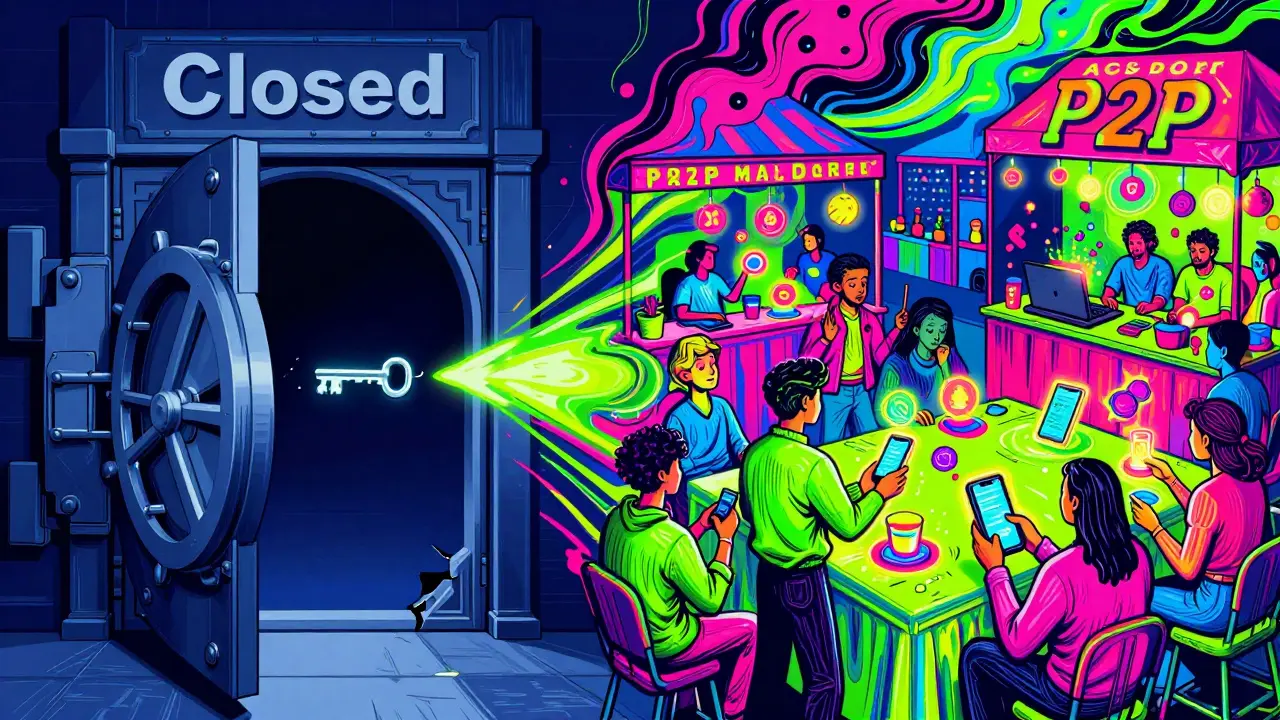
How Users Bypass the Banking Blockade
When the banks say "no," the people find a way. In restricted zones, Peer-to-Peer (P2P) trading is the lifeblood of the industry. P2P is essentially a digital classifieds section where a buyer and seller agree on a price, and the payment happens outside the exchange's direct control-often via mobile money or direct cash transfers.
While P2P solves the access problem, it introduces new risks:
- Price Slippage: P2P rates are often higher than global exchange rates because sellers charge a premium for the risk they take.
- Scams: Without a bank acting as a trusted intermediary, users are vulnerable to "trust trades" where one party disappears after receiving payment.
- Account Freezes: In Nigeria, banks use AI to flag accounts that show patterns typical of P2P trading (many small transfers from different people), leading to sudden account freezes.
The Shift Toward Formal Legislation in 2025-2026
The tide is starting to turn. Governments are realizing that bans don't stop crypto; they just push it underground where it can't be taxed or monitored. By mid-2025, we saw a surge of activity in East Africa, with Kenya, Zambia, and Rwanda publishing draft legislation to bring digital assets into the light.
Morocco is another example. After banning crypto transactions in 2017, the central bank has pivoted toward creating a formal regulatory framework. This shift is largely driven by the need to attract foreign investment. International Web3 companies won't build offices or hire developers in a country where they can't legally move their capital.
We're also seeing a more collaborative approach. In Kenya, the government actually invited industry leaders from companies like Yellow Card to help draft the laws. This is a huge departure from the "ban first, ask questions later" mentality. It suggests that the goal is no longer to kill crypto, but to tame it through AML (Anti-Money Laundering) and CTF (Counter-Terrorist Financing) standards.

Practical Tips for Navigating Restricted Zones
If you are operating in a country with banking restrictions, you need a strategy that prioritizes security over convenience. Relying on a single bank account is a gamble. Diversifying your exit ramps-using a mix of different P2P platforms and perhaps holding a portion of assets in stablecoins like USDT-can mitigate the risk of a sudden account freeze.
For businesses, the move toward compliance-first tools is essential. Technology like real-time transaction monitoring and risk scoring (similar to what Scorechain provides) helps VASPs prove to regulators that they aren't facilitating illicit flows. Being able to provide a clean audit trail is the only way to move from the "shadow economy" back into the legitimate banking system.
Is it illegal to own cryptocurrency in Nigeria or Cameroon?
Generally, no. In both Nigeria and Cameroon, owning and trading cryptocurrency as an individual is not explicitly illegal. The restriction is specifically targeted at banks and financial institutions, which are prohibited from facilitating these transactions. You can own the assets, but you cannot use your official bank account to buy or sell them through an exchange.
What is the "Travel Rule" in South African crypto regulation?
The Travel Rule requires Virtual Asset Service Providers (VASPs) to collect and share detailed information about the originators and beneficiaries of digital asset transfers. In South Africa, this typically applies to transactions exceeding ZAR 25,000. It's designed to stop money laundering by ensuring there is a clear identity attached to every significant movement of funds.
Why do central banks in Africa restrict crypto access?
Most central banks cite three main reasons: financial stability, the prevention of money laundering, and the protection of the national currency. They fear that unregulated crypto markets could lead to systemic financial failure or allow criminals to move money undetected due to the pseudonymity of blockchain transactions.
How does P2P trading work in restricted countries?
P2P (Peer-to-Peer) trading involves a buyer and seller interacting directly. The exchange acts as an escrow service, holding the crypto until the buyer sends the local currency (via bank transfer, mobile money, or cash) directly to the seller. Once the seller confirms receipt of the funds, the exchange releases the crypto to the buyer.
Which African country has the most welcoming crypto laws?
Currently, South Africa is considered the leader due to its comprehensive and clear licensing framework via the FSCA. While it has strict compliance rules, these rules provide a legal path for businesses to operate openly, which is preferable to the regulatory silence or outright bans found in other regions.
Next Steps for Users and Businesses
If you're a resident in a restricted nation, your first move should be to research the specific difference between "ownership" and "facilitation" in your local laws. Knowing that holding an asset is legal while using a bank to buy it is not can save you from unnecessary panic.
For those starting a business, keep a close eye on the draft legislations in Kenya and Rwanda. These will likely set the tone for the rest of the continent. If you are already operating, start implementing basic KYC (Know Your Customer) and AML protocols now. When the regulations finally hit the books, the businesses that already have clean data and transparent records will be the first to get their banking access restored.
Write a comment